
Pool automation does more than put controls on a phone: it coordinates equipment and water care through a central controller. One of the clearest pool automation system benefits is that sensors can monitor water chemistry while the system schedules pumps and other equipment, including around off-peak utility rates. Depending on the setup, it can also manage variable-speed pump schedules and dispense small chemical doses to help keep water balanced.
It makes sense to want fewer manual adjustments without losing sight of how your pool is operating. This guide explains how automation connects equipment to a control center, what continuous pH and ORP monitoring can do, and how schedules can support efficient pump use. You’ll also see how automation fits into ongoing pool care, including what the system can and can’t control.
Key Takeaways
- See how a controller connects pool equipment and coordinates schedules, settings, and controls.
- Learn how pH and ORP monitoring can support steadier water chemistry and measured chemical dosing.
- Understand how off-peak scheduling may shift filtration to lower-rate hours, depending on local utility schedules.
- Explore how variable-speed pump management can help make equipment run more efficiently.
How does pool automation work?
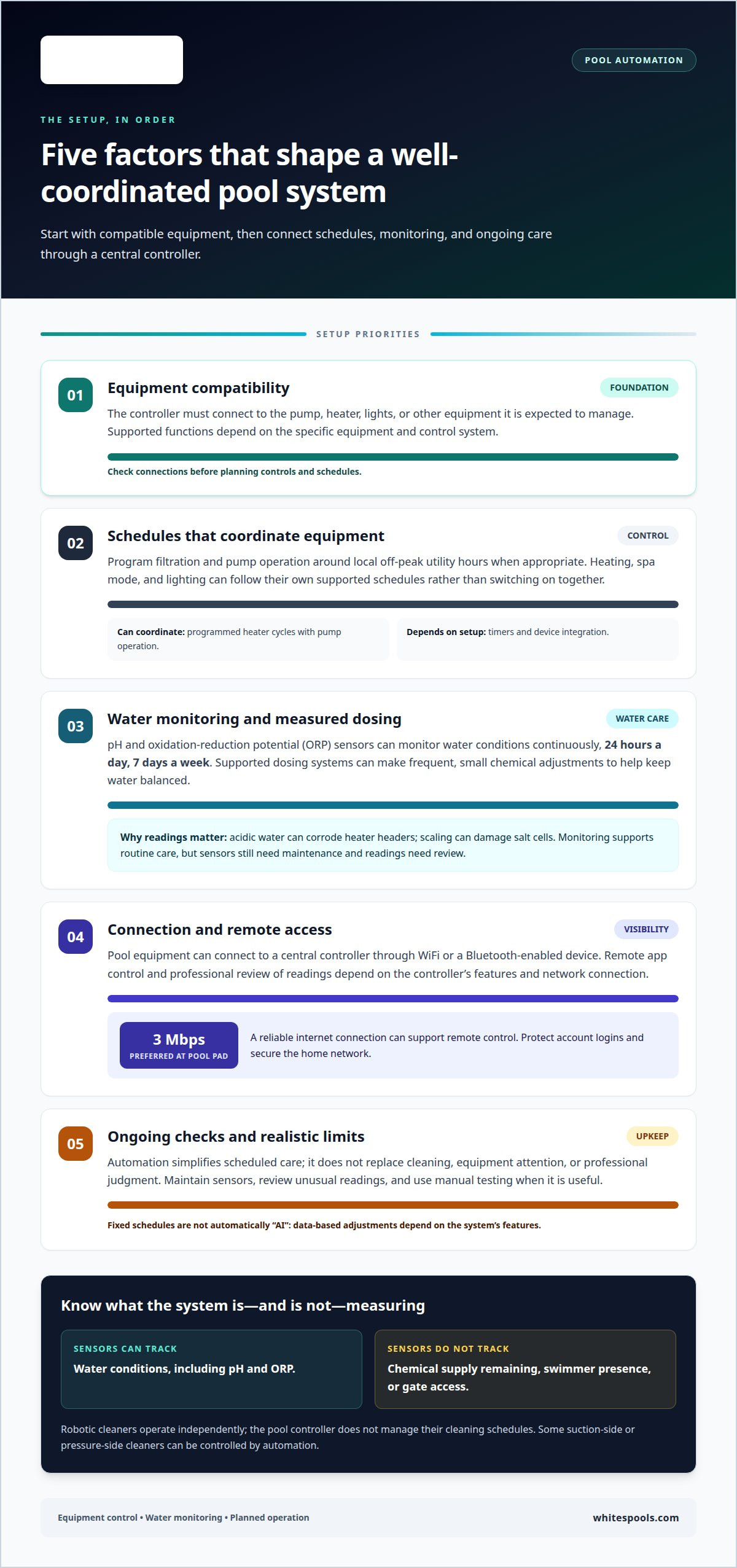
Pool automation connects equipment to a central controller through WiFi or a Bluetooth-enabled device. From a home panel or smartphone app, owners can manage pumps, heaters, lights, and some compatible cleaners. Sensors gather information, while actuators operate connected equipment. A pool professional can configure pump speeds, schedules, and timers to suit the equipment setup.
With manual controls, owners adjust switches and timers at the equipment panel. A smart pool controller adds centralized or app-based control, while an automation system coordinates connected equipment through configured schedules. For example, it can coordinate heater operation with pump speed or spa mode. These functions depend on compatible equipment and the controller’s capabilities.
AI scheduling should not be assumed to mean every system learns or adjusts automatically. Some automation follows fixed schedules and timers, such as running filtration at set hours. Where a system supports data-based adjustments, its scheduling functions depend on the features provided. A reliable internet connection can support remote control, with at least 3 Mbps at the pool pad preferred.
Schedules can coordinate heating and cleaning. For example, a programmed heater cycle can run alongside the pump, and automation can control some suction-side or pressure-side cleaners. Robotic cleaners operate independently, so the pool controller doesn’t manage their cleaning schedules. Timers can also switch pool lights on and off at selected times.
Dispatch and route optimization serve a different purpose. Pool-service businesses can use separate scheduling tools to organize technician visits and group nearby stops. That doesn’t mean a pool controller dispatches cleaners. For owners, automation focuses on pool equipment, such as setting filtration hours or managing a heater schedule.
Drawbacks include dependence on compatible equipment and a reliable internet connection for remote access. Sensors and connected controls also need attention if readings or operation seem incorrect. Network-connected systems bring account-security considerations: protect login access and secure the home network. Automation can simplify scheduled care, but it doesn’t replace regular pool cleaning or attention to equipment performance.
Automated pH and ORP monitoring and chemical dosing
Automated sensors can monitor pH and oxidation-reduction potential (ORP) continuously, 24 hours a day and 7 days a week. These readings help show whether water chemistry is shifting, rather than relying only on occasional manual testing. With automating your pool, the system can make frequent, small chemical adjustments to help keep water stable.
Stable pH matters for equipment as well as swimmer comfort. Acidic water can corrode heater headers, while scaling can damage salt cells. If monitoring detects a changing pH reading, for example, an automated dosing system can make a measured adjustment. This supports routine care, but doesn’t eliminate the need to maintain sensors and review water conditions.
Remote access can let a pool professional review system readings away from the pool, if the controller supports it. This may help identify a chemistry change sooner and guide a response before a routine visit. A smartphone app may display measurements and equipment status, while manual testing and professional judgment remain useful for understanding unusual readings.
Chemistry monitoring and chemical inventory are different tasks. A pH sensor measures water, not the amount left in a chemical container. Keeping a simple record of supplies helps owners plan replenishment and avoid finding an empty container during dosing. Likewise, pH and ORP sensors track water conditions, not swimmer presence or gate access, so they aren’t pool-access monitors.
Pool automation systems can be controlled remotely through a smartphone app when remote control is supported. Voice assistant control isn’t inherent to every system; it depends on compatible integration. A professional can help interpret readings and support pool water care when adjustments or routine maintenance are needed.
Scheduling equipment around off-peak utility rates
Pool automation can shift filtration to off-peak hours based on local utility rate schedules. A controller runs the pump at programmed times instead of relying on an arbitrary daytime routine. This can align equipment use with lower-rate periods while keeping filtration on its planned schedule.
Compatibility comes first. A controller must connect with the existing pump, heater, lights, or other equipment it will manage. A pool professional can review connections and configure supported functions, such as timers and heater coordination. Integration depends on the specific equipment and control system.
If a utility’s off-peak period falls overnight, filtration can be scheduled for then. Owners can set temperature targets and lighting times separately instead of turning on every connected device at once. This makes schedules more practical for different equipment and household routines.
Connected controls can help owners monitor equipment and notice issues earlier. A change in pump or heater operation, for example, may signal a problem that needs attention. Sensors provide system information, while remote monitoring depends on the controller’s features and network connection.
Yes, local electrical requirements can affect pool automation installation. Planning should account for applicable requirements before wiring or integration begins, since connections and installation scope shape the work. Pool owners who aren’t comfortable with electrical work should hire a professional to install the system.
Installed cost depends on controller features, compatibility with existing equipment, and installation scope. A basic setup differs from one with remote access, scheduling, and chemical dosing. Costs vary according to equipment and labor needs, so the price is provided after a quote request.
Separate timers can coordinate functions without giving every device the same schedule. For instance, a heater cycle can follow its own program while pool lights remain on separate switches.
Variable-speed pump management and energy efficiency
A variable-speed pump adjusts its motor speed for different pool tasks. Automation can apply programmed settings, helping owners manage circulation without relying on one fixed operating speed.
Energy Use and Operating Costs
Energy use reflects the pump’s power draw and how long it runs, while operating costs also depend on electricity rates. Pool automation system manufacturers state that running your pool filter only 6 hours a day versus 24 hours will reduce your energy use by 75% daily. This comparison highlights the role of runtime, but filtration needs still shape a suitable schedule.
For example, an owner can consider pump operation alongside the utility’s rate schedule and the pool’s circulation requirements. A shorter runtime may not suit every pool, so the goal is to balance effective filtration with sensible energy use. Reviewing schedules can help show whether current pump operation meets those needs.
Potential Energy Efficiency
Variable-speed pump management means adjusting the motor speed to match the task rather than running at one speed throughout operation. The U.S. Department of Energy puts real-world variable-speed pump energy savings at 50-75% per day over a single-speed pump. At half speed, a variable-speed pool pump draws about one-eighth the power.
These figures help explain why programmed speeds are among the pool automation system benefits: the pump can use a lower setting for routine circulation when appropriate. A higher setting may suit tasks that need more flow. The schedule should balance pool circulation needs with efficient operation, rather than simply minimizing pump hours.
If pump efficiency is part of a new pool plan, consider it alongside the pool’s design and equipment needs. Explore a custom concrete pool project and discuss how those decisions fit together.
White’s Pools
White’s Pools can help align pool-care decisions with the equipment and design of your swimming space. If you’re planning a new pool, discuss how automation needs can inform equipment choices and daily operation. For an existing pool, Pool Cleaning & Maintenance can support water quality and equipment performance as part of ongoing care.
Automation is most useful when its schedules, controls, and maintenance routines suit the way a pool is used. A conversation about your pool and care priorities can clarify what to consider, from water monitoring to pump operation. White’s Pools also designs and builds Custom Concrete Pools, so equipment and care can be considered as part of the overall project.
Contact White’s Pools to discuss your pool care or project needs.
Make pool care fit your plans
Start by deciding what you want pool automation to make easier. Consider how you use your pool, which routines feel cumbersome, and whether you’re planning a new build or refining care for an existing pool. Those priorities can shape a practical discussion about equipment compatibility and controls that suit your routine. Pool automation system benefits matter most when they support how you want to enjoy and care for your pool, not simply add more technology.
White’s Pools can help you consider pool design and ongoing care as connected parts of your plans. Its work includes Custom Concrete Pools, Pool Cleaning & Maintenance, and Outdoor Fireplaces, so you can discuss pool needs alongside the wider outdoor setting. Sharing your priorities can help make the next decisions clearer.
Contact White’s Pools to discuss your automation plans and take the next step toward a pool routine that works for you.
Frequently Asked Questions
What are the main benefits of a pool automation system?
The main pool automation system benefits include less hands-on equipment adjustment and clearer oversight of daily operation. Owners can coordinate controls around household routines, such as preparing the pool before planned swimming or setting lighting independently. The practical value depends on which tasks you want to simplify and whether your equipment supports the controls you need.
Can pool automation reduce pool energy and chemical costs, and by how much?
It can help reduce energy use through efficient pump operation, but savings depend on pump type, settings, runtime, and electricity rates. Among the pool automation system benefits, chemical dosing can help maintain water balance, but there’s no single savings figure for chemical costs because usage and prices vary. Track operating patterns to understand how schedules affect your pool’s energy use.
What pool equipment can an automation system control?
Depending on its capabilities and equipment connections, a system may control pool pumps, heaters, and lights. It may also control some suction-side and pressure-side cleaners. Robotic pool cleaners operate independently, so pool automation doesn’t manage them. Before planning controls, identify which functions you want coordinated, such as running the heater with the pump or scheduling lights separately.
What features should you look for when choosing a pool automation system?
Start with functions that fit your routine: equipment scheduling, remote access, water-chemistry monitoring, or chemical dosing. Consider whether you want to manage controls from a home panel or smartphone, and whether the system supports your desired pump speeds. Choose a system that matches your pool equipment and care priorities instead of adding features that won’t support daily use.
Are pool automation systems compatible with existing pool equipment and brands?
Compatibility depends on the automation system’s supported connections and the specific equipment already installed. A pool pump, heater, or lighting setup may require different control connections, so brand name alone doesn’t establish compatibility. For an existing pool, map the equipment and functions you want controlled. This gives a professional a clear basis for assessing integration options and configuring the system.
How much does pool automation cost to buy and install in the United States?
The final installed cost depends on equipment compatibility and installation needs.

