
A pool pump can use 3,000 to 5,000 kilowatt-hours of electricity per year, making it a major contributor to a pool’s energy use. Optimizing pool pump energy consumption starts with matching run time and pump size to the pool’s needs, rather than relying on a longer schedule or a larger motor.
It’s understandable to want dependable circulation without wasting electricity. This guide explains how daily run time, proper pump sizing, and ENERGY STAR certification can influence energy use, and why the right balance depends on your pool and equipment. You’ll also see how efficient pump choices fit into the bigger picture of maintaining a well-designed, comfortable pool.
Key Takeaways
- Tailor pump run time to pool size, use, and conditions instead of relying on a one-size-fits-all daily schedule.
- Choose a pump that matches the pool’s flow needs; a larger motor can use more energy without improving circulation.
- Compare ENERGY STAR-certified models and their Weighted Energy Factor to understand how pump efficiency can affect electricity use.
- Explore how incentives may influence the overall cost of an efficient pump, including a regional utility incentive discussed in the article.
What’s the ideal run time for a pool pump?
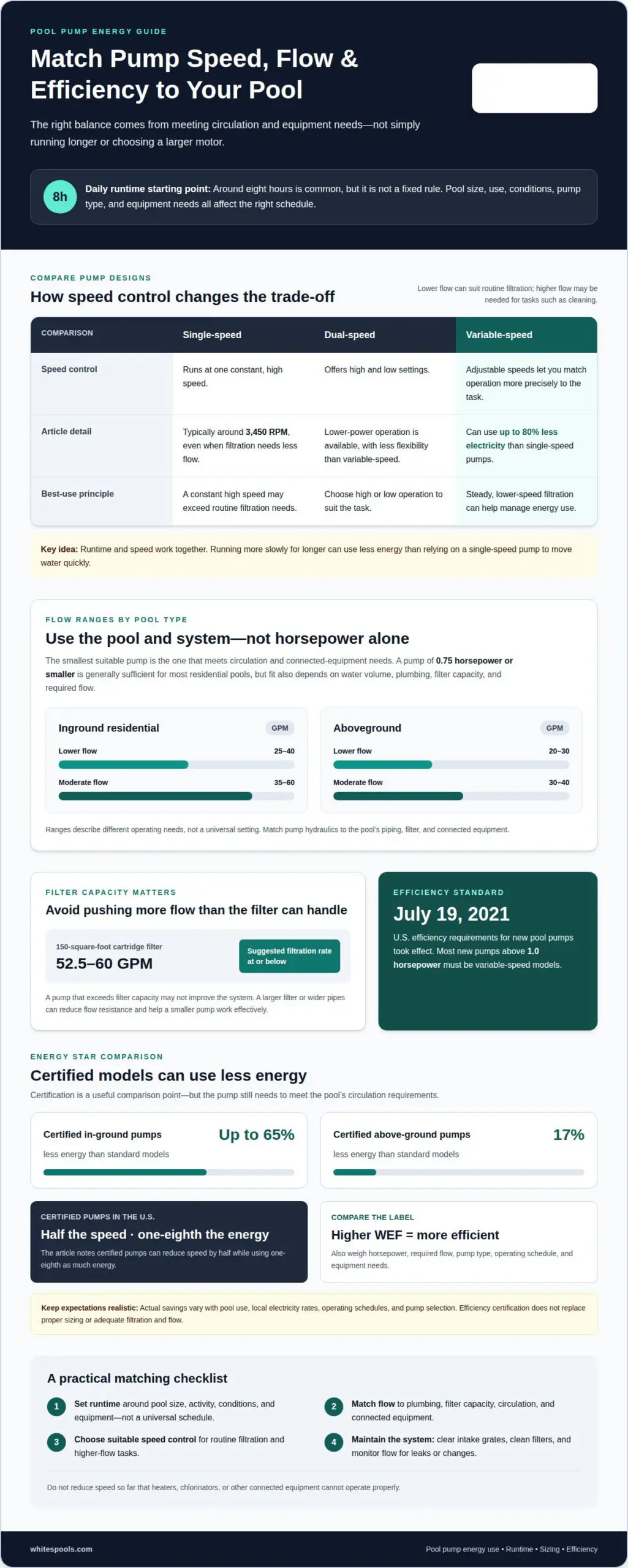
Around eight hours of daily operation is a common starting point, not a fixed rule. The right schedule depends on pool size, use, and conditions. Pump type matters too: different designs move water differently and use electricity at different rates.
Pump Speed, Flow, and Power Use
Pump speed affects how quickly water moves through the system and how much electricity the motor uses. A traditional single-speed pump runs at a constant high speed, typically around 3,450 RPM, even when filtration needs less flow.
A dual-speed pump has high and low settings, while a variable-speed pump lets you adjust speed more precisely. Lower flow may be suitable for routine filtration, while higher flow can support tasks such as cleaning. Match the setting to your pool and equipment: speed alone does not tell you how much water is circulating.
Variable-Speed Pump Energy Savings
Variable-speed pumps use adjustable motor speeds to match circulation to the task, rather than running at full power throughout the day. They can use up to 80% less electricity than single-speed pumps.
A variable-speed pump can help manage energy use, particularly when your pool needs steady, lower-speed filtration. Dual-speed pumps also offer lower-power operation, but with less flexibility. Runtime and speed work together: running a pump more slowly for longer can use less energy than relying on a single-speed pump to move water quickly.
Efficiency Rules and Operating Schedules
U.S. efficiency requirements for new pool pumps took effect July 19, 2021; most new pumps above 1.0 horsepower must be variable-speed models. For operating schedules, use pool size, activity, environmental conditions, and equipment needs to guide runtime rather than treating eight hours as a universal rule.
Local requirements may affect pump selection or operation, so a general schedule should not be treated as a legal requirement. Preserve the flow needed by connected equipment, such as heaters or chlorinators. Reducing speed too far can interfere with their operation.
Maintenance also affects energy use. Debris in intake grates, dirty filters, and leaks can make a pump work harder. Keep the intake clear, clean the filters, and monitor water flow as part of routine pool care.
Choosing the smallest suitable pool pump
The right pump is the smallest model that meets the pool’s circulation and equipment needs. A pump of 0.75 horsepower or smaller is generally sufficient for most residential pools, but horsepower alone doesn’t determine fit. Pool owners also need to consider water volume, plumbing, filter capacity, and the flow required by connected equipment.
A design chart can match a pump’s hydraulic characteristics to the pool’s piping and flow requirements. For inground residential pools, lower flow ranges are 25-40 gallons per minute (GPM), while moderate ranges are 35-60 GPM. Aboveground pools have lower ranges of 20-30 GPM and moderate ranges of 30-40 GPM. These ranges describe different operating needs, not a universal setting.
Filter capacity is another key part of the match. For a 150-square-foot cartridge filter, the suggested filtration rate is at or below 52.5-60 GPM. A pump that pushes more flow than the filter can handle may not improve the system. Reducing water-flow resistance with a larger filter or wider pipes can allow a smaller pump to work effectively.
Optimizing pool pump energy consumption starts with matching the pump to the whole system, not simply choosing the lowest horsepower. Consider the flow required by connected equipment and the pool’s circulation needs. For a new pool, these requirements can be considered during design. For an existing pool, compare the pump’s output with the filter and plumbing capacity. This system-wide approach helps avoid excess motor capacity while maintaining effective circulation.
For a new pool project, pump requirements can be considered alongside the pool design and equipment. Thoughtful planning for a custom concrete pool accounts for those relationships from the outset. For an existing pool, proper sizing offers a practical foundation for optimizing pool pump energy consumption without selecting a larger motor “just in case.”
ENERGY STAR-certified pool pumps
ENERGY STAR certification helps distinguish pool pumps designed to use less electricity than standard models. Certified in-ground pool pumps use up to 65% less energy than standard models, while certified above-ground pumps use 17% less. Those figures make certification a useful starting point when comparing models, but the pump still needs to suit the pool’s circulation requirements.
An efficiency label does not guarantee identical savings for every pool owner. Results depend on pool use, local electricity rates, operating schedules, and pump selection. In the U.S., ENERGY STAR-certified pumps can reduce speed by half while using one-eighth as much energy.
When comparing certified models, look at the Weighted Energy Factor (WEF). A higher WEF indicates a more energy-efficient pump. Also consider horsepower, required flow, and the equipment the pump needs to support. An efficient model that cannot meet your pool’s circulation needs is not the right match: water quality depends on adequate filtration and flow.
Potential lifetime savings can help inform the decision, but actual results depend on operating conditions. Treat savings estimates as possibilities, not fixed outcomes for every pool.
For a useful comparison, consider WEF alongside pump type, pool requirements, and the expected operating schedule. ENERGY STAR certification indicates efficiency, while proper sizing determines whether the pump can deliver the flow your system needs. Weighing both factors gives you a clearer basis for evaluating electricity use and potential savings.
What are the upfront costs, rebates, and incentives for efficient pool pumps in the United States?
Upfront pump costs vary with the model, capacity, and installation requirements, so no single price applies to every pool. Compare the purchase and installation scope with expected electricity use over time. An efficiency rating can inform that comparison, but the pump’s capacity and operating requirements matter too.
Rebates and incentives may reduce what a homeowner pays, but programs vary by location and eligibility. Treat any specific utility incentive as local, not as a nationwide rebate. Homeowners elsewhere should not assume the same amount or program applies.
To assess an incentive, identify the program, qualifying pump requirements, and application steps. Then weigh the potential rebate against the upfront cost and projected electricity savings. Long-term value depends on pool use, local electricity rates, and pump operation. A lower purchase cost alone does not show which option may cost less over its service life.
ENERGY STAR certification can help narrow your options, but the pump must also suit the pool system. A model that cannot deliver the required flow may not be a sound choice, even if an incentive lowers its initial cost. Compare suitable options by efficiency, capacity, installation scope, and available local programs. This keeps a rebate in perspective rather than making it the sole reason to choose a pump.
For a new pool project, pump decisions can be considered alongside the pool design and equipment requirements. If you’re planning a custom concrete pool, discuss pump planning as part of the project. For an existing pool, focus on the equipment’s actual needs and local incentive terms before estimating potential savings. The result is a more complete view of upfront spending and ongoing electricity use.
White’s Pools
White’s Pools helps pool owners connect efficient equipment operation with the care needed to keep a pool functioning well. Its Pool Cleaning & Maintenance service supports ongoing attention to water quality and equipment performance, including circulation and filtration as part of routine care.
For a new pool, pump requirements can be considered alongside the design and equipment. For an existing pool, regular maintenance can help identify issues such as clogged filters or reduced water flow that may make the pump work harder. The right operating approach depends on your pool system and its equipment.
For help with pool care and equipment performance, contact White’s Pools.
Make Your Pool’s Energy Plan Part of the Bigger Picture
Managing electricity use is an ongoing part of pool ownership, not a one-time equipment decision. When your pool use or equipment needs change, revisit how the system operates and whether its setup still meets your goals. This makes optimizing pool pump energy consumption a practical part of pool care, rather than an isolated adjustment.
White’s Pools can help align pool care and equipment performance with your pool’s needs. Whether you’re planning a new project or need ongoing maintenance, start a conversation about your priorities and how you use your pool.
Contact White’s Pools for pool pump advice, and take a considered next step toward a pool that works well for your household.
Frequently Asked Questions
How much electricity does a pool use?
A pool’s electricity use depends on its equipment, but its pump is a major part of the total. An average pool pump uses 3,000 to 5,000 kilowatt-hours (kWh) per year. Heaters, lighting, and other equipment add to a pool’s overall consumption. To understand your total, consider each device separately and account for how often it operates.
How much electricity does a typical pool pump use per year?
A typical pool pump uses 3,000 to 5,000 kWh annually. Actual use varies with the motor, daily operating schedule, pool system, and electricity demands of connected equipment. A pump that runs longer or at higher power will generally consume more. Reviewing the pump’s electrical rating and operating hours gives you a more useful estimate for your specific setup.
How do you calculate pool pump energy consumption and operating cost?
Multiply the pump’s power in kilowatts by its operating hours to calculate kilowatt-hours (kWh), then multiply that figure by your electricity rate. For a monthly estimate, multiply daily kWh by the number of operating days, then apply the same rate.
How much can a variable-speed pool pump reduce energy use?
A variable-speed pool pump can use up to 80% less electricity than a single-speed pump. The actual reduction depends on how the pump is set and used, since speed, runtime, and required circulation all affect consumption. For a practical comparison, look at the pumps’ energy use under the schedules and flow needs your pool actually requires.
Variable-speed vs. single-speed pool pump: What’s the cost and savings comparison?
A variable-speed pump may cost more upfront, while its adjustable operation can lower electricity use over time. It can use up to 80% less electricity than a single-speed pump, but actual savings depend on usage and local rates. Compare purchase and installation costs with estimated operating expenses over time. Avoid relying on a savings estimate that assumes a different schedule or pool setup.
How many hours per day should a pool pump run?
Around eight hours per day is a common starting point, not a universal schedule. Pool size, use, environmental conditions, and equipment needs all affect the runtime required for circulation and water quality. A salt chlorinator or heat pump, for example, may require the pump to run during specific periods. Changing the schedule without accounting for connected equipment can disrupt normal operation.

