
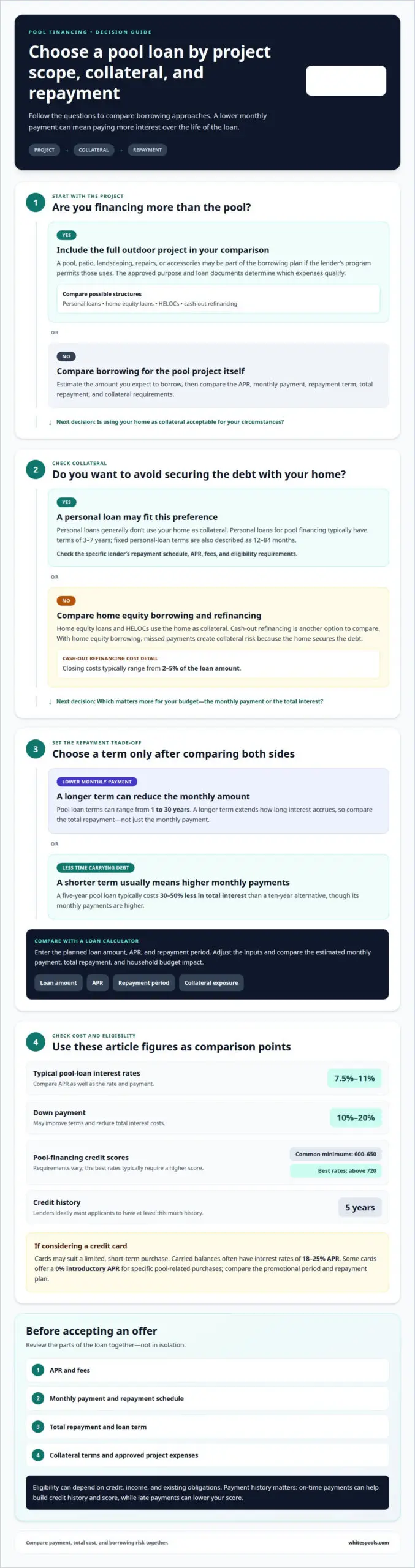
A lower monthly payment can mean paying more interest over the life of a pool loan. Swimming pool financing can spread project costs over time, with loan terms ranging from 1 to 30 years.
When planning a major outdoor project, it’s natural to focus on what fits your monthly budget. But the amount borrowed, interest rate, repayment term, and credit profile all affect what you’ll pay, so the monthly payment is only part of the picture.
Learn how pool loans work, estimate monthly payments, and understand how repayment can affect your credit. You’ll also see how financing choices can fit a broader outdoor project, helping you weigh the monthly commitment against the total cost over time.
Key Takeaways
- Compare the APR, monthly payment, loan term, and collateral requirements together to understand the full trade-off between payment size and borrowing risk.
- Use a loan calculator to estimate payments, then compare different terms to see how the repayment period changes the total cost.
- Review your credit profile and income before applying; payment history and verified income can affect approval and loan terms.
- Plan financing around the full outdoor project, since a pool, patio, and other improvements may call for a different borrowing approach than a pool alone.
What is a pool loan?
A pool loan is money borrowed to pay for a pool project and repaid over an agreed term with interest. Swimming pool financing may involve a personal loan, home equity borrowing, or another loan structure, each with different repayment and collateral terms.
Loan Amounts and Repayment Terms
The amount depends on the project scope, lender limits, and your financial profile. Pool loan terms can range from 1 to 30 years, while personal loans for pool financing typically have repayment terms of 3-7 years. A longer term can lower monthly payments but extend how long interest accrues.
There is no single installation cost for inground or above-ground pools across the United States. Design, site conditions, local requirements, and selected features all affect a project’s budget.
Rates, APR, and Payment Comparisons
Typical pool loan interest rates range from 7.5% to 11%. Compare APR, monthly payments, and total repayment when evaluating swimming pool financing. A five-year pool loan typically costs 30-50% less in total interest than a ten-year alternative, though the shorter term means higher monthly payments.
A 10-20% down payment may improve terms and reduce total interest costs. Cash-out refinancing closing costs typically range from 2-5% of the loan amount. With home equity borrowing, the home secures the debt, creating collateral risk if payments aren’t made.
Program Terms and Eligibility
Eligibility depends on the lender’s program and your credit, income, and existing obligations. Personal loans generally don’t use your home as collateral; home equity options do. Before accepting an offer, review its APR, repayment schedule, fees, and collateral terms.
Permit requirements vary by state and local area, depending on the project and its location. Tax treatment also depends on the purpose of the borrowing and your circumstances, so don’t assume personal pool installation costs or loan interest qualify for a deduction.
Monthly payment estimates and loan calculators
A loan calculator estimates a monthly payment from your planned loan amount. Enter the amount, APR, and repayment period, then adjust each input to see how it affects your budget.
Mortgage and Home-Improvement Loan Comparisons
Compare a separate home-improvement loan with mortgage-based borrowing, including home equity options. A separate pool loan keeps its payment distinct, while mortgage-based borrowing may combine the pool expense with home debt.
Hundreds of thousands of homeowners have used lenders to fund pool projects. That doesn’t mean one structure suits every household. Use a calculator to compare the full monthly obligation, total repayment, APR, and collateral exposure before applying.
Fixed Payments and Shorter Terms
Personal loans used to finance a pool usually have fixed terms ranging from 12 to 84 months. Fixed payments make it easier to map repayment against monthly income.
Try different repayment terms in the calculator. A shorter term generally means higher monthly payments but less time carrying the debt. Compare that commitment with your regular household expenses.
Before applying, prepare proof of income, government-issued identification, and basic information about the project and contractor. Lenders use these documents to verify your application and assess your income alongside your credit. Approval timing depends on income verification and documentation, so complete paperwork helps avoid unnecessary gaps in the review.
For a useful estimate, enter the amount you expect to borrow, then compare payment scenarios. As you refine the project scope, explore custom pool design options alongside your financing estimate.
Do pool loans affect your credit score?
Applying for a pool loan involves a review of your credit profile and income. Lenders assess whether you qualify, and approval timing depends on income verification and application documents. They may request proof of income, government-issued identification, and basic project and contractor information to assess your ability to repay the requested amount.
Prequalification can provide an early indication of eligibility before a full application. A soft credit check may be used during prequalification; a lender’s formal application process may involve a more complete credit review. Credit requirements vary, but pool financing lenders commonly require minimum scores of 600-650, while the best rates typically require scores above 720. Income, existing debts, and credit history also shape an applicant’s profile.
Payment behavior matters after approval. On-time pool loan payments can help build credit history and score, while late payments can lower your score. Lenders ideally want applicants to have at least five years of credit history. If you’re preparing to apply, the Federal Trade Commission says U.S. consumers can obtain a free credit report once a year from each of Experian, Equifax, and TransUnion.
A weaker score can affect the interest rate and the loan’s length, changing the overall repayment burden. Improving a score by 50-100 points can significantly reduce pool-loan interest costs. Used carefully, it can support credit-building through consistent payments.
Credit cards may suit a limited, short-term purchase, but carried balances often have interest rates of 18-25% APR. Some cards offer 0% introductory APR periods for specific pool-related purchases. Compare the promotional period and repayment plan; otherwise, revolving debt can cost more than a structured loan. Home equity borrowing also uses the home as collateral, so missed payments carry a different risk.
Financing for pools and other outdoor projects
Outdoor projects can combine a pool with landscaping, a patio, or other backyard improvements. Financing options include personal loans, home equity loans, HELOCs, and cash-out refinancing. The right fit depends on the total amount, term length, and whether borrowing against home equity suits your circumstances.
Loan proceeds may cover installation and related landscaping, repairs, or accessories if the lender’s program permits those uses. The approved purpose and loan documents determine which expenses qualify, so include the full project scope when estimating how much to borrow.
Project size can help narrow the financing choices. Personal loans are presented as suitable for pool projects under $75,000, while cash-out refinancing is presented as most effective for projects exceeding $100,000. Qualified personal loan borrowers may be able to borrow up to $100,000-150,000. These are broad guides, not a substitute for comparing the actual terms offered.
Home equity loans and HELOCs often have interest rates 2-4 percentage points below personal loan rates. That potential rate difference comes with a collateral consideration: the home secures the debt. Many home equity lenders limit combined mortgage and equity debt to 80-85% of a property’s value, which can affect eligibility and borrowing capacity.
A $50,000 pool project may suit a different loan structure than a $100,000 pool-and-patio project. Use a loan calculator to compare the monthly payment and total repayment for each amount and term length. A lower payment from a longer term can mean carrying the debt longer, so compare both figures before choosing.
If your backyard plan includes a pool and surrounding features, create one project budget before choosing financing. List the pool, landscaping, and other planned work separately, then identify which costs the loan program allows. This clarifies how much you need to borrow and helps keep related outdoor improvements within the project scope.
Explore pool and outdoor project options as you shape the scope and estimate your financing needs.
White’s Pools
White’s Pools can help turn a financing estimate into a clearly defined pool project. Before settling on a loan amount, clarify the design, construction scope, and features you want included. A specific project plan gives you more useful details to discuss with your lender.
White’s Pools designs and builds Custom Concrete Pools, Indoor Pools, and other distinctive pool options. Its Pool Cleaning & Maintenance service can support pool care after construction. For a broader outdoor space, Outdoor Fireplaces may also fit your plans. Start with the project you want to create, rather than choosing a loan first.
Bring your ideas and priorities to White’s Pools to discuss your project, then use the resulting scope as you consider financing with a lender. Contact White’s Pools to talk about your pool project.
Make the Next Step a Clear One
Before committing to a loan, shape the pool project around how you want to use your backyard. Decide which design elements matter most now and which could wait. A clear list of priorities helps align the project scope and borrowing decision, rather than letting the monthly payment alone drive your plan.
Consider how the project will fit your home over time. Think about how the pool will suit your routines and outdoor space, and how you’ll manage ongoing care. These details help clarify the project and support a financing decision based on your overall vision, not just the initial construction.
With a defined plan, swimming pool financing becomes one part of a considered home improvement decision. The next step is to talk through the pool you have in mind and how it fits your property. Discuss your pool project and financing considerations with White’s Pools, then move forward with a vision that feels right for your home.
Frequently Asked Questions
Can I finance pool projects if I have existing debt?
Existing debt doesn’t automatically prevent you from qualifying, but lenders consider your income, credit history, and current repayment obligations. A car payment or credit card balance, for example, can affect how much room remains in your budget for another loan. Review your monthly obligations alongside the proposed payment, and consider whether reducing existing balances could strengthen your application before you apply.
How does financing a pool into a mortgage work?
A homeowner may finance a pool through a mortgage transaction, such as a cash-out refinance, or use a home equity loan or HELOC. These options secure borrowing against the home. Because the loan structure affects how you access and repay the funds, compare revised mortgage terms and collateral risk with a separate pool loan before deciding.
How much can I borrow for a swimming pool project?
The amount depends on the project scope, lender limits, and your financial qualifications. Qualified personal loan borrowers may be able to borrow up to $100,000-150,000, while home equity borrowing depends partly on available equity and the lender’s limits. Build a project budget that separates the pool from optional outdoor improvements, then compare the requested amount with each program’s borrowing cap.
How Fast Can I Get Approved?
Approval timing depends on the lender’s review and how quickly you provide complete documents. Some North Carolina applicants may receive conditional approval within 24 to 48 hours after submitting a complete application, but that isn’t the same as final approval. Income verification and supporting paperwork can affect the final decision, so organize identification, income records, and project details before submitting.
How much will my monthly payment be?
Your payment depends on the amount borrowed, APR, repayment term, and any financed fees. Enter those details into a calculator, then adjust one factor at a time to see how the payment changes. Compare the monthly amount with your other household obligations, and review total repayment as well. A payment that fits today’s budget should remain manageable throughout the loan term.
Should I finance through my pool contractor or shop independently?
Compare financing terms available through the project with other offers, focusing on APR, repayment schedule, fees, and collateral. White’s Pools works with up to seven trusted financing platforms. Review each offer’s written terms alongside your project plan, then choose the structure that best fits your budget and comfort with borrowing.

