
What if the best way to talk about a pool isn’t to persuade your spouse, but to understand what matters to you both? If you’re thinking about convincing your spouse to get a pool, it’s natural to feel excited and want them to see the possibilities. But a pool changes how you use your backyard, share household responsibilities, and spend time at home. The conversation works best when both partners have room to be heard.
Questions about upkeep, cost, space, and whether a pool fits your family’s routines are reasonable. Your spouse may picture a different use for the yard, or feel unsure about taking on another responsibility. Those concerns deserve an honest discussion, not a quick rebuttal. A shared decision starts with understanding what each of you wants from the space.
This guide will help you identify both partners’ priorities, compare pool and backyard options with your household’s needs, and discuss long-term care. You’ll also see how thoughtful design can turn a shared vision into a tailored plan, whether that means exploring a compact plunge pool or a broader outdoor living space. If you’re both interested, you can choose a next step together.
Key Takeaways
- Ask what each of you wants your backyard to make possible before discussing pool designs.
- Include ongoing care in the conversation, and consider how routine maintenance would fit your household.
- When convincing your spouse to get a pool, compare options with your shared priorities instead of assuming one design suits everyone.
- Separate must-haves from nice-to-haves to make the decision clearer.
- If you both want to explore the idea, a design discussion with White’s Pools can help shape your priorities into a custom pool plan.
Convincing Your Spouse to Get a Pool Starts With Understanding What You Both Want
A pool is more than a backyard feature. It can change how you use outdoor space, shape household routines, and add ongoing responsibilities. A productive conversation starts with shared priorities, not a sales pitch. Before debating designs or trying to win agreement, ask what each of you hopes your backyard could make possible.
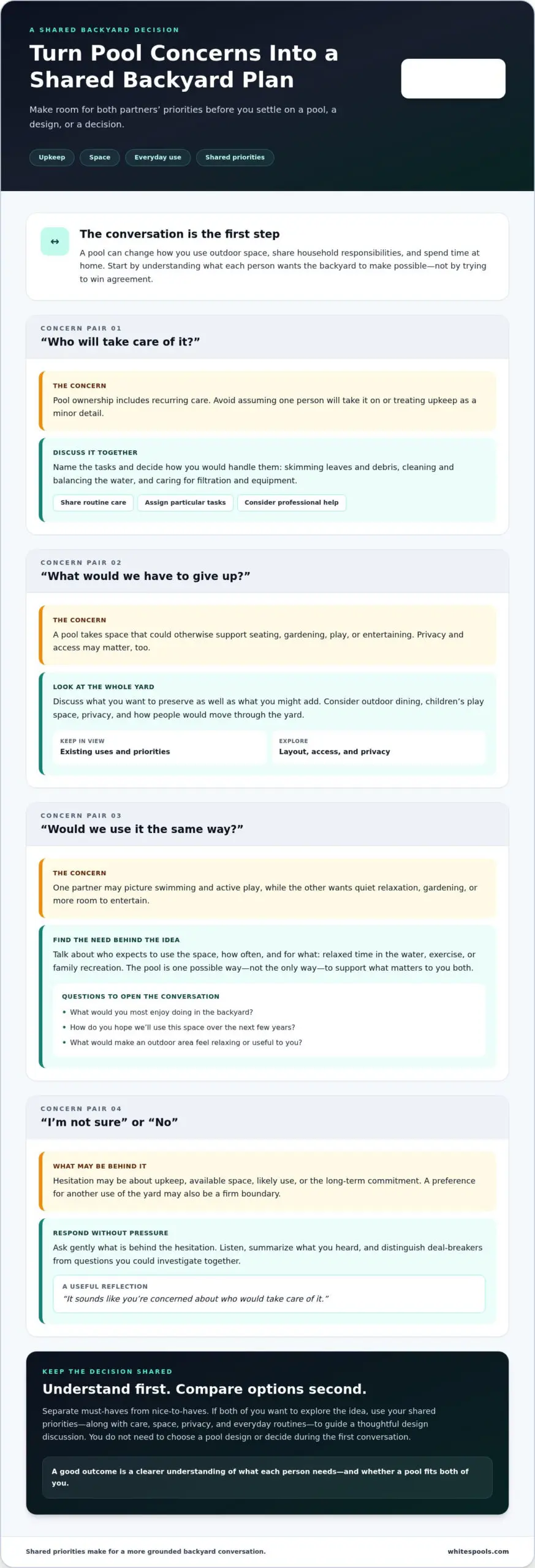
One partner might picture swimming and active play; the other might want a quiet place to relax, or more room for gardening and entertaining. The pool may be only one way to meet those wishes. Separating the underlying goal from the specific feature can reveal where your priorities overlap and where they differ. Pools have a long history as places for recreation and gathering, as the history of swimming pools illustrates. The more important question is whether one fits your household today.
How to start the pool conversation without creating pressure
Choose a calm moment when neither of you is upset or trying to make an urgent home decision. Introduce the subject as something to explore together, not a request for an immediate yes. Open questions can help you hear an honest answer:
- What would you most enjoy doing in the backyard?
- How do you hope we’ll use this space over the next few years?
- What would make an outdoor area feel relaxing or useful to you?
Listen for the need behind each answer. If one person wants more family time outdoors and the other values a peaceful place to unwind, those goals can guide a wider conversation about how the yard should function. You don’t need to settle on a pool design, or even decide whether to get a pool, during the first discussion.
How to uncover the real concern behind a no
A “no” may reflect a firm preference or a specific worry that needs more discussion. Ask gently whether the hesitation is about upkeep, available space, how often the household would use a pool, or the long-term commitment. Avoid rebutting the answer right away. Instead, summarize what you heard: “It sounds like you’re concerned about who would take care of it.” That gives your partner a chance to clarify and shows you’re taking the concern seriously.
Next, distinguish deal-breakers from open questions. A strong preference to keep the yard available for another purpose may be a firm boundary. Uncertainty about routine care, by contrast, may be something you can investigate together, including whether professional pool maintenance would suit your household. The aim of convincing your spouse to get a pool shouldn’t be to overcome every objection. It’s to understand what each person needs before deciding whether a pool makes sense for both of you.
Address Pool Ownership Concerns With Clear, Realistic Answers
Enthusiasm for a pool and readiness for its ongoing care are two different things. A useful conversation considers both the enjoyment a pool could bring and the practical responsibilities that come with owning one. Taking those responsibilities seriously can make the decision feel more shared and grounded.
Talk through maintenance and household responsibilities
Instead of assuming one person will “take care of the pool,” name the recurring tasks and decide how you’d like them handled. Depending on your household’s preferences, that could include:
- Skimming leaves and other debris from the water.
- Cleaning the pool and keeping the water balanced.
- Paying attention to filtration and equipment care.
Then discuss whether you’d divide routine care, assign particular tasks, or prefer professional help. White’s Pools offers professional pool cleaning and maintenance, giving couples an option to consider as they plan for long-term care. The right arrangement depends on your household. Avoid treating upkeep as a minor detail or assuming how much time it will take.
Shared decisions can be easier when partners explain their needs and consider options together. Michigan State University Extension offers practical guidance on family decision-making, a useful perspective for discussing responsibilities without turning the conversation into a contest.
Assess space, privacy, and everyday use together
A pool uses space that could otherwise support seating, gardening, play, or entertaining. Look at the backyard as a whole and discuss what you’d want to preserve, not only what you’d like to add. Would either of you feel uncomfortable with reduced privacy? Do you want room for outdoor dining or a clear area for children to play? These preferences can shape a workable plan.
Be specific about how a pool would fit your routines. Who expects to use it, how often, and for what activities: relaxed time in the water, exercise, or family recreation? If one partner imagines frequent use and the other isn’t sure, talk about what would make the space feel worthwhile to both. Note practical questions about the yard’s layout, access, privacy, and the features you’d want alongside the pool. Those details can guide a tailored design discussion without forcing a decision before you’re ready.
Convincing your spouse to get a pool shouldn’t mean brushing aside concerns about care, space, or daily life. If you both want to explore how a pool could fit your priorities, review custom pool design as a way to turn those considerations into a thoughtful plan.
Compare Pool and Backyard Options Against Your Shared Priorities
Once you’ve discussed each person’s priorities and concerns, compare options side by side. The goal isn’t to prove that a pool is the right answer. It’s to see which features support the backyard life you both want, what responsibilities they bring, and what questions remain. Use this comparison as a starting point, then adapt it to your household.
| Shared priority | Possible direction | Care and space to consider | Question to explore together |
|---|---|---|---|
| Swimming and recreation | A custom concrete pool or plunge pool | Consider routine pool care and how much yard space the pool and surrounding area would use. | Who would use it, and what activities matter most? |
| A natural-feeling setting | A natural or waterfall pool | Discuss how the pool would fit with the landscape and other ways you use the yard. | Which elements create the atmosphere you both want? |
| A distinctive visual feature | An infinity edge pool | Consider the setting, layout, and how the design would relate to the home and outdoor space. | Is the visual effect a priority for both partners? |
| Swimming in an indoor setting | An indoor pool | Talk through how an indoor pool would fit into your home and household routines. | How would you expect to use it day to day? |
| Gathering and relaxing outdoors | An outdoor fireplace, with or without a pool | Consider how the feature would complement seating, entertaining, or poolside time. | Would it support a shared plan, or is another backyard use more important? |
Think of pool styles as design directions
Each pool type suggests a different design conversation, not a universal solution. Custom concrete pools can be tailored to a project’s design goals, while a plunge pool may suit a more compact pool concept. Natural and waterfall pools can help shape a preference for a landscape-led setting. An infinity edge pool or indoor pool may suit a different vision and context. Compare each possibility with your priorities instead of choosing by name alone. For more ideas, explore this custom concrete pool guide.
Consider the whole backyard plan
A pool and an outdoor feature don’t have to compete. An outdoor fireplace might complement a shared vision for gathering and relaxing, while another household may decide that open yard space matters more. Treat poolside features as possible parts of a larger plan, not automatic additions or replacements. If that idea appeals to both of you, browse these poolside fireplace ideas.
This comparison makes convincing your spouse to get a pool less about winning an argument and more about finding an option that respects both people’s priorities. Mark what you agree on, note unanswered questions, and bring those points into your next discussion.
Use a Shared Decision Process Before Committing to a Pool
A clear process can keep a major backyard decision from turning into a tug-of-war. Instead of trying to secure a yes in one conversation, work through the questions together and agree on what progress looks like. The aim of convincing your spouse to get a pool shouldn’t be to wear down their resistance. It should be to find out whether a pool can meet shared needs and what both of you would need to feel comfortable exploring it.
- List priorities. Each partner writes down preferred activities, design priorities, and practical limits for the backyard.
- Name concerns. Identify questions about pool care, space, household use, or the commitment involved.
- Compare options. Review the same pool and backyard ideas together, using your priorities to evaluate them.
- Agree on a next step. Decide whether to learn more, begin a design conversation, or pause and revisit the decision later.
As you compare ideas, separate essential requirements from features that would simply be enjoyable. For example, preserving room for outdoor dining might be a must, while a particular decorative feature could be a nice-to-have. This distinction keeps the conversation focused on what matters most to each of you.
Turn different preferences into a useful brief
Have each partner describe the activities they’d like the backyard to support, the design qualities they value, and any practical limits they want respected. Then mark the overlap and list differences that still need discussion. Your shared brief might include a wish for recreation, a preference for keeping part of the yard open, and questions about who would handle pool care. These notes give a tailored design conversation a useful starting point without requiring either partner to fill gaps with assumptions.
Know when you’re ready to explore a design
You may be ready to take a next step when you agree on the pool’s purpose, who is likely to use it, and the general feel you want for the backyard. You don’t need every detail decided, but be clear about open questions, such as how maintenance would fit your household or which design direction suits the space. If you’re considering a compact concept, explore this plunge pool guide together.
If a major concern remains unresolved, pause rather than forcing a conclusion. A considered decision protects trust, whether you move forward now or decide a pool isn’t right for your household. If you both feel ready to explore possibilities, start a custom pool design conversation based on the priorities you’ve agreed on.
Explore a Custom Pool Plan Together With White’s Pools
Once you both want to explore the idea, a design discussion can turn broad hopes into a pool plan shaped around your household. White’s Pools designs and builds custom pools, including concrete, indoor, and infinity edge pools. These are design directions to consider together, not recommendations that suit every family or backyard. White’s Pools is a third-generation, family-owned company established over 75 years ago.
What to bring to a pool design conversation
Bring the priorities and questions you’ve already discussed. You don’t need a polished plan. A few clear notes can help both partners explain what they want and what they’re unsure about:
- Shared goals: How would you like the backyard to support recreation, relaxation, or time together?
- Preferred activities: Who might use the pool, and what would you hope to do in and around it?
- Backyard priorities: Describe how you use the space now and which features or areas you’d like to preserve.
- Open concerns: Bring questions about design, space, household routines, and ongoing care.
Invite both partners to take part. One person may focus on how the pool looks and fits the landscape, while the other may think more about everyday use or upkeep. Hearing those perspectives together gives the design conversation a fuller picture of your shared priorities, without requiring you to settle every detail beforehand.
Include professional pool care in the long-term plan
Design is only part of ownership. Discuss how ongoing water care and equipment upkeep would fit into your household’s routines, and decide whether you’d prefer to handle pool care yourselves or consider professional support. White’s Pools offers professional pool cleaning and maintenance, an option to include in your long-term plan. That brings care into the conversation from the start, rather than leaving it as an assumption for later.
For couples who have been working through concerns about use, design, and responsibilities, convincing your spouse to get a pool is less about winning agreement than deciding together whether a pool fits. If you’re both ready to explore a tailored direction, explore a custom pool plan together with White’s Pools.
Take the Next Step Together
A pool decision should reflect how you both want to live in and use your backyard. Start with shared priorities, make room for honest concerns about care and space, and compare design possibilities with your household’s real routines. Convincing your spouse to get a pool isn’t about winning an argument. It’s about deciding together whether a pool fits and what a thoughtful plan would need to include.
If you’re both ready to explore, White’s Pools can help turn your shared vision into a custom pool plan. The company designs and builds custom pools and offers professional cleaning and maintenance to consider as part of long-term ownership.
Explore a custom pool plan together and take the next step at a pace that feels right for both of you. A well-considered backyard can begin with a conversation where each partner feels heard.
Frequently Asked Questions
How do I convince my spouse to get a pool without pressuring them?
Approach the conversation as a shared exploration, not a request for an immediate yes. Ask what each of you wants the backyard to make possible, then listen to your spouse’s concerns without trying to counter each one. Discuss whether a pool could support your shared priorities, and leave room for the answer to be no or not yet. Convincing your spouse to get a pool should never come at the expense of trust.
What if my spouse thinks a pool will be too much work?
Take the concern seriously and discuss the tasks involved, such as cleaning, water care, and equipment upkeep. Decide whether you’d share routine responsibilities or prefer professional support, and consider how each option fits your household. White’s Pools offers professional pool cleaning and maintenance, which you can include in the ownership conversation. Avoid promising that upkeep will be effortless; instead, make a realistic plan that both partners can accept.
How can we decide whether we would use a pool often enough?
Talk through who would use it, what activities you imagine, and how those uses fit your routines. For example, consider whether you picture swimming for exercise, family recreation, or relaxing outdoors, and whether those activities matter to both of you. Compare those hopes with how you currently spend time in the yard. You don’t need to predict exact usage; an honest discussion can help clarify whether a pool feels worthwhile to your household.
Should we choose a pool design before agreeing to get one?
No. First decide whether a pool generally fits your shared priorities and whether you’re both open to exploring it. Then review design directions together, considering how each might relate to your yard, desired activities, and care preferences. Custom concrete, plunge, indoor, and infinity edge pools offer different possibilities, but no single type is right for every household. Treat early design ideas as ways to inform the conversation, not as a commitment.
Can a pool fit a household with different backyard priorities?
It may, if a plan can respect the needs each partner considers essential. Start by naming those priorities, such as swimming, open lawn, gardening, privacy, or space to gather. Then consider how a pool and other outdoor features could work together in the overall layout. A tailored design discussion can help explore possibilities, but it’s also reasonable to decide that a different use of the yard better suits your household.
What should we discuss before deciding to get a pool?
Talk about why you want a pool, who would use it, how it would affect the backyard, and what responsibilities come with ownership. Discuss routine maintenance and whether you’d handle it yourselves or consider professional pool care. Separate essential requirements from features that would simply be enjoyable, and write down unanswered questions about design or planning. If a major concern remains unresolved, pause rather than rushing into a decision.
How do we take the next step if we both want to explore a pool?
Gather your shared goals, preferred activities, backyard priorities, and open questions, then use them to guide a design conversation. White’s Pools designs and builds custom pools, including concrete, indoor, and infinity edge pools, and offers professional cleaning and maintenance. White’s Pools is a third-generation, family-owned company established over 75 years ago and can help shape a tailored direction around your household’s vision and long-term care preferences.

