
The lowest pool quote isn’t automatically the best fit. To compare pool builder quotes, look at what each proposal includes, the likely total cost, and the site conditions behind its assumptions, not just the headline price. Choose the one that clearly matches your plans and explains how the work will be handled.
It’s natural to focus on the total at the bottom of each proposal. But differences in pool size, materials, equipment, decking, site preparation, and exclusions can make two offers hard to compare at a glance.
This guide shows you how to compare proposals, spot gaps in scope, and assess assumptions about your property before deciding. You’ll also find practical questions about changes, schedules, workmanship, and ongoing support, so you can see more clearly what each offer covers.
Key Takeaways
- Compare structural, finish, equipment, and workmanship warranties to understand what protection each proposal describes.
- Line up inclusions, exclusions, and allowances so the headline price reflects comparable work and features.
- Look for site-specific assumptions about excavation, soil, access, and unexpected conditions that could affect the project.
- Clarify how changes, schedules, payment milestones, and construction updates will be handled before signing.
What is a Pool Builder Quotation?
A pool builder’s quote describes the proposed construction work and its estimated cost. It should connect the design, materials, labor, equipment, and requested features to a clear scope. Treat it as a project document, not just a single figure. Its details show what the builder plans to deliver and which decisions remain open.
A useful estimate identifies the pool’s structure, finish, and equipment. It also explains whether options, such as a different filter or finish, change the scope. Compare the written details closely, because similar descriptions can refer to different materials or equipment. A design consultation can clarify choices, but the proposal should record the agreed scope.
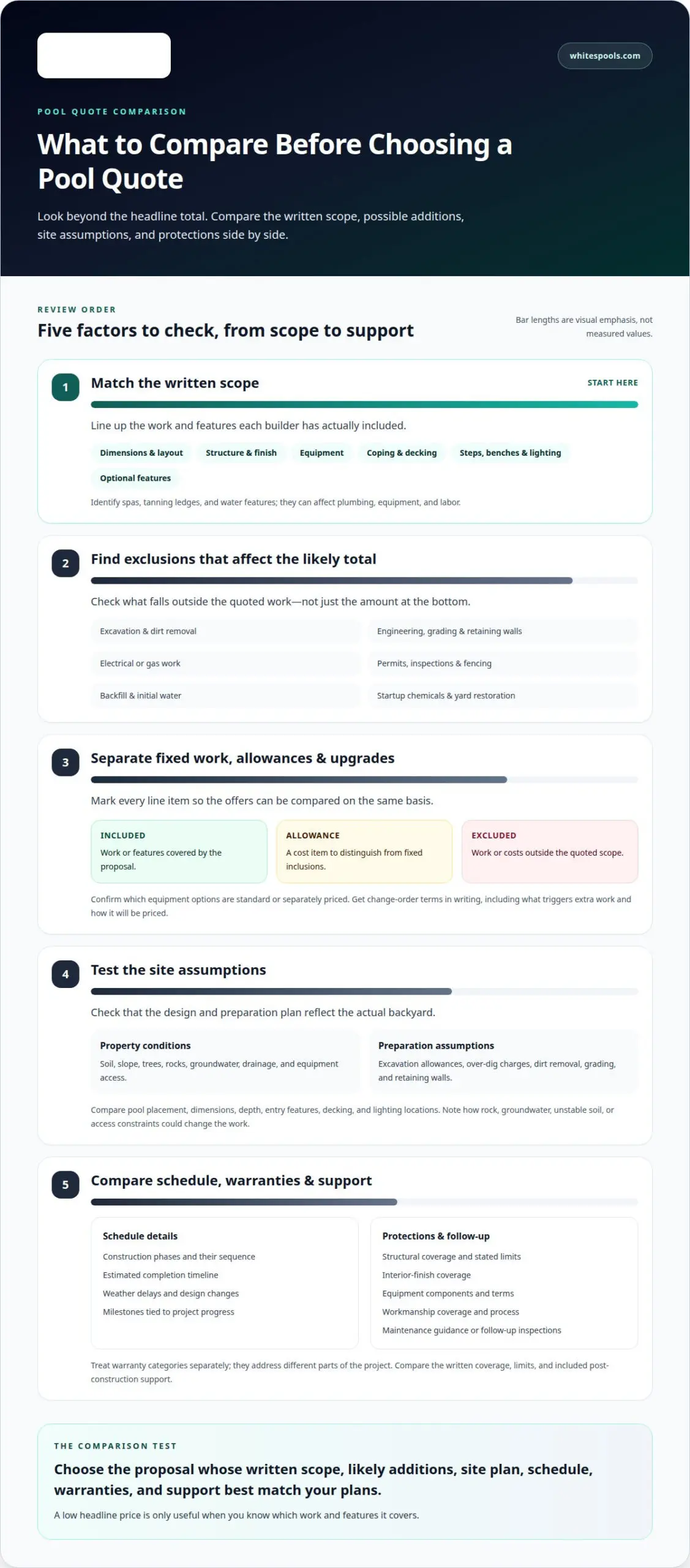
Compare timelines by reviewing the construction phases, their sequence, and the milestones tied to progress. Look for the estimated completion timeline, how weather delays are handled, and how design changes affect the schedule. A schedule that explains dependencies is easier to assess than a single completion date.
Review warranties as separate categories. A structural warranty concerns the pool structure, while an interior-finish warranty addresses the finish. Equipment warranties cover specified components, and workmanship warranties address the builder’s work. These categories are not interchangeable. The contract should identify each warranty, its coverage, and any stated limits. Also review what post-construction support includes, such as maintenance guidance or follow-up inspections.
Use this comparison to see whether each proposal covers the same protections:
| Warranty option | What it addresses | What to compare |
|---|---|---|
| Structural | Pool structure | Coverage and stated limits |
| Interior finish | Pool finish materials | Named finish and coverage |
| Equipment | Specified pool equipment | Components and warranty terms |
| Workmanship | Builder’s construction work | Covered work and process |
| Post-construction support | Guidance after completion | Included support and follow-up |
Choose the offer whose written scope, schedule, warranty coverage, and support best match your plans.
Comparing pool proposal scope and total price
Comparing pool builder quotes starts with matching the proposed work, allowances, and exclusions. Commonly excluded costs include site preparation, dirt removal, electrical or gas work, permits, fencing, startup chemicals, initial water, and yard restoration. A headline total only helps if you know which parts of the finished project it covers.
Included Scope and Features
Included scope describes the work, features, and services covered by each proposal. Compare pool dimensions and layout, then line up the interior finish, coping, decking area, steps, benches, and lighting. One offer may include a pool shell and minimal decking, while another covers a larger finished surround. Optional features, such as spas, tanning ledges, and water features, should be identified because they can change plumbing, equipment, and labor.
Excluded Costs and Total Price
Excluded costs show which parts of the finished project fall outside the quoted work. One proposal may omit excavation and dirt haul-off; another may exclude engineering, grading, retaining walls, or fencing. Compare these omissions alongside the included work, not in isolation. Site preparation, backfill, electrical and gas runs, permits, inspections, initial water, and yard restoration can all affect the likely total.
A practical way to compare pool builder quotes is to separate fixed inclusions from allowances and optional upgrades. Check whether decking and coping are included, and note their materials and coverage. Confirm whether equipment options are standard or priced separately. This helps you assess offers based on comparable work rather than headline totals.
Ask for inclusions, exclusions, allowances, and change-order terms in writing. Clarify what triggers extra work and how it will be priced. Record preparation assumptions, including clearing, grading, difficult access, and excess soil removal. Written answers make the scope easier to compare and show how changes could affect the project.
Mark each line item as included, excluded, or an allowance. Then weigh the full scope and likely additions against your plans before choosing an offer.
Customized pool blueprints and site conditions
A useful blueprint connects the pool design to the backyard’s actual layout. Compare each plan’s size, shape, placement, and depth profile, including shallow and deep areas. A 3D design can help show how the pool shell, decking, steps, and lighting relate to the home and outdoor space. Plans should reflect your intended use, not just a standard layout.
Site assumptions matter because excavation depends on property conditions. Soil type, slope, trees, rocks, groundwater, and equipment access can affect preparation and construction. A proposal should explain how the design accounts for these factors and how unexpected conditions will be handled. Compare excavation allowances, over-dig charges, dirt removal, grading, retaining walls, and access constraints. For example, if a narrow side yard limits equipment movement, that should be clear in the site plan and proposal.
Use a consistent review across plans:
- Match pool placement and dimensions to the yard layout.
- Compare depth, entry features, decking, and lighting locations.
- Review soil preparation, drainage, and access assumptions.
- Note how rock, groundwater, or unstable soil may change excavation.
A portfolio shows how a builder’s designs translate into finished pools. Review completed projects with similar yard layouts, pool shapes, finishes, and surrounding features. Customer feedback can provide context about communication and the construction experience, while visiting a completed pool lets you see the workmanship firsthand. These steps support an informed comparison; a polished rendering alone cannot show how a design will work on a specific site.
Speaking with previous customers can clarify how the finished project compared with the plans. Ask about specifics, such as whether the pool placement suited the yard, how site challenges were handled, and whether updates reflected the work underway. Read feedback alongside project examples rather than treating one review as the full picture. A builder’s insurance and licensing details also belong in your evaluation, alongside design quality and site planning.
Questions to ask pool builders before signing
Before signing, compare payment terms, credentials, and how each proposal handles local approvals. Clear answers help you assess an offer beyond its headline price.
Payment Schedules and Deposits
A payment schedule explains when deposits and later payments are due, and which project milestone triggers each payment. Terms differ between builders, so compare the timing, amounts, and written conditions rather than assuming schedules match. Ask how changes affect payment draws and how each change will be documented. A detailed schedule makes it easier to connect payments with construction progress.
Don’t choose the lowest offer based on price alone. A significantly lower quote may reflect a narrower scope or omitted work. Compare labor calculations, materials, and change-order pricing before deciding. Keep the answers in writing so the agreed terms are clear before signing.
Licenses, Insurance, and References
Review the builder’s applicable license details and ask for proof of insurance. These checks differ from price comparisons because they concern credentials and liability, not included features. Read customer feedback alongside examples of completed projects, then speak with previous customers when possible. Ask how closely the finished work matched the proposal and how the builder handled updates or changes.
Use specific examples to assess communication and craftsmanship. A previous customer’s account of project updates, supervision, or change approvals can add context beyond a general rating. Consider these details alongside the written scope, not as a substitute for it.
Permits, Inspections, and Code Requirements
Ask whether permits, required inspections, engineering, and applicable local safety features are included or priced separately. Requirements vary by location, so the proposal should identify the approvals and features it covers. Fencing, barriers, alarms, and self-closing gates can affect the scope where required.
Clarify who handles permit submissions and inspection coordination, and how related fees appear in the estimate. Then compare the answers across proposals. A quote that clearly states responsibilities and allowances is easier to assess than one that leaves approvals implicit.
For a pool design conversation grounded in your plans, discuss your pool project.
White’s Pools: Pool Cleaning & Maintenance
White’s Pools provides pool cleaning and maintenance for homeowners who want ongoing care after choosing a pool proposal or completing construction. Regular maintenance supports water quality and equipment performance, both important to enjoying a pool over time. It’s a natural next step once the build decision is made and the focus shifts to keeping the pool clean and operating well.
Whether you’re planning a new custom concrete pool or need routine care for an existing pool, maintenance extends beyond the construction phase. White’s Pools provides professional pool cleaning and maintenance tailored to your pool’s needs.
Contact White’s Pools to discuss pool cleaning and maintenance for your home.
Shape the Next Step Around Your Plans
The proposal you choose shapes more than construction. It sets the direction for how your outdoor space supports daily life, gatherings, and ongoing care. As you compare pool builder quotes, look beyond the signing date and consider how the design will serve your home over time. A well-planned project starts with a clear picture of how you want to use the space.
White’s Pools offers custom concrete pools, pool cleaning and maintenance, and outdoor fireplaces. These services can connect the pool with the care and setting around it, whether you’re planning a new build or considering what comes after construction. The next step is to talk about your plans, preferred features, and the experience you want to create at home.
Discuss your pool plans with White’s Pools and take a considered step toward shaping an outdoor space that feels distinctly yours.
Frequently Asked Questions
Should I choose the lowest quote?
No. Choose the proposal that best matches your intended project and clearly explains its assumptions. A lower total can reflect a different design, material selection, or level of service rather than better value. For example, compare the listed pump and filter, finish, and decking area before deciding. If proposals differ, clarify the scope in writing so the price comparison is meaningful.
Should I visit completed projects?
Yes. Seeing a completed pool can help you judge details that drawings may not convey. Notice how the pool sits in the yard, how its finish looks in natural light, and whether the transitions to surrounding areas feel considered. If you speak with a previous customer, ask about communication and how the finished result matched their plans. Treat a visit as useful context, not the only measure.
What’s the most important thing to compare?
Start by checking whether each proposal describes the same project. A quote for a compact plunge pool is not directly comparable to one for a larger family pool, even if both use concrete. First align the intended use, layout, depth, and features. Then review the assumptions behind each offer. This gives you a fair basis for weighing materials, project delivery, and overall value.
Why do pool quotes vary so much?
Pool quotes vary because designs, materials, equipment, and property conditions differ. A plan with a tanning ledge, water feature, or custom lighting requires different work from a simpler layout. Yard access, soil preparation, drainage, and excavation conditions also shape a proposal. Builders may define project responsibilities differently, so similar pool concepts can produce offers with different scopes and assumptions.
What should a pool builder quote include?
A useful quote should clearly describe the proposed pool and work, including its size, shape, layout, depth, finish, equipment, and selected features. It should distinguish included work from exclusions and allowances, and explain how changes are documented. For example, check whether the proposal names the decking material and area rather than simply saying “decking.” Clear descriptions connect each line item to your planned result.
How do pool builder quotes compare by pool type, size, and materials?
Compare like with like: identify each pool’s type, dimensions, shape, and depth before assessing materials. A larger pool generally requires different quantities of materials and work than a smaller design, while a waterfall or infinity edge adds features that change the scope. Compare concrete, finish, tile, coping, and decking descriptions individually. The closer the designs match, the more useful the price comparison becomes.

