
Swim lessons don’t replace adult supervision. Backyard safety with a new pool starts with an attentive adult watching children whenever they’re in or near the water, alongside barriers, household rules, and other protective measures. For young children and non-swimmers, staying within arm’s reach adds another layer of protection.
It’s natural to hope lessons will help children feel safer and more confident in the water. Lessons can build skills, but they don’t replace close supervision, properly fitted life jackets for weak swimmers, or clear household rules.
This guide explains how to assign a dedicated Water Watcher, set practical pool rules, and reduce risks around drains and suction outlets. It also covers how safety covers and touch supervision fit into a layered approach to keeping children safer around your new pool.
Key Takeaways
- Assign one adult to watch swimmers without distractions, and make a clear handoff before that person steps away.
- Keep access controlled with a barrier around all four sides, a self-closing, self-latching gate, and alarms that are reset after use.
- Teach children to stay away from drains and suction outlets, where hair, limbs, jewelry, or swimwear can become trapped.
- Remove a safety cover completely before anyone enters the pool, and keep rescue equipment visible and within quick reach.
- Keep young children and non-swimmers within arm’s reach, and use a properly fitted life jacket when appropriate.
1. Adult supervision and designated Water Watchers
Assign one responsible adult to watch children continuously, stay close, and hand off supervision directly before leaving. Keep the adult focused on pool safety, even when children are taking swimming lessons or using swim aids.
Make the role explicit before anyone enters the water. During summer gatherings, appoint a dedicated water watcher for a 15–30 minute shift, then name the next adult before the first watcher steps away. The watcher should keep swimmers in view, avoid phone use and conversation distractions, and remain near the pool area. If no relief adult accepts the role, swimming should pause. A child in a shallow pool still needs an attentive adult.
Use closer supervision for young children and weaker swimmers. Stay within arm’s reach when a child needs hands-on support, and don’t leave to answer the door or fetch supplies. Prepare towels, a charged phone, and water before swimming starts. Swim aids can slip or shift, so they never replace an adult’s attention. Adults who regularly supervise should learn CPR and basic first aid and know where rescue equipment is kept.
Lessons help children build skills, but they don’t replace active supervision, barriers, or family rules. Formal swimming lessons are recommended to begin at age 4. A case-control study found about an 88% lower risk of unintentional drowning among children ages 1–4 who had formal lessons. Water-survival training can also teach practical responses, but children still need an adult watching them. The American Academy of Pediatrics identifies drowning as the second leading cause of death among children ages 1–4.
Check the water and equipment before each swim. If the water is cloudy or you can’t see the pool bottom, keep the pool closed until visibility improves. Look for damaged equipment or anything that isn’t operating normally, and address problems before anyone enters the water. Test and maintain pool water chemistry according to the directions for the products you use. Clear water and properly working equipment support safer swimming, but neither replaces supervision.
Teach children practical rules before pool time. Explain that they need an adult’s permission before entering the water or pool area, and show them where the Water Watcher will sit or stand. The watcher should scan the entire swimming area, rather than focus on one child or assume someone else is watching. For backyard safety with a new pool, a clear handoff and uninterrupted attention make supervision a defined responsibility, not an assumption.
2. What are the most important pool safety rules for families?
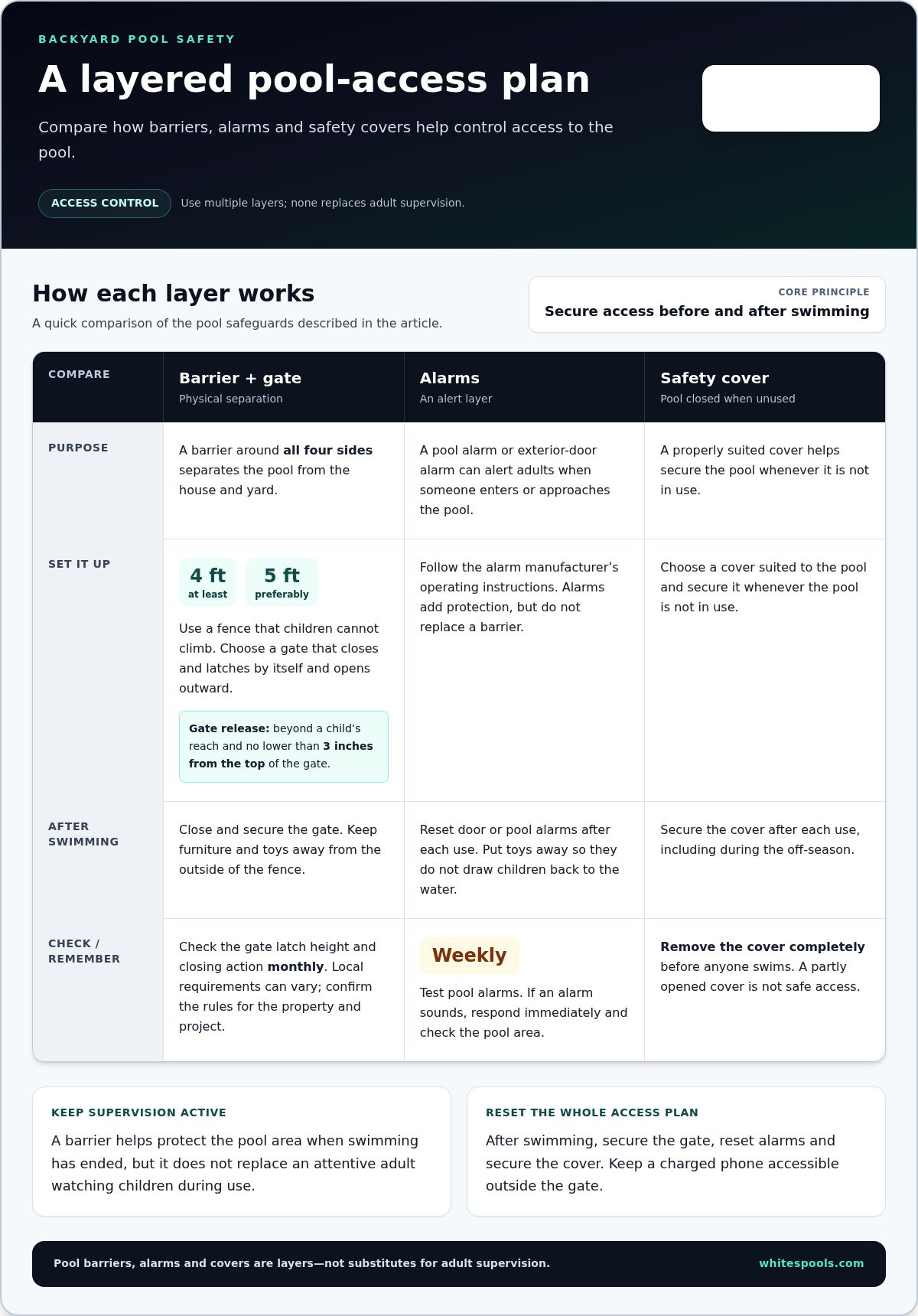
Build a layered access plan around the pool: use a barrier, secure its gate, and reset alarms and covers after swimming. The U.S. Consumer Product Safety Commission recommends a fence around all four sides of a pool. This separates the water from the house and yard, rather than relying on a house wall as one side. A barrier protects the pool area when swimming has ended, but it doesn’t replace adult supervision during use.
Fence-height guidance and local code requirements aren’t identical. The provided safety guidance recommends a barrier at least 4 feet tall, preferably 5 feet. Local requirements can vary by jurisdiction, property type, and project details, so there isn’t one height that answers every local-code question. The International Swimming Pool and Spa Code may be adopted or amended locally; homeowners in Virginia, Maryland, and Washington, DC should confirm the barrier requirements that apply to their jurisdiction and project.
Choose a gate that closes and latches by itself, opens outward, and keeps its release mechanism beyond a child’s reach. Design the fence so children can’t climb it, and keep furniture or toys away from the outside. Check the latch height and closing action monthly. The CPSC recommends placing the gate’s release mechanism no lower than 3 inches from its top. After every swim, close and secure the gate, then reset any door or pool alarm.
Alarms add a layer of protection, but they don’t replace a barrier. A pool alarm or an alarm on an exterior door can alert adults when someone enters or approaches the pool. Test pool alarms weekly and follow the manufacturer’s operating instructions. If an alarm sounds, respond immediately and check the pool area. Put toys away after swimming because floating objects can draw children back to the water. Keep a charged phone accessible outside the gate.
Choose a safety cover suited to the pool, and secure it whenever the pool isn’t in use. Remove the cover completely before anyone swims; never treat a partly opened cover as safe access. Reset gates, doors, alarms, and covers after each use, including during the off-season. Installation costs depend on factors such as the fence or cover type, pool dimensions, materials, access, and site preparation. Requesting an itemized quote clarifies the price for the specific work.
For a new pool, plan safe access alongside the layout. Homeowners considering a custom concrete pool can think through how its placement relates to the barrier, gate, and routes into the pool area.
The guidance calls for a barrier around all four sides, at least 4 feet tall and preferably 5 feet, with a self-closing, self-latching gate that opens outward and has a child-inaccessible release. Because local jurisdictions may adopt or amend the International Swimming Pool and Spa Code, confirm the requirements for the specific property and project.
3. Keeping children away from pool drains and suction outlets
Backyard pools create two distinct hazards: drowning and entrapment at suction outlets. Children’s hair, limbs, jewelry, or bathing suits can become caught in a drain or suction opening. Teach children to stay away from drains and never play beside or cover an outlet. In 2002, 7-year-old Virginia Graeme Baker died after suction trapped her at a hot tub drain.
Young children can drown in very shallow water. As little as 1 inch can be enough for an infant or toddler, and children can drown in less than two inches. Keep infants and toddlers away from water unless an attentive adult is close. Empty small pools after use, and don’t leave containers or play areas holding water accessible to young children.
Set ground rules before children and guests enter the pool area. Explain that children need an adult’s permission before approaching or entering the water. Tell them not to touch drain covers, play near outlets, or swim alone. Point out the drains before swimming starts, then reinforce the rule each time they use the pool. Consistent directions make the hazard and expected behavior clear.
To keep pets safer around a backyard pool, keep them out of the pool area unless an adult is supervising. Secure the gate after every entry or exit, and don’t rely on a pet’s ability to swim. During gatherings, designate an adult to watch pets near the water as well as children. This helps prevent an open gate or distracted guest from creating unsupervised access.
Swim lessons can teach children water skills, while water-survival training can teach practical responses around water. Neither removes the need for close supervision or household rules. Before lessons, explain the pool boundaries and the rule against approaching drains. Afterward, keep practicing safe habits on dry ground and beside the pool, so children understand that learning skills doesn’t give them permission to swim without an adult.
Make drain awareness part of each swim routine. Point out the outlets, repeat the rule against playing near drains, and redirect children who approach them. Give guests and babysitters the same instructions instead of assuming they know the household rules. If a drain cover looks loose or damaged, keep swimmers out until the problem is addressed. Clear rules and regular equipment checks help reduce avoidable exposure to suction hazards.
4. Safety covers and drain anti-entrapment devices
A safety cover and a drain cover protect against different hazards. A pool cover helps control access after swimming, while a drain cover helps reduce underwater suction-entrapment risks. Neither replaces active supervision or a barrier. Choose each for its intended purpose, and make sure it fits the pool and equipment properly. A partly open cover can create confusion about whether the pool is ready for use.
Remove the pool cover completely before anyone enters the water. Don’t leave sections hanging over the pool or let swimmers climb across the cover. After swimming, clear people and toys from the pool, then replace the cover according to its operating instructions. Keep the opening and closing equipment accessible to the adult responsible for securing the pool. A consistent routine makes it clear when the pool is covered and when it’s open.
Drain protection needs separate attention. Under the Pool and Spa Safety Act, all public pools and spas must have drain grates or covers that meet safety standards. The federal law named for Virginia Graeme Baker requires public pools and spas to have anti-entrapment drain covers and other devices. Drain covers should be chosen to suit the pool and its equipment. Requirements vary by pool type and jurisdiction, so don’t assume a public-pool rule applies unchanged to a private backyard pool.
Include each visible drain cover in routine pool checks. A cover that appears loose, cracked, missing, or damaged needs prompt attention. Keep swimmers out until the problem is resolved. Use a suitable replacement that meets applicable safety requirements, rather than improvising with a household object. The replacement must fit the outlet and pool system; a poorly matched cover may not provide the intended protection. Don’t let children touch or stand on drain covers.
Keep rescue equipment, such as a throw ring, where adults can see and reach it quickly. Tell guests where it is before swimming starts, and keep the route clear. In an emergency, nearby equipment can help someone respond promptly while another person calls for help. Don’t enter the water to attempt a rescue if doing so would put you at risk; use available rescue equipment from a safe position.
For backyard safety with a new pool, assign one adult to secure the cover after each swim and confirm it’s fully in place. Check drain covers during routine maintenance, and act promptly if you see damage. A clear sequence helps families protect outlets, keep rescue equipment ready, and secure the water whenever the pool isn’t in use.
5. Touch supervision for young children and non-swimmers
For young children and non-swimmers, stay within arm’s reach whenever they’re in or beside the water. This touch-supervision distance lets an adult respond quickly if a child slips under or struggles. The rule matters even in shallow water: as little as 1 inch can be enough for an infant or toddler to drown. Keep hands available, not occupied with a phone, food, or pool equipment.
Set permission rules before swimming starts. Children should never enter the pool area or water without an adult’s permission, and no one should swim alone. Explain that permission applies to each swim, not just the first visit of the day. Make sure guests and babysitters know the same rules. Lessons build skills, but they don’t replace close adult attention or barriers. Water wings aren’t a safe substitute for a properly fitted life jacket.
For weak swimmers, use a properly fitted U.S. Coast Guard-approved life jacket when appropriate. Check the fit before the child enters the water, and keep the child within arm’s reach. A float or swim aid isn’t permission to move farther away. Remind children that an adult remains responsible for watching them, even during a lesson or a short break between activities.
Weather and visibility can change the plan quickly. According to the National Weather Service, thunder means lightning is close enough to strike, so end swimming before a storm is overhead. After dark, confirm pool, deck, and pathway lights work before anyone swims. If a child becomes tired, cold, or less responsive, end the swim and help them leave the water. Don’t wait for a scheduled break.
Prepare supplies before children enter the pool area. Place towels, water, a charged phone, and any needed life jackets within reach, while keeping the phone outside the pool gate. Decide who will call emergency services and where responders can find the home address. Adults can keep first-aid materials, including American Red Cross materials their household uses, with emergency supplies. Being prepared helps adults stay focused on supervision instead of leaving children unattended to fetch essentials.
Touch supervision works best as a clear, repeatable routine: give permission, check the life jacket when needed, stay close, and end swimming when conditions change. As you plan a pool layout, consider sightlines around the water so an adult can watch swimmers from the poolside.
White’s Pools: Custom Concrete Pools
White’s Pools designs and builds Custom Concrete Pools for homeowners planning a new backyard pool. If your family is weighing pool placement, shape, and how the space will be used, thoughtful planning is a natural next step after setting supervision and safety rules. Discuss how the pool will fit your yard and daily routines, including how people will move between the house, pool, and surrounding outdoor area.
For an existing pool, Pool Cleaning & Maintenance can support ongoing water quality and equipment performance. These services complement, but don’t replace, adult supervision, barriers, or safe drain covers. Choose the conversation that fits your project, whether you’re planning construction or caring for a pool you already have.
Contact White’s Pools to discuss your pool project or maintenance needs, or visit whitespools.com.
Make Your Pool Plans Work for Everyday Life
A pool becomes part of household life, shaping where guests gather and how your family uses the yard. Let safety guide those choices from the start. Thoughtful backyard safety with a new pool means planning not only for opening day, but also for how the space will serve your household over time.
White’s Pools can help shape your plans with Custom Concrete Pools and Pool Cleaning & Maintenance. If you’re considering a broader outdoor setting, Outdoor Fireplaces can also be part of the vision. Start with your priorities, how you want to use the space, and the features you want to include.
Contact White’s Pools to discuss your pool plans and take a considered step toward a welcoming backyard.
Frequently Asked Questions
Do swim lessons replace pool supervision?
No. Lessons teach skills, but a child’s ability can vary with fatigue, distractions, and unfamiliar water. Keep an adult responsible for watching whenever children are near the pool, even after they complete a class. For example, don’t assume a child can safely manage a deeper section simply because they swim confidently in lessons. Treat lessons as one part of water safety, not permission for independent swimming.
Should a backyard pool stay open during thunder or lightning?
No. End swimming when you hear thunder and move everyone indoors. National Weather Service guidance says thunder means lightning is close enough to strike, so swimming should stop before a storm is overhead. Don’t wait for rain or visible lightning. Keep children away from the water while the storm approaches, and resume pool use only after it has passed and conditions are safe.
What are the most important pool safety rules for families?
Set rules that every household member and guest can follow: get adult permission before entering the pool area, walk rather than run on wet surfaces, and keep glass away from the deck. Don’t allow diving unless the pool is designed and clearly approved for it; otherwise, enter feet first. Explain the rules before guests arrive, then ask a responsible adult to reinforce them during the gathering.
What are the essential backyard pool safety measures for children?
Use several protections together: adult supervision, a barrier that limits unsupervised access, and clear rules about when children may approach the water. Keep the pool closed if cloudy water prevents you from seeing the bottom. Before guests arrive, identify the adult responsible for watching and tell children where to wait before entering. A clear routine helps prevent assumptions during busy transitions.
What pool fence height, gate, and latch requirements apply in the United States?
There isn’t one fence height that applies uniformly to every U.S. pool; local codes vary. The U.S. Consumer Product Safety Commission recommends barriers at least 4 feet tall, preferably 5 feet, and fences around all four sides. It also recommends a self-closing, self-latching gate, with the release mechanism no lower than 3 inches from the gate’s top. Local rules determine the requirements for a particular property.
Which pool covers and alarms provide the best protection, and how do they compare?
A secured safety cover physically closes access to the water, while an alarm alerts adults to entry or activity. They serve different purposes, so use them as complementary layers, not substitutes for supervision or barriers. Remove the cover completely before swimming. Door alarms can alert caregivers when someone goes outside, while pool alarms should be tested weekly. Follow each device’s operating instructions and respond promptly to alerts.
What swimming lessons and CPR training are recommended for pool owners?
Formal swimming lessons are recommended to begin at age 4, with instruction suited to the child’s ability. Adults who supervise pools should learn CPR and basic first aid; an adult or pediatric CPR class averages 2 hours. Keep emergency contact information accessible, and make sure supervising adults know how to call for help. Lessons can build swimming skills, but they never replace an adult’s attention.
How should pool chemicals be stored and handled safely?
Store pool chemicals securely, away from children and pets, and follow each product’s label for handling and storage. Keep chemicals in their original containers, separate from other products, and never mix different chemicals. The CDC advises keeping pool chemicals in a storage area below 95°F. Use the protective equipment and ventilation specified by the label, and keep the storage area dry and orderly.

