
A crack in a concrete pool can start beyond the pool shell. Common concrete pool problems, including shell cracks and shifting, can stem from soil conditions, installation details, coping and deck movement, expansion joints, or groundwater. A structural crack reaches the pool shell itself, unlike a crack limited to the surface.
It’s understandable to worry when a crack appears or the surrounding deck seems to move. The cause matters: ground pressure, water movement, and the way connected surfaces are built can all affect the pool.
This article explains how soil conditions influence shell stability, why concrete installation and curing can contribute to cracking, and how coping, joints, and groundwater play a part. You’ll also learn how to distinguish a surface issue from a crack in the shell, helping you understand the problem before considering the next step.
Key Takeaways
- Distinguish a crack in the pool shell from a surface crack, since they point to different kinds of problems.
- Soil conditions and groundwater affect shell stability; careful site assessment and a maintained hydrostatic valve can help reduce risk.
- Concrete curing and finishing practices matter: shrinkage cracks can develop as concrete cures, while excess water worked into the surface can contribute to spalling.
- Deck and coping movement can transfer stress to the pool wall. Expansion joints and mastic sealer help accommodate movement.
- When groundwater is high, drainage measures such as a well pit or sump pump can help manage water beneath the pool.
1. Soil conditions and pool-shell stability
Soil is part of the pool’s support system, not simply the ground around it. If soil shifts or settles unevenly, it can place unequal stress on the concrete shell. A crack in the shell itself is structural; a mark confined to plaster may be a surface defect. That distinction matters because resurfacing addresses the finish, not movement in the shell.
Before construction, the soil should be examined thoroughly so the pool structure can account for site conditions. Soil composition, drainage, and changes in moisture affect how the ground supports the shell. For example, water draining toward one side may soften or disturb the soil there while the opposite side remains more stable. Uneven support can stress the pool and contribute to cracks or shifting.
Groundwater creates another source of pressure. When water collects beneath a pool, upward force can push against the shell, especially if the pool is empty or its water level is low. A hydrostatic valve should be installed and maintained to help prevent a concrete shell from floating. The valve helps protect the shell, but it does not replace an understanding of groundwater conditions at the site.
A pool shell that lifts or “pops up” may shift out of position, stressing attached plumbing and surrounding surfaces. A sudden change in groundwater can increase this risk. If the shell has visibly moved, adding a new surface layer won’t correct its position or resolve the underlying pressure. The ground and water conditions need attention alongside the visible damage.
A concrete shell may have a service life of around 50 to 70 years if it has no major failures. That estimate describes the shell, not every pool component or its interior finish. Concrete pools typically need replastering every 10-15 years, so a worn finish alone doesn’t establish structural failure. A shell with major cracks or movement needs a different assessment than aging plaster.
How can you tell whether a concrete pool needs resurfacing or structural repair? Rough, stained, or worn plaster points to a surface concern; a crack through the shell or visible displacement raises structural concerns. The damage’s location and pattern help distinguish between them.
Do pool repair permits or rules vary by city or state in the United States? Permit requirements depend on local rules, and the shell’s condition alone doesn’t determine them. Check the requirements that apply where the pool is located.
How much does it cost to repair common concrete pool problems in the United States? The price depends on the damage, site conditions, and repair scope, and is provided after a quote request. A plaster finish and a shifted shell require different work, so the repair needed is a key cost factor.
What causes concrete pool leaks, and how are they diagnosed? Shell or patio movement can damage plumbing, while pressure testing the pool plumbing helps identify leaks. Secure installation can reduce the risk, but movement may still cause a leak.
Why does pool plaster become rough, stain, or discolor? Imbalanced water chemistry can discolor plaster, while incorrect troweling can contribute to surface damage. Concrete pools typically need replastering every 10-15 years.
What maintenance and water chemistry help prevent concrete pool damage? Test pool water once a week to help avoid imbalanced chemistry and discoloration. Ongoing maintenance also helps monitor water quality and equipment performance.
What are the risks of draining a concrete pool, and when is it safe? With high groundwater, removing pool water can leave upward pressure against the shell and increase the risk of floating. A maintained hydrostatic valve helps manage that risk; groundwater pressure and the valve’s function matter before draining.
2. Concrete installation and cracking
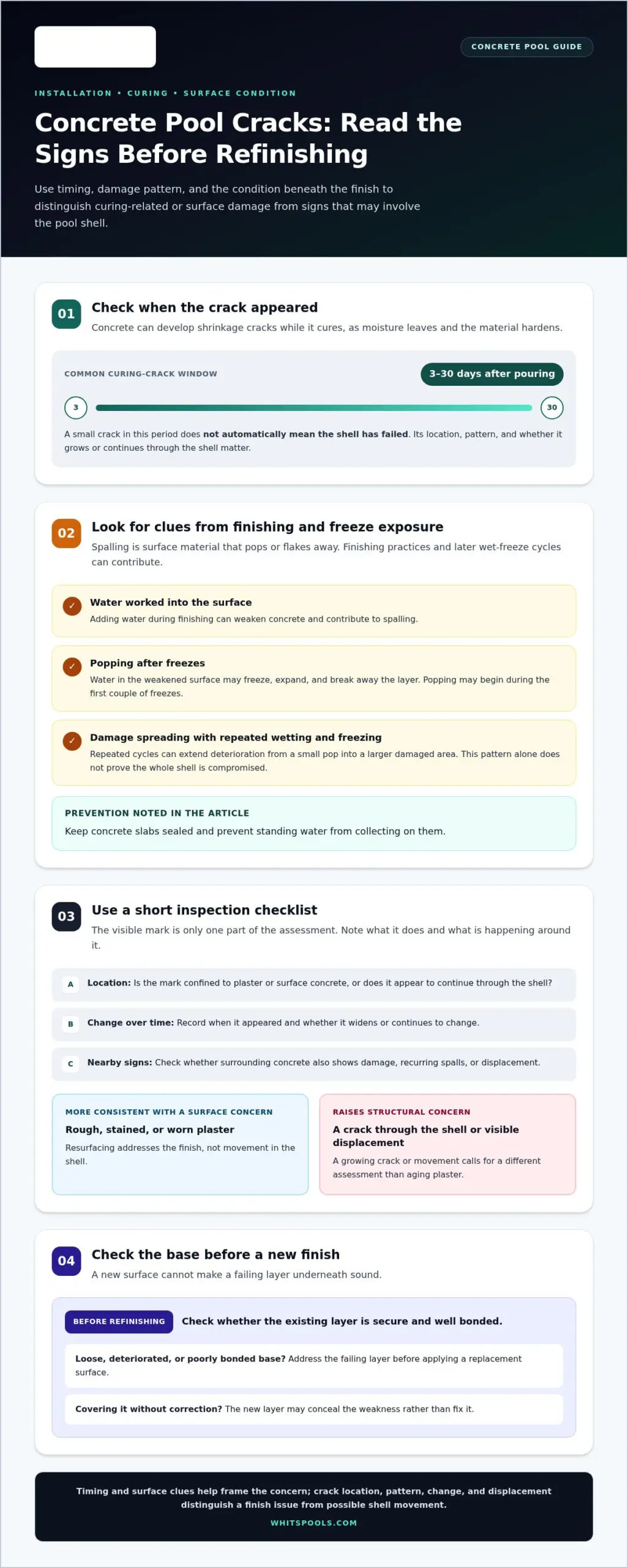
Concrete develops shrinkage cracks as it cures, commonly 3 to 30 days after pouring. As moisture leaves and the material hardens, the concrete changes slightly in volume. A small crack during this period doesn’t automatically mean the pool shell has failed. Its location, pattern, and whether it widens or continues through the shell help distinguish curing-related cracking from more serious movement.
Installation conditions can affect the finished surface, too. Adding water to concrete during finishing can weaken it and contribute to spalling, when pieces pop or flake away. Water worked into the surface may later freeze, expand, and break away the weakened layer. Repeated wetting and freezing can extend the damage, turning a small pop into a larger area of deterioration.
Timing matters. Concrete weakened by spalling may begin popping during the first couple of freezes after surface water was worked into it during finishing. That pattern points to a surface weakened during placement, rather than proving that the entire pool shell is structurally compromised. Keep concrete slabs sealed as a preventive measure and prevent standing water from collecting on them.
Pool interiors need careful preparation before refinishing. Installing a new surface over an older, failing layer is inadvisable because the new layer is only as strong as the material beneath it. If the base is loose, deteriorated, or poorly bonded, covering it can conceal the weakness without correcting it. Address the failing layer before applying a replacement surface.
Look at the damage in context. A fine crack that appears during the 3-to-30-day curing period differs from a growing crack accompanied by displacement or recurring spalls. Note when the crack first appeared, whether it changes, and whether nearby concrete also shows damage. Those observations help clarify whether the concern is limited to the surface or involves movement in the structure.
Practical prevention starts during placement and continues afterward. Avoid adding water to the concrete surface during finishing, protect slabs from excess water, and maintain the seal. If freezing follows wet finishing, watch for new pops across the affected area. These steps address conditions associated with spalling; they don’t replace assessment of a crack that crosses the pool shell.
For a planned build, sound custom concrete pool construction brings installation decisions into focus before concrete is placed. For an existing pool, the key is to identify whether the visible issue is curing-related, surface deterioration, or evidence of continuing structural movement. The repair approach depends on that distinction.
3. Coping movement and bond shear
Coping forms the edge around a pool, where the deck meets the pool wall. If the concrete deck is not isolated from the coping, horizontal deck movement can transfer force to the top of the wall and cause cracking. The connection matters: movement in one adjoining surface can stress another.
Bond shear describes force acting along a bonded interface, rather than pulling directly away from it. At a pool edge, stress along bonded materials can contribute to bond failure, including tile problems. A crack near the coping or loose tile may therefore call for attention to both the visible finish and the connected surfaces. Appearance alone doesn’t show what moved first.
For example, imagine a deck section shifting outward while its edge remains tightly connected to the coping. That horizontal force can transfer to the upper edge of the pool wall. A resulting crack near the top of the wall may appear close to the coping, even though deck movement contributed to the stress. Examining only the crack line can miss how the surfaces relate.
Look at the pool edge as a connected assembly. Note whether the crack follows the wall near the coping, whether coping pieces have shifted, and whether nearby deck sections show movement. Also observe whether tiles near the edge are loose or separated. These clues help describe the pattern, but they do not establish the underlying cause on their own.
A useful first step is to record where each visible change begins and ends. Photograph the same area from consistent angles, and note whether the crack crosses the coping, follows the wall, or appears only in the deck. Compare your observations over time. A changing pattern can help distinguish ongoing movement from a stable surface mark.
Repairs should address the connection causing the stress, not just conceal the visible result. Filling a wall crack or resetting a loose tile without accounting for deck movement may leave the force pathway unchanged. The right approach depends on whether the deck is transferring movement, a bond has failed, or both conditions are present. Treating each symptom as an isolated defect can lead to recurring damage.
During pool construction, consider the deck-to-coping relationship before finishing the surrounding concrete. An isolated deck can move horizontally without transferring that movement directly to the pool wall. For an existing pool, document a crack beside the coping, shifted edge material, and loose waterline tile together. Their alignment can help clarify how movement travels through the pool edge.
4. Expansion joints and mastic sealer
A concrete pool deck expands in heat and contracts as temperatures fall. Across a 100-linear-foot deck, this movement may reach up to 3/4 inch with temperature changes. If the deck presses directly against the pool coping, that horizontal force can travel toward the pool wall. An expansion joint creates separation, while mastic sealer fills the joint and accommodates movement. Together, they can help prevent deck movement from cracking the wall’s top.
The joint matters because a long deck behaves as a connected concrete surface. As its temperature changes, the deck’s edges can press or pull against nearby materials. Without room for that movement, the coping may become the transfer point between deck and pool wall. A visible crack near the coping may therefore relate to how the deck and pool edge meet, not just to the wall material.
Mastic sealer sits within the expansion joint, helping preserve separation between the deck and coping. The joint should remain a visible gap, rather than being bridged by rigid concrete or other hard material. For example, if concrete or patching material spans the joint, it can restrict movement and create a direct path for stress to reach the pool wall.
Inspect the pool perimeter for changes along the joint. Look for gaps where the sealer has pulled away, areas where it is missing, or sections where concrete appears to bridge the separation. Compare those locations with cracks in the coping or at the top of the pool wall. A crack following the deck edge may offer a clue about where movement is concentrating.
One location alone doesn’t tell the whole story. Check whether the joint’s condition and nearby cracking continue along the same stretch or appear only at a distinct point. Note changes over time and photograph the same area for comparison. If the deck shifts while the wall crack grows, those observations together describe the problem more clearly than either symptom alone.
During construction, the expansion joint and mastic sealer should be treated as functional parts of the pool edge. They aren’t merely decorative lines. The joint gives the deck room to move; the sealer fills that separation without making the deck rigidly continuous with the coping. The 100-linear-foot example shows why even modest temperature changes matter across an extended concrete surface.
For an existing pool, don’t treat a crack at the deck edge as an isolated surface blemish before examining the joint. A repair that covers the crack but leaves restricted movement in place may not address the force affecting the wall. Consider the joint, sealer, deck, coping, and wall as connected parts, then match the repair to the movement pattern.
5. High groundwater and drainage
Groundwater beneath a pool can create upward pressure against its concrete shell. If water accumulates below the structure, the pressure may push the shell upward, especially when the pool is drained or contains little water. That movement can affect the shell and nearby surfaces. Drainage planning should account for where groundwater collects, not just where rainwater appears above ground.
A high water table calls for a way to manage water beneath the pool. A well pit or sump pump can collect and remove groundwater under the structure. Their purpose is practical: reduce water buildup below the pool, where pressure can act against the shell. Site drainage conditions help determine whether this approach is appropriate.
Surface water matters, too. Rooflines can discharge water near a concrete slab, allowing runoff to collect beside the pool. Plastic laid over concrete can also hold water against the slab instead of allowing it to drain away. Keep water off concrete surfaces and consider where roof runoff travels after rain. A puddle that repeatedly forms beside one edge signals a drainage route worth examining.
Trace water movement around the pool before deciding where it gathers. Observe the area after rainfall, note whether roof runoff crosses the deck, and look for water trapped between plastic and concrete. These observations connect a visible wet area with a possible source. Water collecting below the shell requires attention different from water resting on the deck.
High groundwater also changes the risk of draining a pool. Removing the water inside reduces the shell’s downward load, while groundwater continues to press upward. A hydrostatic valve should be installed and maintained to help prevent a concrete shell from floating. A well pit or sump pump addresses water below the pool; maintaining the valve is another part of protecting the shell.
In practice, separate three questions: where does water come from, where does it collect, and can it reach beneath the pool? For example, roof runoff may explain a wet deck edge, while persistent groundwater beneath the structure points to a different drainage concern. Consider the drainage route and the shell together, rather than treating every puddle as evidence of a shell problem.
For a new pool, plan drainage alongside the pool structure, including roof runoff and the site’s groundwater conditions. If you’re planning a custom concrete pool, discuss how the design accounts for water beneath and around the shell. For an existing pool, visible water patterns can help clarify whether the concern lies at the surface or below ground.
White’s Pools: Custom Concrete Pools
White’s Pools designs and builds custom concrete pools for homeowners planning a pool around their property and outdoor vision. If you’re considering a new build, the earlier discussion of soil, groundwater, coping, and deck movement can help guide your design questions. Site conditions and the relationship between the pool shell and surrounding concrete are important parts of planning.
For an existing pool, Pool Cleaning & Maintenance supports ongoing water quality and equipment performance, while visible shell movement or structural cracking calls for attention to the specific condition. White’s Pools can help you plan a custom concrete pool with these construction considerations in mind. Contact White’s Pools to discuss your pool project.
Plan Your Pool’s Next Chapter
Understanding common concrete pool problems gives you a stronger starting point for deciding what you want from your pool next. Think beyond the immediate concern: consider how you use the space, what upkeep suits your routine, and what you’d want a future design to include. A clear picture of your priorities can make the next conversation more focused.
White’s Pools offers custom concrete pools for homeowners planning a new build, along with Pool Cleaning & Maintenance for ongoing care. Share what you’ve noticed and what you hope to achieve, whether you’re planning a pool or supporting its continued upkeep. The right next step begins with a thoughtful discussion of your goals.
Contact White’s Pools to discuss your pool plans, and take a confident step toward an outdoor space you’ll enjoy.
Frequently Asked Questions
What are the most common problems with concrete swimming pools?
Common concrete pool problems owners often notice include worn or rough plaster, discoloration, surface spalling, loose tile, cracks, and leaks. These symptoms don’t all point to the same issue. For example, a rough finish can reflect surface wear, while water loss alongside a changing crack may call for a closer look at the shell or plumbing. Note where each symptom appears and whether it changes.
Why do concrete pool shells crack, and which cracks are serious?
Concrete can develop shrinkage cracks as it cures, typically 3 to 30 days after pouring. Cracks that reach the pool shell are different from marks limited to plaster. Pay attention to a crack that widens, crosses connected surfaces, or appears alongside visible displacement. Record its location and appearance over time; those details help distinguish a surface concern from a potential structural problem.
What causes concrete pool tile and coping to crack or come loose?
Tile failures can result from poor installation practices or bond shear, which stresses the bonded interface. Coping can also be affected when deck movement transfers horizontal force to the pool wall. Look for loose or cracked tiles concentrated near the pool edge, and note whether nearby coping or deck sections have shifted. The pattern can help show whether the issue is isolated to tile or involves connected surfaces.
How long do concrete pool plaster and other finishes typically last?
Concrete pool plaster typically needs replastering every 10-15 years, while properly installed swimming pool tile can last 20 years or more. These finishes have different roles and lifespans, so tile durability shouldn’t be used to estimate plaster condition. Roughness, spalling, or discoloration can signal that the interior surface needs attention. Track when changes appear and how they spread across the pool.
How much does it cost to repair common concrete pool problems in the United States?
Costs depend on the damage, site conditions, and repair scope.

