
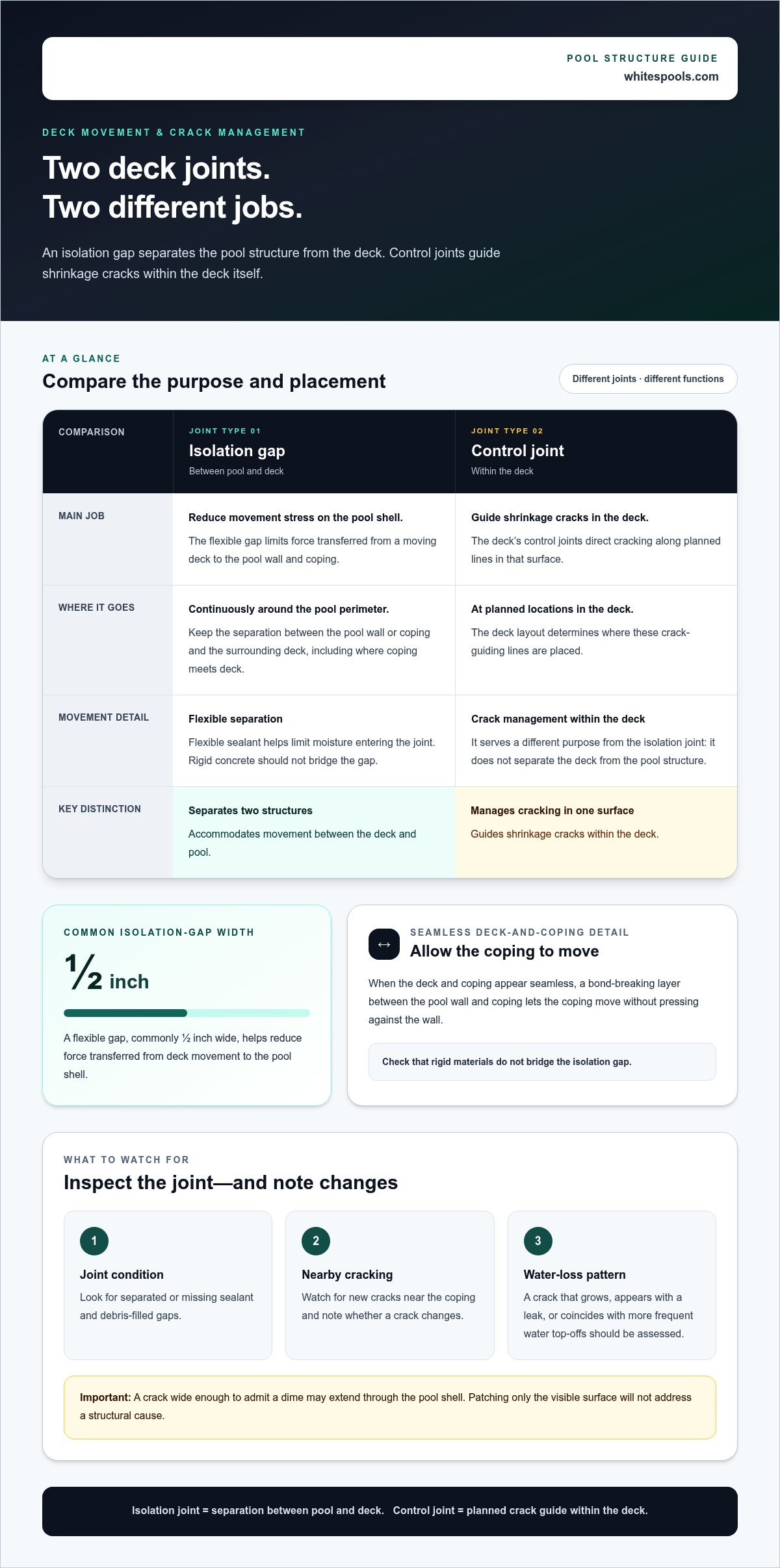
A pool crack often starts long before it becomes visible. Preventing cracks in concrete pools means managing the stresses that build during curing and as soil shifts, temperatures change, and the shell ages under chemical and water exposure. A flexible gap, commonly 1/2 inch wide, can separate the pool wall and coping from the surrounding deck, helping reduce the force transferred between them.
If you’re concerned about a crack, it’s natural to wonder whether it signals a deeper problem or could be prevented with better care. The cause matters: shrinkage during curing calls for a different response than soil movement or gradual wear from pool water and chemicals.
This article explains how curing practices, ground conditions, aging, water chemistry, and deck movement can contribute to cracks. You’ll also learn what signs to watch for and why identifying the underlying cause is important to protecting a concrete pool over time.
Key Takeaways
- Cracks can stem from curing shrinkage, temperature changes, shifting soil, or long-term exposure to pool chemicals and water; the cause shapes what needs attention.
- Proper curing helps limit shrinkage stress. Concrete pool shells should cure for at least 14 days before plastering.
- A flexible 1/2-inch gap can help separate the pool wall and coping from the deck, reducing stress as the deck moves.
- Ground conditions matter: expansive or poorly compacted soil can shift beneath a pool and put stress on its shell.
- Watch for new cracks and changes in how often you top off the water; identifying the underlying cause can help prevent further damage.
Flexible isolation gap between pool walls and deck
A concrete pool and its surrounding deck respond differently to temperature and moisture changes. A flexible isolation gap separates the pool wall and coping from the deck, reducing the force that deck movement can transfer to the shell. This joint is commonly 1/2 inch wide. Flexible sealant helps limit moisture entering the joint, where water can contribute to further damage.
Keep the joint continuous around the pool perimeter, including where the coping meets the deck. In a seamless deck-and-coping installation, a bond-breaking layer between the pool wall and coping lets the coping move without pressing against the wall. Control joints serve a different purpose: they guide shrinkage cracks in the deck along planned lines. The isolation joint separates the deck from the pool structure, so rigid concrete should not bridge it.
How should control joints and expansion joints be placed in a concrete pool? Place control joints in the deck to manage cracking within that surface, and use a flexible isolation gap between the deck and pool wall or coping. The gap is commonly 1/2 inch wide, while the deck layout determines control-joint locations.
How much does it cost to prevent or repair cracks in a concrete pool in the United States? Costs depend on the crack’s cause, location, extent, access, and whether the repair involves patching, structural work, or restoring a finish. The price varies by project and is provided after a quote request.
What are acceptable crack widths in concrete pools, and when do they need repair? A crack wide enough to admit a dime may extend through the pool shell. Have a crack assessed if it grows, appears alongside a leak, or coincides with more frequent water top-offs.
Ask about how the design defines the isolation joint, sealant, and deck-to-coping detail. Clarify how it keeps rigid materials from bridging the gap. For example, if the coping and deck are designed to look seamless, ask where the bond-breaking element sits. These details show how the joint accommodates movement instead of concealing a direct connection between surfaces.
Include the deck joint in regular pool inspections and maintenance. Look for separated or missing sealant, debris-filled gaps, and new cracks near the coping. Repairing damaged sealant helps keep water out of the joints, while prompt attention to a changing crack can help limit further damage. Patching only the visible surface won’t address a structural cause.
Take extra care before draining a swimming pool. Groundwater can cause a concrete pool to float when water no longer holds the shell down, so seek professional assistance with draining. If a structural crack appears, or water loss changes after draining, a professional assessment can help distinguish surface damage from movement or shell failure.
What causes concrete pools to crack?
Cracks form when stress exceeds the concrete pool shell’s ability to resist movement or deterioration. Extreme temperature changes, curing conditions, ground shifts, and construction details can all contribute to that stress.
General Causes of Pool Cracks
A pool crack is a visible break in concrete caused by stress, material change, or movement. Identifying its likely cause matters because patching the surface may not resolve stress within the shell. For example, a crack linked to ground movement needs a different response from one caused by shrinkage during curing. Preventing cracks in concrete pools starts with understanding these different sources of stress.
Temperature is one source of movement: concrete expands and contracts as conditions change. Pool shape can affect where that stress concentrates. A 90-degree corner is identified as a structurally weak feature, where stress may focus instead of distributing evenly. Wall thickness also matters; walls 6 inches or thinner can raise concerns about shell strength and construction quality.
Assess the crack’s location and pattern alongside visible changes around the pool. A crack near a corner, for instance, may reflect a concentrated stress point, while movement across the pool may suggest a broader structural cause. These clues can help distinguish a surface issue from potential shell failure, but appearance alone doesn’t establish the cause. Note whether the crack changes, and record nearby ground or water changes.
Common Causes of Structural Cracks
A structural crack affects the pool shell’s integrity, not just its finish. Its cause matters because ongoing movement or a construction weakness can continue to stress the shell after patching. Structural cracks can result from poor construction or engineering, ground movement, groundwater, poorly compacted soil, and freezing and thawing.
Site conditions add complexity. Expansive soils can change with moisture, while flood plains, uncompacted ground, or different soil materials beneath one pool can contribute to uneven support. When parts of the ground settle or shift differently, the shell experiences uneven stress. That differential movement can produce cracks even when the visible surface initially appears intact.
Engineering and site evaluation help match structural design to ground conditions. Soil samples and site inspections give an engineer information about the ground supporting the pool, allowing the structural design to account for those conditions. This matters where soil varies across the site or groundwater affects the excavation. Rather than treating every crack as a finishing defect, consider whether ground movement or construction could be driving it.
Keep a record of where cracks appear and whether they change, then compare those observations with nearby ground movement or water changes. That information can help a pool repair professional assess potential structural causes. For a new project, concrete pool construction allows design decisions to address site conditions and shell strength. These considerations are central to preventing cracks in concrete pools over time.
Shrinkage cracks and curing practices
As concrete hardens, moisture loss and shrinkage can create stress inside a pool shell. Curing keeps moisture available as the cement develops strength, helping reduce early cracking before plastering or other finishes begin.
Concrete Curing and Moisture
Curing is the controlled retention of moisture in fresh concrete while it gains strength. For a concrete pool shell, that process matters because rapid drying can increase shrinkage stress and surface cracks. Keep the concrete moist during curing for at least 14 days, and allow the shell to cure for at least 14 days before plastering. Some shells are cured for 28 days before plastering.
Hot weather calls for particular care: a gunite or shotcrete pool should be half filled with water, with its surfaces kept wet. That moisture helps limit rapid drying during early curing. Follow the planned curing sequence before applying plaster rather than treating a dry surface as ready for finishing.
Mix Design and Concrete Additives
Mix design sets the proportions and strength of concrete used in the pool shell. It matters because cement, water, and aggregate proportions affect the material’s ability to resist stress. A 4-to-1 sand-to-cement mix is described as stronger than a 5-to-1 mix. The stated minimum compressive strength is 4,000 psi, rising to 5,000 psi in salt environments or where high sulfates are present.
What concrete mix, water-cement ratio, and additives are best for pool construction? Use a mix designed for the pool’s structural demands and exposure; the stated strength targets are 4,000 psi, or 5,000 psi in salt environments or where high sulfates are present. The facts here give no specific water-cement ratio or additive recipe, so don’t add water or admixtures outside the designed mix.
What building codes and engineering standards apply to concrete pool construction in the United States? ANSI/APSP/ICC-5 2011 (R2022) is identified as a standard reference; ACI 318 and ACI 350 are cited with a 0.18-0.20% steel-to-concrete ratio recommendation, while ACI 224R-01 suggests exceeding 0.60% for better crack control.
Temperature and Weather Precautions
Temperature and weather precautions manage how quickly fresh concrete loses moisture. Extreme temperature changes can make concrete expand and contract, while hot-weather drying adds curing stress. Keep gunite or shotcrete surfaces wet and the pool half filled during hot-weather curing, then maintain moisture for at least 14 days.
What temperature and weather precautions reduce cracking during pool construction? In hot weather, keep the surfaces wet and the pool half filled during curing; avoid letting the shell dry rapidly. Concrete pool shells should cure for at least 14 days before plastering, with 28 days used in some cases.
For pool deck repairs, remove loose material before applying crack filler. Let the filler cure for 24 hours before sealing the filled area. That sequence gives the repair time to set before the sealer covers it, helping limit further moisture entry.
Soil stability and differential settlement
A concrete pool depends on consistent support beneath its shell. Soil samples and site inspections can reveal ground conditions that influence structural design and construction.
Ground Movement and Soil Compaction
Ground movement occurs when soil shifts, compresses, or changes with moisture beneath a structure. Poorly compacted soil can leave parts of a pool shell less supported, while expansive soils can change volume as conditions change. Both can affect how evenly the ground carries the pool. Before construction, soil samples and site inspections help identify conditions that should inform the structural design.
Site conditions can vary across the same property. One area, for example, may contain compacted soil while another includes fill or different soil materials. That contrast can create uneven support beneath the shell as the ground settles. Flood plains and groundwater also matter because they influence conditions around the excavation. A site assessment helps account for these differences instead of assuming the entire pool area behaves alike.
Compaction matters because loose or uneven ground can compress under the pool’s weight. During construction, consider the excavation and prepared base as part of the whole support system, not merely a level surface. If a pool sits partly on firm natural ground and partly on less stable fill, differences in support can cause movement. The structural design must suit the actual site conditions.
Soil Movement and Structural Stress
Soil movement creates structural stress when the pool shell is unevenly supported or shifts with the ground. If one section settles while the next remains stable, for example, the shell can bend under the difference. That uneven loading may appear as a crack, even though the visible damage is in the concrete. Identifying the movement matters because patching the surface alone won’t correct the underlying support problem.
Expansive soils, poorly compacted ground, groundwater, and freezing and thawing can all contribute to structural cracks. A crack near a location where the ground has settled may have a different cause from one associated with seasonal soil movement. The pattern and location are clues, not proof. Compare the crack with changes around the pool, such as ground displacement or drainage changes.
An engineer can design the pool’s structural elements and use soil samples and site inspections to assess local conditions. This information helps match the shell design to the supporting ground. Soil differences may also affect decisions about shell thickness and reinforcement, because the structure must resist the stresses expected at the site. Good construction planning begins with understanding the ground, not just selecting a concrete application.
For an existing pool, record where cracks appear and note visible ground changes nearby. If a crack changes alongside settlement, document both before repairs. A professional assessment can relate those observations to site conditions and help distinguish a surface issue from movement beneath the pool. Addressing the source of stress is central to limiting further damage.
Effects of aging, chemicals, and water exposure
Over time, water and pool chemicals can degrade a concrete shell’s integrity. Damage may develop gradually, so a new surface crack isn’t the only sign to watch for. Changes in water loss, visible deterioration, or recurring repairs can help you spot a problem earlier. Consider how long-term exposure affects both the finish and the structure beneath it.
Water can contribute to erosion and leaching in concrete, while damage to protective layers may expose reinforcing steel to pool water. A waterproofing system can help protect the shell from these effects and limit steel exposure. Its role is to reduce water-related deterioration, not to correct ground movement, poor construction, or another cause of structural stress.
Chemical exposure also matters over a pool’s life. Pool water that repeatedly contacts concrete can contribute to gradual wear, especially where the surface is already damaged. Keep a record of changes made during routine water care, and note whether deterioration appears near fittings, steps, or areas with persistent moisture. These details can help distinguish a localized surface concern from a wider pattern.
Regular inspections provide a practical way to track changes. During routine maintenance, look for new cracks, damaged finishes, and areas where water appears to be escaping. Compare observations over time rather than relying on memory. If the pool needs topping off more often than usual, record that change: a structural crack can cause a leak, and increased topping-off may occur before the crack becomes visible.
If you notice a crack, document its location and appearance, then identify its likely cause before patching. A surface repair may not address water-related erosion or movement within the shell. If the crack grows, appears alongside a leak, or returns after repairs, consult a pool repair professional. An engineer’s assessment can help evaluate structural stress when the pattern suggests movement or shell damage.
During installation, a waterproofing approach can form part of a broader plan for protecting a concrete pool from ongoing water exposure. For an existing pool, timely inspection and maintenance help identify deterioration before further damage develops. White’s Pools’ pool design and construction services are a relevant next step when planning a concrete pool with long-term water exposure in mind.
White’s Pools: Custom Concrete Pools
White’s Pools designs and builds Custom Concrete Pools for homeowners planning a pool shaped around their property and vision. If you’re considering a new concrete pool, the causes discussed above can guide conversations about site conditions, shell design, curing, and long-term water exposure. For an existing pool, Pool Cleaning & Maintenance supports ongoing water quality and equipment performance, while regular inspections help you notice changes that may need professional assessment. Thoughtful planning and consistent care each play a role in managing the factors that affect a pool over time. Contact White’s Pools to discuss your pool project or maintenance needs.
Plan for a Pool Built Around Your Next Chapter
Start with a clear conversation about how you want to use your outdoor space. Whether you’re planning a new pool or caring for one you already own, preventing cracks in concrete pools can guide thoughtful decisions about design and ongoing care. Bring your priorities, questions, and any concerns about your pool’s condition to the discussion.
White’s Pools offers Custom Concrete Pools and Pool Cleaning & Maintenance, helping homeowners plan a new project and continue caring for an existing pool. For a broader outdoor living plan, Outdoor Fireplaces can complement a poolside setting. Choose features that suit how you want to spend time at home, then move forward with a plan that fits your property.
Contact White’s Pools for pool advice and take the next step toward a thoughtfully planned outdoor space.
Frequently Asked Questions
Why does this happen?
Concrete cracks when stress within the shell exceeds what the material can accommodate. Shrinkage as concrete dries, temperature changes, shifting support, and long-term water or chemical exposure can all contribute. For example, a crack that returns after patching may indicate that the repair covered the surface without addressing movement or deterioration beneath it. Tracking when a crack appears and what changes nearby can help clarify its likely cause.
What causes cracks in concrete swimming pools?
Cracks in concrete swimming pools can result from construction or engineering problems, ground movement, groundwater, poorly compacted soil, freezing and thawing, and concrete shrinkage. Temperature changes can also create expansion and contraction stresses. A crack near a corner or alongside a change in the surrounding ground provides useful context, but its appearance alone doesn’t prove the cause. Note changes in water loss or nearby soil and share those observations during an assessment.
How should a concrete pool shell be designed and reinforced to prevent cracking?
A concrete pool shell should be engineered for its site and reinforced to manage structural stress. Reinforcing bars in inground concrete pools are commonly spaced 12 to 16 inches apart, with rebar raised 3 inches off the floor so the steel cures within the concrete shell. ACI 318 and ACI 350 are cited with a 0.18-0.20% steel-to-concrete ratio, while ACI 224R-01 suggests exceeding 0.60% for better crack control.
How do curing methods and timing affect cracking in concrete pools?
Curing controls moisture loss while concrete gains strength, so rapid drying can raise shrinkage stress. Keep the concrete moist for at least 14 days, and allow the shell to cure for at least 14 days before plastering. Some shells are cured for 28 days before plastering. During hot-weather curing, a gunite or shotcrete pool should be half filled with water, with its surfaces kept wet.
How can soil testing, drainage, and groundwater control prevent pool cracks?
Soil samples and site inspections help engineers understand ground conditions before designing a pool shell. Expansive soils, flood plains, different soil materials, and uncompacted ground can affect support and contribute to cracking. Groundwater also matters because it can influence conditions around the excavation and shell. For example, a site with differing soil layers needs design attention to those conditions, rather than the assumption that support is uniform across the pool footprint.
How does proper excavation and backfill prevent concrete pool movement and cracking?
Careful excavation and backfill help create consistent support around and beneath a concrete pool. Poorly compacted soil can settle, leaving parts of the shell supported differently and creating structural stress. Consider the excavation, existing ground, and backfill materials together during site planning. Where fill meets natural soil, that transition deserves attention because differential movement can stress the concrete shell.
What construction steps help prevent shrinkage cracks in shotcrete or gunite pools?
For shotcrete or gunite pools, use a designed mix, controlled application, and consistent curing. The shotcrete design mix minimum compressive strength is 4,000 psi. ACI 318, Section 26.13.3.2 is cited regarding continuous inspection during shotcrete installation. After application, maintaining moisture for at least 14 days helps manage drying; in hot weather, keep surfaces wet and the pool half filled during curing.

