
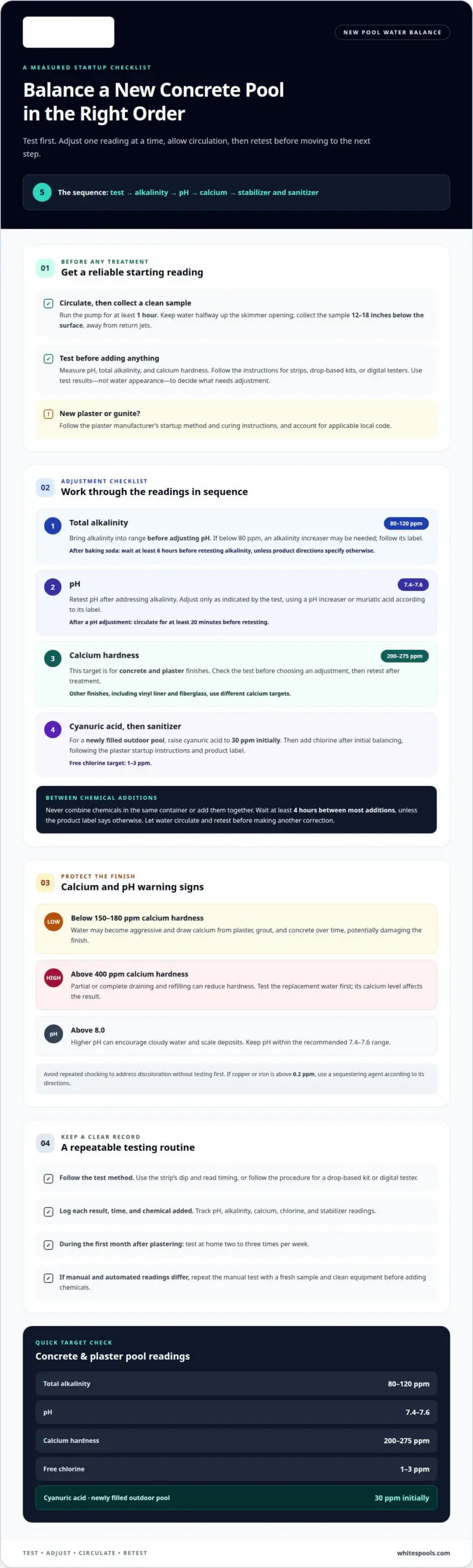
The order matters: adding every treatment at once makes it harder to correct a new pool’s water accurately. To learn how to balance chemicals in a new concrete pool, start with total alkalinity, then adjust pH and calcium hardness before setting cyanuric acid and sanitizer levels. For concrete and plaster, aim for calcium hardness of 200-275 ppm; for a newly filled outdoor pool, raise cyanuric acid to 30 ppm initially.
It’s understandable to focus first on chlorine, but other readings also help establish balanced water. This guide explains how to test a fresh fill, what to adjust first, and how to manage calcium hardness and cyanuric acid.
You’ll also find target ranges and learn why outdoor pools need a different stabilizer step from indoor pools. Follow the sequence and retest as the water circulates. Make measured adjustments instead of adding several chemicals at once.
Key Takeaways
- Adjust water chemistry in sequence, giving each treatment time to circulate before retesting.
- Use a reliable water sample and testing method to guide adjustments instead of relying on appearance alone.
- Keep calcium hardness suited to a concrete or plaster finish to help protect the pool surface.
- For an outdoor pool, account for cyanuric acid as you establish and maintain effective chlorine protection.
In what order should you balance your pool chemicals?
Start with a water test, then correct total alkalinity before adjusting pH. For a new plaster or gunite pool, follow the finish instructions while establishing balanced water.
Check pH, Alkalinity, and Calcium
- Test pH, total alkalinity, and calcium before adding treatment. Use the results to identify which readings need adjustment, rather than adding chemicals by guesswork. For a new plaster or gunite pool, the startup sequence is to fill and circulate the water, test it, then adjust alkalinity, pH, calcium, and sanitizer in order. Follow the plaster manufacturer’s startup method and account for applicable local code; this sequence is general water-balancing guidance.
Adjust Total Alkalinity First
- Bring total alkalinity into its recommended range before changing pH. Pool water’s recommended total alkalinity range is 80-120 ppm. If it’s below 80 ppm, an alkalinity increaser may be needed; add it according to its label. Allow circulation before retesting. After adding baking soda, wait at least six hours before retesting alkalinity; product directions take precedence if they specify otherwise.
- Never combine chemicals in the same container or add them together. Wait at least four hours between most chemical additions unless the product label says otherwise. Chemical costs depend on pool volume and required corrections. Professional startup pricing depends on the pool and work scope, and is provided after a quote request.
Adjust pH After Alkalinity
- Retest pH after addressing alkalinity, then adjust toward 7.4-7.6. Use a pH increaser or muriatic acid only as indicated by the water test and product label. Circulate the water for at least 20 minutes after a pH adjustment before retesting. Don’t use cloudy water alone to judge whether the chemistry is balanced.
- Check calcium before choosing any calcium adjustment. Add chlorine after initial balancing, following the plaster startup instructions and product label. Test for metals, too: if copper or iron is above 0.2 ppm, use a sequestering agent according to its directions.
Calcium hardness targets for concrete and plaster pools
Match calcium hardness to the concrete or plaster finish to help protect the surface. Balance it alongside pH, alkalinity, and chlorine to maintain stable water chemistry.
-
Identify Calcium Hardness Targets
Test calcium hardness and compare the result with the concrete and plaster target of 200-275 ppm. This range is specific to these finishes; vinyl liner and fiberglass pools use different targets. A new pool’s full water targets are pH 7.4-7.6, total alkalinity 80-120 ppm, calcium hardness 200-275 ppm, and free chlorine 1-3 ppm, according to the CDC. Use the finish type to guide your calcium reading.
-
Adjust Calcium Hardness
Raise calcium hardness if testing shows a level below the target, and follow the product label for dosing and application. Water below 150-180 ppm may become aggressive, drawing calcium from plaster, grout, and concrete over time. That can damage the finish. Retest after treatment before making another adjustment; adding more than the test indicates can push hardness too high.
If calcium hardness exceeds 400 ppm, partial or complete draining and refilling can reduce it. The amount of replacement water depends on the test result and source-water calcium. Test replacement water before refilling, then retest the pool after circulation. This avoids correcting a high reading with water that also has elevated calcium.
-
Protect the Surface Through Balanced Water
Maintain the recommended calcium range and keep pH within 7.4-7.6. Calcium below the target can draw minerals from plaster; pH above 8.0 can encourage cloudy water and scale deposits. Avoid trying to fix discoloration by shocking repeatedly without first testing. A water test helps distinguish a chemistry imbalance from a surface concern, while balanced levels support the finish.
For a concrete pool planned around its finish and long-term water care, explore custom concrete pool design.
Testing pool water with strips, kits, and digital testers
Test the water before adding treatment. Use a clean sample and a method suited to each reading, and record the results so every adjustment responds to measured pool chemistry.
-
Prepare Water and Testing Equipment
Run the pump for at least one hour before collecting a sample, and make sure water reaches halfway up the skimmer opening. Collect water 12 to 18 inches below the surface, away from return jets. For a newly plastered pool, follow the plaster manufacturer’s startup instructions for the required curing period before filling; the finish determines the procedure.
-
Test Water Before Adding Chemicals
Take a water test before adding chemicals, then measure pH, total alkalinity, and calcium. Follow the test-strip package instructions for how long to dip the strip and when to read it. A drop-based kit or digital tester can provide readings through its own procedure, so follow its instructions. Don’t add treatment based only on cloudy water or appearance.
-
Document Water Chemistry Results
Record each test result, the time, and any chemical added. During the first month after plastering, test the water at home two to three times per week. Log pH, alkalinity, calcium, chlorine, and stabilizer readings. Dated records help show how levels change after treatment or when fresh water enters the pool.
-
Use Manual Tests or Automated Controllers
Use manual tests to measure the parameters your equipment displays or does not monitor, and record the results with the date. An automated controller can track the readings it monitors, while a separate test offers a useful comparison. If the readings differ, repeat the manual test with a fresh sample and clean equipment before adding chemicals.
Keep halfway skimmer level before testing; retest after 8 hours pump run time. Health departments typically require manual tests once a day. Free available chlorine 0.3 ppm or lower than total available chlorine: likely chloramines.
Cyanuric acid use in outdoor pools
Outdoor pools need cyanuric acid to help shield chlorine from sunlight. For a new outdoor fill, establish stabilizer as part of balancing the water, after testing the other key readings.
- Test cyanuric acid before adding stabilizer. Newly filled pools usually start at 0 ppm, so an initial target of 30 ppm gives outdoor chlorine protection. Test the fill water first, since its starting level determines how much stabilizer the pool needs.
- Calculate the pool volume before measuring a dose. For 10,000 gallons, the guide’s dose is 3 pounds of stabilizer; use the product label to confirm application and handling instructions. Pool volume matters because the same amount produces a different concentration in a smaller or larger pool.
- Add stabilizer carefully, following the product label for dissolving and circulating it. Don’t add a full dose if the water already contains cyanuric acid. Retest after treatment: excess stabilizer can make chlorine harder to manage and may require water replacement to lower it.
- Continue testing cyanuric acid as you maintain chlorine levels. Chlorine tablets can also add stabilizer, so repeated use may gradually increase the reading. Track stabilizer alongside chlorine, pH, and calcium hardness. Balanced water in a plaster pool depends on the full set of readings, not chlorine alone.
- Keep the pool type in mind: indoor pools and spas should not use stabilizer or stabilized chlorine. For a new outdoor concrete pool, plan water care around its finish and exposure to sunlight. To discuss an outdoor pool project, talk with White’s Pools.
Recommendations vary by pool type and guidance: outdoor commercial pools generally target cyanuric acid levels of 20-40 ppm, while another recommendation places a pool’s level at 35 to 60 ppm except for saltwater pools. Pool chlorine stabilizer, or cyanuric acid, should be between 30 and 50 parts per million. For chlorine pools, the page says to start with at least 10 ppm of cyanuric acid.
Saltwater pools have a recommended cyanuric acid level of 60 to 80 ppm. Levels above 40 ppm are identified as excessive and may require partial water replacement. These ranges are not interchangeable targets, so use guidance that fits the pool and its chlorine system, and keep testing to avoid excessive stabilizer. Indoor pools and spas should not use stabilizer or stabilized chlorine.
White’s Pools: Custom Concrete Pools
White’s Pools designs and builds custom concrete pools shaped around each property and the homeowner’s vision. Once the pool is in use, professional cleaning and maintenance help support water quality and equipment performance, keeping routine care on track.
If you’re planning a new concrete pool or need help maintaining pool water and equipment, White’s Pools can help. Share your project goals or maintenance needs to discuss the right fit.
Contact White’s Pools to talk about your pool project or maintenance needs.
Make pool care part of the plan
Knowing how to balance chemicals in a new concrete pool is a strong start, but water care continues as the pool is used and fresh water is added. Make testing and recording results part of your routine. Clear records help you spot changes and make measured adjustments instead of reacting to appearance alone.
Pool design also shapes how the surrounding space works for your household. White’s Pools offers outdoor fireplaces to complement a pool and create a considered outdoor setting. If you’re planning a project or need support with pool care, connect with the team to discuss the next step.
Contact White’s Pools for pool help, and move forward with a clear plan for your space and its ongoing care.
Frequently Asked Questions
What are some common pool water balancing problems?
Common problems include pH or alkalinity readings outside their target ranges, low calcium hardness, cloudy water, and scale deposits. When learning how to balance chemicals in a new concrete pool, treat these symptoms as prompts to test the water, not as reasons to add chemicals by guesswork. High pH can slow chlorine’s sanitizing action, while low calcium hardness can draw calcium from plaster and grout.
How should pH and total alkalinity be adjusted in a new concrete pool?
A practical approach to how to balance chemicals in a new concrete pool is to test both readings, correct total alkalinity first, then adjust pH based on the new results. Make one adjustment at a time and follow the product label rather than estimating a dose. If you add water during startup, test again because fresh water can change the pool’s chemistry.
How do you raise calcium hardness in a new plaster pool, and what target level is recommended?
For a plaster pool, the recommended calcium hardness target is 200-275 ppm. If testing shows a lower reading, use a calcium hardness increaser according to its label, basing the dose on pool volume and measured hardness. Retest after treatment before adding more. This measured approach helps avoid overshooting the target and keeps adjustments tied to the pool’s actual water chemistry.

