
What if the best sign of a reputable pool builder isn’t the lowest proposal, but a clear explanation of the work behind it? Knowing how to choose a reputable pool builder means looking beyond a polished presentation to assess qualifications, relevant experience, project fit, and communication before making a major investment.
It’s reasonable to feel uncertain. Proposals can differ in scope, assumptions, and detail, making a fair comparison difficult. A pool is also more than a construction project: it becomes part of your home and outdoor life. The right choice should feel grounded in trust as well as design.
This guide offers a practical way to evaluate a builder’s qualifications, past work, proposal, and communication. You’ll also learn how to compare options with greater confidence. White’s Pools is a third-generation, family-owned business established over 75 years ago, building custom concrete and indoor pools as well as infinity-edge, natural waterfall, and plunge pools.
Key Takeaways
- Learn how to choose a reputable pool builder by assessing applicable qualifications, relevant experience, a clear project scope, and communication.
- Evaluate credentials in the context of your project location, since requirements can vary by jurisdiction.
- Compare proposals side by side, including materials, features, exclusions, responsibilities, schedule assumptions, and warranty terms.
- Clarify your priorities, consider your property’s conditions, select features, and align the project scope before moving forward.
- White’s Pools brings more than 75 years of history as a third-generation family business and builds several pool types to suit different visions.
How to Choose a Reputable Pool Builder Without Guessing
A pool is a major home project, with design, construction, and property-specific decisions that deserve careful evaluation. A polished portfolio can spark ideas, and a low bid may catch your attention, but neither alone shows whether a builder is equipped for your project. Look for several kinds of evidence that support one another.
A reputable builder should be able to demonstrate applicable qualifications, relevant experience, a clear project scope, and dependable communication. These signals help you assess not only a company’s reputation, but whether its work and approach suit the pool you have in mind. The details matter wherever you live, even though licensing and permitting requirements vary by jurisdiction.
What does a reputable pool builder demonstrate?
Confident marketing describes what a company says it can do. Evidence gives you something concrete to assess. Credentials provide information about qualifications; examples of relevant completed work show experience; a written scope explains what the project includes; and clear communication helps you understand decisions as they arise.
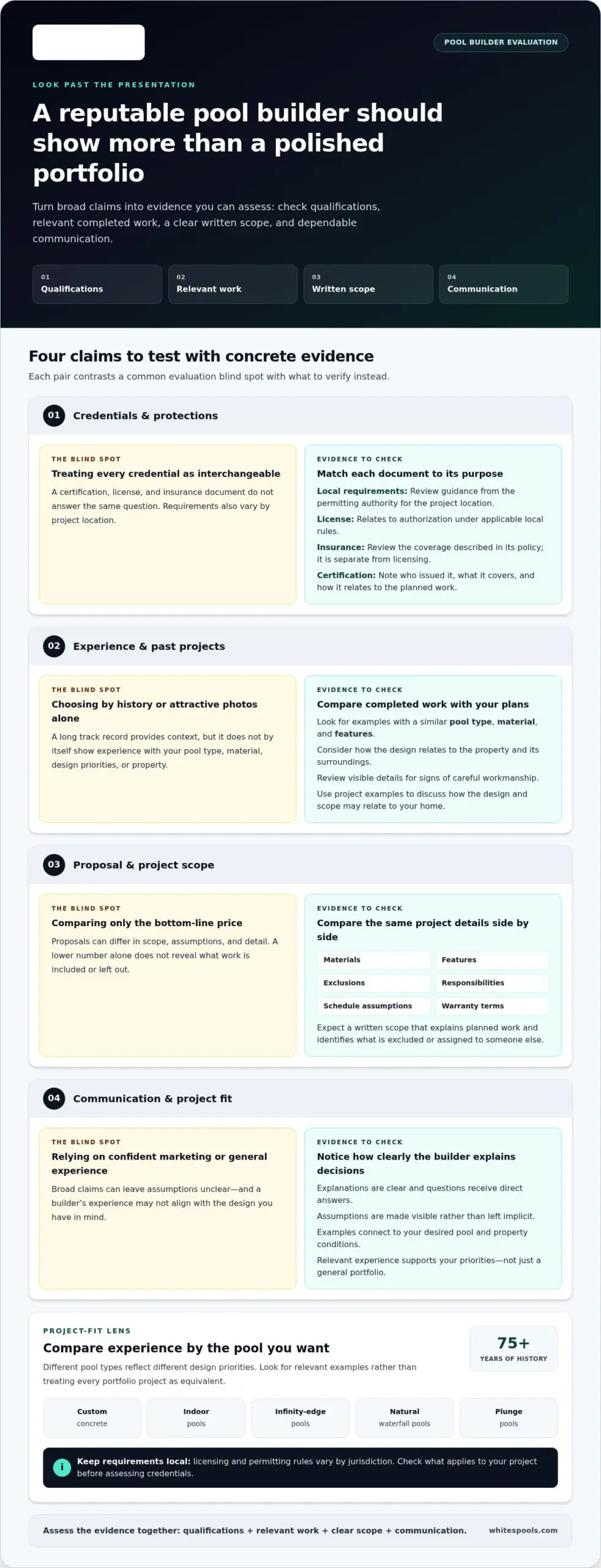
Consider these signals together rather than treating any one as a guarantee:
- Qualifications: Review documentation relevant to the builder and your project location, and distinguish required credentials from voluntary training.
- Relevant work: Look for examples that resemble your desired pool type and design priorities, not just attractive projects in general.
- Written scope: Expect the proposal to explain the planned work and identify what is excluded or assigned to someone else.
- Communication: Notice whether explanations are clear, questions receive direct answers, and assumptions are made visible.
Requirements differ by location, so don’t assume one national checklist applies everywhere. Review the requirements that govern your project before assessing documentation. For a broader overview of pool types and construction, the Swimming Pool Construction Overview can help you get familiar with the subject before comparing project details.
Why project fit matters as much as reputation
A builder’s general experience is useful, but the key question is whether that experience aligns with your vision. Custom concrete, indoor, infinity-edge, and plunge pools involve different design priorities. A portfolio that includes the pool type you’re considering can help you discuss how its design, features, and overall scope might relate to your property.
White’s Pools builds custom concrete, indoor, infinity-edge, natural waterfall, and plunge pools. Its third-generation, family-owned history, spanning more than 75 years, provides context for its experience across these project types. For homeowners weighing concrete materials and design possibilities, the custom concrete pool guide offers a deeper look at that option.
To understand how to choose a reputable pool builder, connect qualifications, relevant work, scope, and communication. The next sections explain how to assess those elements, compare proposals fairly, and judge fit for your property. This evidence-based approach leaves room for differences in homeowners’ priorities, pool designs, and local requirements.
Check a Pool Builder’s Credentials, Experience, and Past Work
Credentials and experience answer different questions. A license or other legally required documentation relates to permission to perform work under applicable local rules. Insurance is separate and has its own documents and terms. Voluntary training and industry certifications may indicate additional education, but they don’t replace requirements that apply to the project or prove experience with a particular pool design.
Use a straightforward evidence check: identify what applies locally, understand what each document represents, then compare it with completed work that resembles your plans. This helps distinguish broad claims from qualifications and experience relevant to your home.
Which credentials and protections should homeowners understand?
Requirements vary by jurisdiction, so avoid relying on a generic national checklist. Review guidance from the local permitting authority for the project location and keep the applicable requirements in view as you evaluate documentation. Licensing and insurance aren’t interchangeable: one concerns authorization under local rules, while the other concerns coverage described in a policy. Don’t assume one document answers questions about the other.
Certification also needs context. Note who issued it, what it covers, and how it relates to the planned work. A credential can be evidence of training or expertise within its stated scope, but it isn’t a substitute for project-specific experience. White’s Pools is a certified construction company.
How to assess experience through completed pool projects
A long history can provide useful context, but the strongest evidence of fit is work related to the pool you’re planning. Compare completed examples by pool type, material, and features. For instance, experience with a custom concrete pool may be more relevant to a custom concrete design than a portfolio focused on other pool types. Indoor, infinity-edge, and plunge pools also reflect distinct project goals.
Look closely at how each pool relates to its property. Consider whether the design appears integrated with its surroundings, whether visible details reflect careful workmanship, and whether the example includes features you value. Photos are most useful when they help you understand the builder’s experience with choices your project involves.
White’s Pools is a third-generation, family-owned business established over 75 years ago, with work spanning custom concrete, indoor, infinity-edge, natural waterfall, and plunge pools. That history and range offer relevant context as you consider project fit. To see how the company’s work connects with different pool visions, explore White’s pool projects and services.
As you assess how to choose a reputable pool builder, keep the evidence connected: understand local requirements, interpret credentials within their stated scope, and look for completed work that aligns with your design. Together, these checks offer a more useful picture than a general claim of expertise or a credential viewed in isolation.
Compare Pool Builder Proposals Beyond the Bottom Line
A proposal’s total is meaningful only alongside the work it covers. The lowest bid isn’t automatically the best value, and a longer, more polished document isn’t necessarily more complete. Proposals may describe different materials, features, or responsibilities, so compare their assumptions before treating the totals as equivalent.
Make a side-by-side comparison using the same categories for each proposal. Mark whether each item is included, excluded, unclear, or assigned to someone else. This makes gaps easier to spot before a headline figure distracts from what the work actually covers.
What should a clear pool construction scope explain?
Look for a written description that separates the main components of the finished project. The pool shell, finishes, equipment, and selected features should be understandable as distinct parts of the scope. If one proposal describes a feature in detail while another leaves it unstated, don’t assume they include the same work.
- Scope and materials: Record what the pool includes, the materials identified, and the finishes or equipment specified.
- Features: List each selected feature separately so it’s clear which design elements are covered.
- Exclusions: Note work or items that aren’t included, especially where an omission could affect the completed project.
- Responsibilities: Identify what the builder handles, what you are responsible for, and any work assigned to others.
- Assumptions: Capture stated conditions that could affect the scope, schedule, or finished result.
- Schedule and warranty terms: Compare schedule assumptions and written warranty terms, including stated exclusions and the process for making a claim.
Clear detail gives you a fairer comparison and a shared reference point. If a responsibility is undefined, such as who coordinates a particular part of the work, different assumptions can lead to confusion once construction is underway. The goal isn’t to favor the longest document; it’s to understand what each proposal commits to.
How to understand timelines, warranties, and subcontractors
Read schedule language carefully. An estimated sequence or completion window is different from a guaranteed date. Note the assumptions behind the schedule and whether the document explains how changes or delays are addressed. That makes it easier to compare proposals without treating an estimate as a firm commitment.
Give warranty terms the same attention. Review what is covered, what is excluded, how claims are handled, and which party is responsible. A warranty statement is most useful when its terms and process are clear in writing, rather than reduced to a broad promise.
Subcontractors may be part of a construction project. Their involvement isn’t automatically a sign of poor quality; what matters when comparing proposals is whether responsibilities and coordination are described clearly. For homeowners considering how to choose a reputable pool builder, this structured review turns proposals into a practical comparison, not a contest of totals or page counts.
Match the Pool Builder to Your Property, Design, and Priorities
A strong project fit starts with your plans, not a builder’s marketing language. A pool designed for swimming laps may call for different choices than one intended for entertaining or visual impact. Your property matters, too: site conditions and applicable requirements need project-specific evaluation before the scope is settled. Use this sequence to turn an initial vision into a clear brief.
- Define your priorities. Decide what you want the pool to support, such as swimming, gathering with family and friends, making a visual statement, or using a compact area efficiently.
- Assess the site. Consider the available space and the property’s conditions. These details can shape what’s practical and should be evaluated for your project.
- Select pool types and features. Narrow down the design direction and identify the features that matter most, rather than treating every appealing option as essential.
- Align the scope. Bring your priorities, site considerations, and selected features together in a project scope, then assess whether the builder’s demonstrated experience fits that vision.
Start with the pool experience and features you want
Different pool types serve different design goals. A custom concrete pool allows for a tailored design; an infinity-edge pool can emphasize visual impact; an indoor pool places the project within an interior setting; a natural waterfall pool incorporates water features into the design; and a plunge pool may suit a homeowner planning for a smaller footprint. These are starting points, not substitutes for evaluating your property and priorities.
Match the builder’s completed work to your intended pool type and features. If compact-space use is a priority, this plunge pool guide can help you think through planning considerations. Also consider ownership beyond the initial design. Pool cleaning and equipment maintenance are part of the ongoing experience, so think about how those needs fit your expectations over time.
Consider the full outdoor project, not only the pool
If your plans include more than a pool, think about how those elements relate to the overall project. An outdoor fireplace may complement a connected gathering space, while a tennis or pickleball court may suit a broader recreation plan. These features aren’t necessary for every backyard; include them only if they support how you intend to use the property.
Planning related elements together can help you describe the full scope and understand how each feature supports your priorities. For ideas on combining a pool and outdoor living space, explore poolside fireplace design ideas. White’s Pools builds custom concrete, indoor, infinity-edge, natural waterfall, and plunge pools, and installs outdoor fireplaces and sports courts. Explore White’s pool and outdoor project options as you shape a plan around your property and vision.
Why White’s Pools Is a Strong Partner for a Custom Pool Project
Choosing a builder is ultimately about matching your priorities with relevant experience and a clear project fit. The steps in this guide provide a framework for assessing qualifications, completed work, proposals, and your property’s needs. White’s Pools brings a long history in pool construction and a range of pool types to consider as you shape your plans.
A long-standing, family-owned pool construction business
White’s Pools is a certified construction company and a third-generation, family-owned business established over 75 years ago. That background provides context: the business has a multigenerational history in its field. Longevity alone can’t predict the outcome of a specific project, so consider it alongside the pool type you’re planning, the scope of work, and how well the proposed design fits your property.
This balanced view keeps the decision grounded. A builder’s history matters, but so does whether its work aligns with the project in front of you. Think about how you’ll use the pool, which features are priorities, and what site-specific considerations may shape the plan. Those details help you judge whether a builder’s experience and offerings are relevant to your vision.
Explore a pool design that fits your vision
White’s Pools builds custom concrete, indoor, infinity-edge, natural waterfall, and plunge pools. Each type can support a different priority: a tailored design, an interior setting, a distinctive visual effect, a natural water feature, or a more compact plan. The right fit depends on your goals and the conditions of your property.
Consider the full ownership experience, too. White’s Pools provides pool cleaning and maintenance, which may be relevant to your plans beyond construction. If you’re developing a broader outdoor space, an outdoor fireplace could complement a gathering area, while a pickleball or tennis court may suit recreation-focused plans. These are options to weigh if they support how you want to use your property, not requirements for every pool project.
As you think about how to choose a reputable pool builder, connect your priorities to the builder’s experience and the scope you want to pursue. White’s Pools’ range of pool types and family-owned history provide a grounded starting point for that evaluation. Explore pool options with White’s Pools and consider which design best reflects your plans.
Take the Next Step Toward a Pool That Feels Like Yours
Turn inspiration into a brief that reflects how you want to use your backyard. Write down the experiences you hope a pool will support, the features that matter most, and the questions you want resolved before committing. This gives your ideas direction without requiring every design detail to be settled at once.
Knowing how to choose a reputable pool builder can make a major decision feel more manageable, but your project should still feel personal. Let your priorities guide the conversation and leave room to refine the design as you explore what suits your property.
Explore custom pool construction with White’s Pools and take a thoughtful next step toward the pool you envision. Your backyard plans can begin with one clear idea.
Frequently Asked Questions
How can I tell if a pool builder is reputable?
Look for evidence that fits your project rather than relying on a confident sales pitch. Review applicable credentials, completed pools similar in type and complexity, and a written scope that makes inclusions and exclusions clear. Read warranty terms and notice how questions are answered during planning. No single signal proves fit; consider the evidence together and in relation to your design and project requirements.
What credentials should a pool builder have?
There isn’t one credential that applies universally across the country. Licensing requirements vary by jurisdiction, so learn which rules govern your project location. Licensing, insurance, and voluntary certification are separate: licensing relates to authorization under local requirements, insurance concerns policy coverage, and certification reflects an issuer’s defined program or training. Understand what each document represents and whether it applies to the planned work, rather than treating a credential as proof of every qualification.
Is the lowest pool builder estimate the best choice?
Not necessarily. Proposals can differ in materials, included features, exclusions, assigned responsibilities, and assumptions about the work. A lower total may reflect a narrower scope, while a detailed estimate may still leave out items you expect. Compare written proposals category by category and note unclear or missing details. Comparing equivalent scopes gives you a more useful basis for judgment than looking at bottom-line totals alone.
What should a pool construction proposal include?
A useful proposal describes the project scope, materials, included features, exclusions, responsibilities, schedule assumptions, and warranty terms. It should help you distinguish what’s included in the pool work from features or tasks outside that scope. Clear documentation makes differences between proposals easier to spot and reduces ambiguity about who is responsible for each part. Use the written details to understand what you’re comparing, rather than assuming unstated items are included.
How important is a pool builder’s portfolio?
A portfolio can help you see whether a builder has completed work related to your plans, such as a concrete pool with design features similar to yours. Look beyond attractive photographs: consider whether examples show the pool type, materials, finishes, and details you’re interested in, and how the design relates to the property. A portfolio is one useful piece of evidence, not a substitute for applicable credentials, a clear written scope, or consistent communication.
How long does it take to build a custom pool?
There’s no single schedule that fits every custom pool project. Timing can depend on the scope, site conditions, design decisions, approvals, and coordination of the work. Review the assumptions behind the schedule prepared for your project. Clarify which milestones are estimates, what factors could affect them, and how changes are communicated. A project-specific schedule is more useful than an unsupported promise of a completion date.
Should a pool builder also provide pool maintenance?
Not necessarily; construction and ongoing care are distinct needs. Planning for regular cleaning and equipment maintenance can help homeowners account for water quality and equipment performance as part of pool ownership. White’s Pools provides pool cleaning and maintenance alongside custom pool construction. Maintenance isn’t automatically included with every construction project, so consider your preferred approach to upkeep as a separate part of planning your pool.

