
The initial deposit is one part of a pool project’s payment plan, and its terms should be clear in the contract. Progress payments should be tied directly to specific project milestones, so a reliable pool construction payment schedule connects each installment to a defined stage of work.
It’s reasonable to ask when payments are due before excavation begins, especially when concrete and shotcrete construction involves several milestones. The deposit is only one part of the plan: the project scope, the timing of materials and labor, and the work completed at each stage all affect how payments are arranged.
This guide explains standard deposit and progress-payment limits, how concrete and shotcrete schedules can be structured, and what to review about late payments, excavation obstacles, and the final balance. You’ll come away with a clearer picture of how payment timing and construction progress fit together with White’s Pools.
Key Takeaways
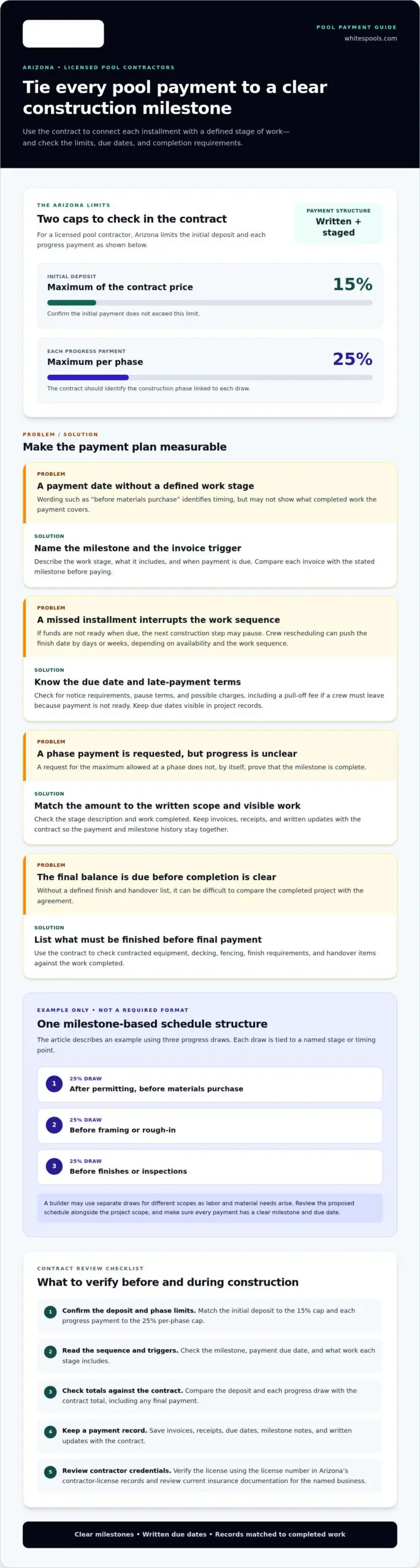
- Arizona caps a licensed pool contractor’s initial deposit at 15% of the contract price, with each progress payment limited to 25% per phase.
- Match installments to clearly described construction milestones so you can see what work each payment covers.
- Review how the contract calculates extra costs if excavation uncovers obstacles such as underground rock.
- Paying late can disrupt crew scheduling and delay later work, so understand payment due dates and any related contract terms.
- Before the final payment, compare the completed work with the contract’s finish and handover requirements.
What happens when swimming pool payments are late?
A missed installment can interrupt the work sequence, not just the accounting. A pool construction payment schedule should connect each payment to completed milestones, and the contract should explain what happens if funds aren’t ready when due. Arizona limits an initial deposit for a licensed pool contractor to 15% of the contract price and caps each progress payment at 25% per phase. Those limits help define the payment structure, but homeowners still need clear written terms for due dates and work stages.
- Check that each payment is tied to a stated milestone. Excavation, steel, shotcrete, decking, and plaster are examples of construction stages that can anchor scheduled payments.
- Confirm the contract explains late-payment consequences. It may allow a pull-off fee if the crew must leave because a scheduled payment isn’t ready.
- Review how missed payments affect the timeline. A payment one day late can delay work if the builder must reschedule the crew around other projects.
- Identify what must be finished before the final payment. List contracted equipment, decking, and fencing so completion can be measured against the agreement.
- Keep payment records with the contract. Invoices, receipts, and written updates help both parties track what was paid and which milestone came next.
Late payment can pause the next construction step while the contractor waits for funds. Contracts commonly exclude delays caused by missed payments from the working days allowed for completion. Rescheduling may then push the finish date by days or weeks, depending on crew availability and the work sequence. Read the late-payment clause for any notice requirements, pause terms, or charges, and keep the payment due date visible in your project records.
Payment methods depend on the amount due and how the funds are arranged. Pool builders may accept credit cards for certain portions, such as equipment purchases. With a pool loan, a check payable only to the homeowner is commonly deposited before the homeowner writes a separate check to the builder. A joint-payee check can be endorsed and given to the builder at each construction phase.
Protect against excessive advance payments by checking that the contract’s amounts match the Arizona limits and the work sequence. A request for the maximum allowed at a phase is not, by itself, proof that the milestone is complete. Compare the invoice with the stated stage before paying, and keep the agreement’s payment table available throughout construction. If a payment dispute arises, document the amount, due date, work completed, and communications in writing. Clear records make it easier to distinguish a missed installment from a disagreement about whether the contracted milestone has been reached.
Pool Payment Schedule in Arizona: How Much Down Payment Is Required?
Arizona limits the initial deposit for a licensed pool contractor to 15% of the contract price. Each progress payment is capped at 25% per phase. A written payment schedule can show how the remaining balance connects to construction milestones, so each invoice has a defined purpose.
Verify the contractor’s license using the license number in Arizona’s contractor-license records, and review current insurance documentation for the named business. Then compare every payment milestone in the contract with the work stage and amount it describes.
Use this checklist to assess the contract’s payment structure:
- Match the deposit to the Arizona limit. Confirm the initial payment doesn’t exceed 15% of the contract price for a licensed pool contractor.
- Check each progress draw against its phase. Arizona caps each progress payment at 25% per phase, so the contract should identify the stage tied to each draw.
- Look for a clear sequence of work. Permitting, materials, framing or rough-in, finishes, and inspections can each serve as a milestone in an example schedule.
- Confirm what triggers an invoice. Wording such as “before materials purchase” identifies timing, while a defined milestone helps connect payment to progress.
- Check that all scheduled amounts add up. Compare the deposit and each progress draw with the contract total, including any final payment.
- Keep invoices with the milestone record. Matching each invoice to the relevant stage makes it easier to track payments and remaining work.
One example schedule uses a 25% draw after permitting and before materials purchase, followed by a 25% draw before framing or rough-in. Another 25% draw is scheduled before finishes or inspections. Treat this as an example of milestone-based billing, not a single required format. A pool builder may use separate draws for different scopes because labor and material needs arise at different points.
Milestone billing helps homeowners compare an invoice with visible progress and the contract terms. It also gives the builder a defined payment point when labor and materials are needed. For example, if the next draw is tied to rough-in, the contract should specify what that phase includes and when payment is due. Precise descriptions reduce confusion about whether a stage is underway, complete, or awaiting another task.
For a concrete project, a custom concrete pool plan can be organized around distinct construction phases. Review the proposed schedule alongside the project scope, and make sure each payment has a clear milestone and due date.
Extra costs for unexpected excavation obstacles
Rock beneath the planned pool footprint can change excavation work once digging begins. The contract should explain how extra expenses for unexpected obstacles will be calculated. Before construction, locate that clause and note what it covers, how changes are documented, and how approval works. A clear process helps distinguish an agreed change from an unexplained addition to the project balance.
- Check how the contract defines an obstacle. Underground rock is a stated example, and the clause should explain whether removal or altered excavation is treated as extra work.
- Look for the calculation method. The contract should describe how added expenses are determined, such as through stated work rates or a written estimate for the specific change.
- Identify what the original scope includes. Compare the planned pool location and excavation description with the contract, so added work can be distinguished from tasks already included.
- Require a written change record. A document describing the obstacle, added work, revised amount, and schedule effect creates a clear record before the project proceeds.
- Connect the added charge to the work. For example, if rock requires extra removal, the change record should describe that work rather than simply adding a vague excavation charge.
- Track any effect on later milestones. If excavation takes longer, ask that the revised sequence show which construction stages move and which payment dates change.
Use a simple review sequence when an obstacle appears. First, compare the site condition with the excavation scope in the signed contract. Next, read the clause covering unforeseen conditions and the calculation of added expenses. Then review the proposed change in writing, including the work description and any schedule adjustment. Keep the original agreement and revised document together so the project record shows why the change was made.
Consider the cost and payment timing separately. An excavation obstacle may require additional work, but the contract should explain how that work is priced and when payment is due. A revised invoice should identify the related change rather than hide it inside a regular progress draw. This makes it easier to compare the charge with the agreed work and construction stage.
For example, if digging reveals underground rock where the pool is planned, pause to review the contract’s obstacle clause before treating the new work as part of an ordinary milestone. Document the condition, proposed removal, added expense calculation, and any effect on following stages. Clear written terms help both parties understand the change and keep the project’s scope and payment records aligned.
Concrete and shotcrete pool payment schedule
Concrete and shotcrete construction moves through distinct stages, so invoices can follow the work rather than calendar dates alone. A schedule might identify excavation, steel reinforcement, shotcrete application, decking, interior finish, and startup as separate milestones. In Arizona, each progress payment is capped at 25% per phase, making clear phase descriptions especially important. The contract should show the amount and due point for every draw.
Fiberglass, vinyl-liner, and gunite pools follow different construction sequences, so their milestone schedules can vary. A fiberglass plan may tie draws to shell delivery and installation, while a vinyl-liner plan can include liner installation. A gunite or shotcrete plan can use milestones for steel, shell application, and interior finishing.
Use this checklist to assess a concrete or shotcrete schedule:
- Check the excavation draw. The contract should identify what excavation completion means before that payment becomes due.
- Match steel reinforcement to its own phase. This separates preparation of the pool structure from shotcrete application.
- Define the shotcrete milestone. State whether the draw is due upon application or after the work reaches a described completion point.
- Separate decking from the pool shell. A distinct deck milestone makes it easier to track surface work separately from structural work.
- Identify the interior-finish payment point. One described concrete or shotcrete schedule makes the remaining 10% due before interior finish work.
- List startup and completion requirements. The contract should explain which final tasks and walkthrough steps remain before the last payment.
These details matter because the work sequence affects cash needs. Steel and shotcrete come before decking and interior finishing, while equipment installation and startup may happen later. If a schedule groups several stages into one vague draw, it can be hard to judge what work supports the invoice. Clear phase labels also help homeowners compare progress with the contract’s payment terms.
Examples show why percentages shouldn’t be copied without examining the full contract. One proposed schedule assigns 25% to excavation; another describes 55% after gunite, 30% after the deck, and 15% at startup. Arizona’s 25% cap per progress-payment phase means the latter example shouldn’t be treated as an Arizona template. Review each draw as a defined phase, not as a percentage borrowed from another project.
For a concrete pool, the useful takeaway is simple: connect every draw to a named task, state its completion trigger, and keep the remaining balance visible. A well-structured pool construction payment schedule follows the project’s actual sequence while keeping each Arizona phase within its payment limit.
How much should be withheld until pool construction is complete?
There isn’t one payment structure that fits every pool contract. One suggested approach is to hold 10% until plastering and startup are complete. An example schedule instead assigns a 5% final payment to project completion and the walkthrough. These are examples, not a universal Arizona retainage rule. The contract should define the amount, the final milestone, and what completion includes.
Look beyond the word “complete.” A finished pool may still have contracted work outstanding, such as tile, decking, plaster, equipment installation, or fencing. List each required item in the completion checklist, then compare it with the contract before releasing the final draw. This gives the walkthrough a practical purpose: recording completed tasks and identifying any remaining contracted work.
- Set a clear final-payment trigger. Link the last draw to a named milestone, such as plastering and startup, rather than an undefined completion date.
- List every contracted finish. Include tile, decking, equipment, and fencing when those items appear in the agreement, so the final review covers the full scope.
- Keep the final balance visible. Compare paid invoices with the contract total and confirm the remaining amount before the walkthrough.
- Document unfinished items. Record each outstanding task in writing, including its location and the agreed next step, before closing out the project.
A proposed pool contract assigns its final 5% payment when the pool is plastered, while another example makes 5% due after project completion and walkthrough. Those triggers differ. A plastering milestone may occur before other contracted work finishes, so the contract should state whether decking, equipment, fencing, or other listed items must also be complete. In Arizona, each progress payment is capped at 25% per phase, so describe the final phase precisely.
Holding back an agreed balance can help tie the final steps to completion, but the amount alone does not make a schedule fair. Compare the payment plan with the work sequence: if startup follows plastering, the contract should explain whether the final draw is due after both. If a walkthrough identifies unfinished contracted work, keep the notes with the invoice and use the contract’s written terms to track completion. Clear records help distinguish a remaining task from a new request outside the agreed scope.
Before signing, confirm that the final payment amount, trigger, and completion checklist appear together in the contract. For help shaping a concrete pool project around defined completion milestones, discuss your pool project.
White’s Pools: Custom Concrete Pools
White’s Pools designs and builds custom concrete pools for homeowners looking for a pool shaped around their property and outdoor vision. Once you understand milestone payments and completion terms, the next step is developing a project scope that fits your goals. A clear scope gives you a practical foundation for discussing construction stages, finishes, and payment terms.
Turn to White’s Pools when you’re ready to explore a custom concrete pool or need professional pool cleaning and maintenance for an existing pool. The team also builds indoor pools and installs outdoor fireplaces as part of broader residential projects.
Contact White’s Pools to discuss your pool project.
Turn Your Pool Plan Into a Thoughtful Project
Bring your design vision and construction plan together. As you shape a pool construction payment schedule, tie each payment to a clearly described stage and keep the agreed scope in view. This practical foundation lets you focus on the decisions that will make the finished space right for your home.
White’s Pools builds custom concrete pools and provides pool cleaning and maintenance to care for the finished pool. An outdoor fireplace can also complement a backyard designed for time together. Consider how these features fit your plans, whether you’re starting a pool project or improving an existing outdoor setting.
For a personal conversation about your pool plans, contact White’s Pools about your pool. A well-considered project begins with a clear vision and a trusted next step.
Frequently Asked Questions
What is a typical swimming pool construction payment schedule in the United States?
There’s no single schedule for every U.S. pool project. Contracts commonly divide payments across construction stages, but the number and timing of draws depend on the project scope and applicable state rules. For example, a schedule may separate excavation, structural work, decking, and finishing. Compare the payment triggers with the written work sequence so each invoice is tied to a defined stage.
What percentage deposit do pool builders typically require?
Deposit requirements vary by contract and state, so a national percentage shouldn’t be assumed. In Arizona, the initial deposit for a licensed pool contractor is limited to 15% of the contract price. That is a state-specific limit, not a U.S.-wide standard. When reviewing a proposed deposit, compare it with the project’s total contract price and the rules where the pool will be built.
What are common pool construction payment milestones and amounts?
Common milestone labels include contract signing, excavation, steel installation, shotcrete or gunite, decking, plaster, and startup, with payment amounts typically divided among these phases. Treat those milestone percentages as one example, not a universal template, keeping in mind that Arizona caps each progress payment at 25% per phase.
When are payments due during excavation, plumbing, concrete, decking, and finishing?
Payment timing follows the written contract, not a single national calendar. A schedule may tie one payment to excavation, then identify separate draws for plumbing, concrete application, decking, and finishing. Check whether each trigger means work has started or reached a stated completion point. For example, “before decking” differs from “after decking is complete,” so precise wording helps prevent timing disputes.
What should a pool construction contract say about payment terms and change orders?
A contract should state each payment amount, due date, milestone, and the work that triggers the invoice. It should also explain how changes are recorded and added costs calculated, including for unexpected excavation obstacles such as underground rock. For example, a written change order can describe the new work, revised amount, and schedule impact. Keep approved changes with the original agreement and invoices.
Are there state laws limiting deposits or requiring escrow for pool construction payments?
State rules differ. In Arizona, the initial deposit for a licensed pool contractor is limited to 15% of the contract price, and each progress payment is capped at 25% per phase. These limits address payment amounts, not escrow arrangements. Don’t assume a deposit cap automatically means funds are held in escrow; treat payment handling as a separate contract and legal issue.
What are the risks of paying a pool contractor too much upfront?
Paying far ahead of completed work can leave less leverage if work stalls or the contractor can’t finish the project. The California CSLB warns that a contractor demanding 50% while completing only 15% of the work is an example of front-loading. A heavily advanced payment can also leave later stages underfunded. Compare each requested draw with the milestone and work described in your contract.

