
About 73% of non-fatal pool injuries involve children under age 5, so a family-friendly pool should be planned around supervision and safe movement, not just play. The best pool features for families include clear sightlines, a shallow entry, gradual depth changes, and slip-resistant decking, with the layout shaped to suit children’s ages and the yard.
It’s natural to want a pool that feels like a fun gathering place and gives you confidence as the children grow. This guide covers the best pool features for families, including how to compare safety, play, available space, and long-term use.
We’ll look at practical options for kids in DFW, from shallow shelves and comfortable exits to lighting and play features, then consider how to choose a layout that fits your family today and over time.
Key Takeaways
- Choose lighting and water features for both play and visibility, while keeping the pool layout easy to supervise.
- Match features to your yard: prioritize the activities your family will use most before adding extras.
- Let children’s ages guide choices, since younger swimmers and confident older kids have different needs.
- Plan slides and waterfall features around available space and how they affect the pool’s usable swimming area.
1. What Makes a Pool Design Family-Friendly?
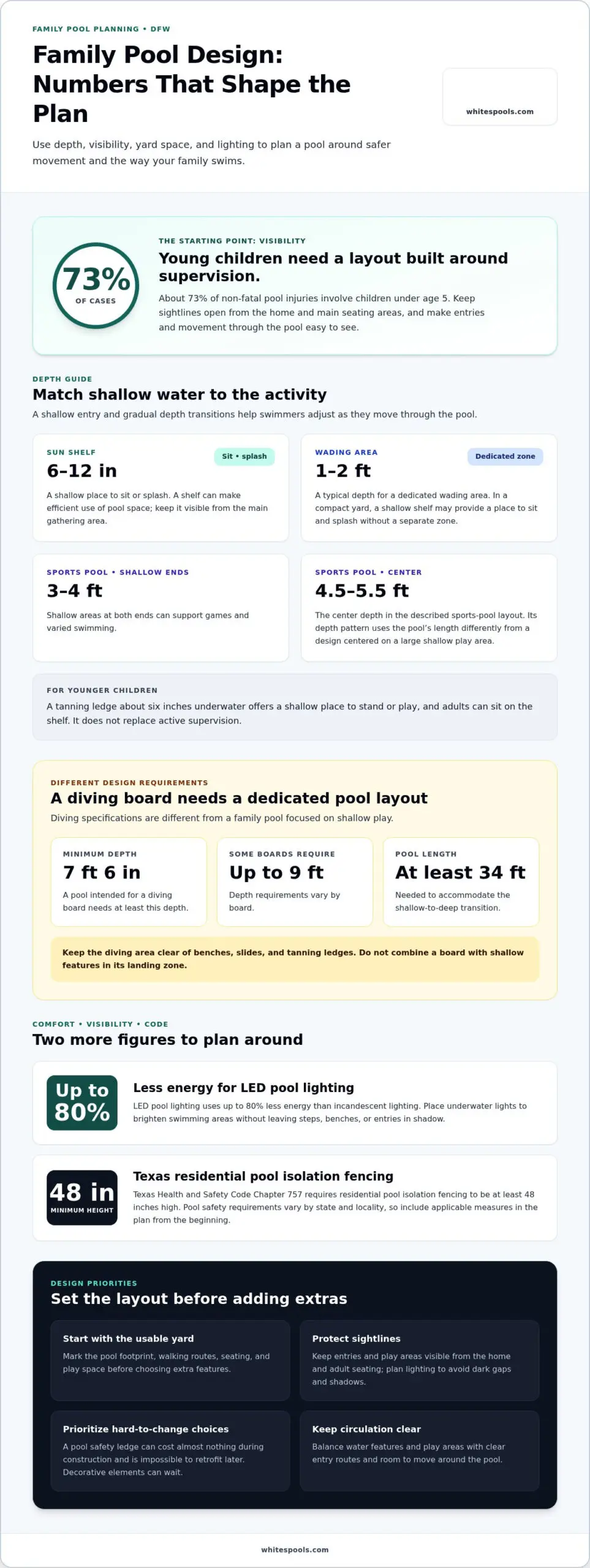
Start with visibility and a layout that suits the youngest swimmers. About 73% of non-fatal pool injuries involve children under age 5, so keep sightlines open from the home and main seating areas. A shallow entry lets children enter gradually, while a level bottom or slight slope can make movement easier to anticipate. In a backyard with room, separate shallow play space from deeper swimming areas.
Match water depth to the activities and ages the swimming pool needs to serve. A sun shelf with 6-12 inches of water creates a shallow place to sit or splash, while a dedicated wading area is typically 1-2 feet deep. Gradual depth transitions help swimmers adjust as they move toward deeper water. A rectangular layout can leave room for shallow-end steps, seating, and games between the ends.
Diving boards require a different design from a family pool focused on shallow play. A pool intended for a diving board needs a minimum depth of 7 feet 6 inches, and some boards require up to 9 feet. The pool needs to be at least 34 feet long to accommodate the shallow-to-deep transition. Keep the diving area clear of benches, slides, and tanning ledges; don’t combine a board with shallow features in its landing zone.
Are saltwater or chlorine pools better for families? Neither is automatically better for every household. Choose based on the water-care routine and comfort preferences you can maintain. Both options require consistent attention to water quality.
What pool safety barriers, alarms, and covers are required in the United States? Requirements vary by state and locality, rather than following one uniform checklist nationwide. Texas Health and Safety Code Chapter 757 requires residential pool isolation fencing to be at least 48 inches high.
Pool safety and fencing requirements vary by state and local jurisdiction, so the applicable rules depend on where the pool is built. Include fencing and any required safety measures in the landscape and pool plan from the beginning.
2. What Are the Best Pool Features for Families With Kids in DFW?
For warm Texas evenings, integrated pool lighting can add ambiance and improve visibility around the water. LED pool lighting uses up to 80% less energy than incandescent lighting. Place underwater lights to brighten swimming areas without leaving steps, benches, or entries in shadow. A well-lit pool makes it easier to see where children are playing, while adults can keep sightlines clear from nearby seating.
Plan landscape lighting as a separate layer around the pool. Illuminate the route from the back door to the patio, then add light near steps and seating. Aim fixtures away from swimmers’ eyes and avoid dark gaps along walking routes. Coordinating landscape and pool lighting creates a more integrated yard and helps family members move between the house and pool after sunset.
Water features add sound and splash, but their scale should suit the yard and the children using the pool. Bubblers create a modest surface effect, while scuppers send water from a wall into the pool. A design with five scupper water features shows how multiple outlets can create a stronger visual focal point. Keep the play area and entry route easy to see around any feature, especially when lights reflect off moving water.
Tanning ledges and water features need to be part of the regular pool-care routine. Remove debris from ledges, clean surfaces, and keep water moving through feature outlets. Leaves and buildup can affect appearance and flow, so inspect the feature and surrounding pool during routine cleaning. The effort depends on the design and how much debris reaches the water.
For a family layout that makes water movement part of the design, explore natural and waterfall pool designs from White’s Pools. Balance the feature’s visual impact with lighting, clear views across the pool, and room for children to play.
3. Choosing features based on yard size, budget, and children’s ages
Start with the usable yard, not a wish list of features. Mark the pool footprint, walking routes, seating, and play space before choosing extras. In a compact backyard, a shallow shelf can offer a place to sit and splash without taking room for a separate wading zone. A larger landscape may accommodate distinct play and swimming areas, as long as movement around the pool remains clear.
For young children, consider a tanning ledge about six inches underwater. It provides a shallow place to stand or play, while adults can use the shelf for sitting. Place it where it remains visible from the main gathering area. A shelf makes efficient use of pool space, but it is not a substitute for active supervision.
Think about how the layout can serve children as they grow. A sports pool has shallow areas at both ends roughly 3 to 4 feet deep, with a center roughly 4.5 to 5.5 feet deep. That arrangement can support games and varied swimming, but it uses the pool’s length differently from a design focused on a large shallow play area. Match the depth pattern to the activities your household expects to use.
Prioritize features that are difficult to change later. A pool safety ledge can cost almost nothing to add during construction and is impossible to retrofit later. Decorative elements can wait until the pool’s footprint, access, and core layout are settled. Compare features by their construction impact, space requirements, and long-term role in family swimming, not appearance alone.
Before settling on a plan, sketch the pool and yard together. Mark the shallow shelf, deep end, views from the house, and walking paths, then remove features that crowd play or circulation. In a compact yard, one well-placed shelf may be more useful than several additions. In a larger yard, separate zones can give toddlers and confident swimmers room to enjoy the same pool.
4. Rock grotto waterfalls and slides
A rock grotto can create a shaded focal point at one end of the pool, while a waterfall adds sound and movement. Plan the feature as part of the pool’s shape, not as an afterthought. Keep the main swimming route open and the entry visible from adult seating. In a smaller backyard, a compact rock wall may suit the space better than a grotto with a large footprint.
A slide adds active play, but it needs room for the ladder, landing zone, and safe circulation. Low-profile slides for younger children are around four feet tall. Position the landing area away from steps, shallow shelves, and the main swimming path. Adults should be able to see the slide and landing zone from their usual supervision areas.
Copper scuppers create a tailored water feature, with water flowing from an outlet set into a wall or raised structure. Incorporate them into a retaining wall or poolside feature, and consider how the water will sound and look from the patio. Their placement should complement the landscape without narrowing the route between the house and pool.
A water basketball hoop can be installed permanently by digging a hole and fixing it to the ground with concrete. Position it where players can move without crowding the entry or waterfall area. A water volleyball net can also bring children and adults together for a game. Keep the play zone clear of hard edges and other features, so games don’t compete with swimming for space.
Before construction, sketch each feature’s footprint, access route, and play area together. Mark the grotto, slide landing, and court space on the same plan, then remove any overlap. Plan a custom pool with waterfall features that brings the visual impact and family play areas together.
White’s Pools: Custom Concrete Pools
White’s Pools designs and builds custom concrete pools, bringing shallow play areas, swimming space, and selected water features together in a layout tailored to your family. Turn to the team when you’re ready to plan around your yard’s dimensions and children’s ages, or to balance playful details with everyday pool use.
After construction, White’s Pools provides pool cleaning and maintenance to support ongoing care of the water and equipment. The right features depend on how your family plans to use the pool, the available yard, and which elements matter most. Share those priorities with White’s Pools to start shaping a pool around your home and family.
Contact White’s Pools to discuss your custom pool plans.
Turn Your Pool Ideas Into a Plan
Before settling on a design, picture an ordinary day in your backyard: who swims, where adults gather, and which areas need to stay open for play. This can clarify which features will earn their place and which might compete for space. Choosing the best pool features for families is less about adding everything and more about creating a setting your household can use comfortably as routines change.
Make a short planning note with your must-haves, preferred play style, and features you’re willing to leave out. Add a rough yard sketch showing the house, pool, seating, and walking paths. This gives your design conversation a practical starting point based on how your family spends time outdoors.
When you’re ready to turn those priorities into a tailored design, contact White’s Pools to plan your family pool. A thoughtful plan can help your backyard become a welcoming place for shared time and summer memories.
Frequently Asked Questions
What Makes a Pool Design Family-Friendly?
A family-friendly design lets adults supervise while different activities happen without crossing paths. Think of the pool in zones: an entry and shallow play area, a clear route into swimming space, and a separate place for games or sitting. Position seating where adults can watch the entry and play zone together, and keep landscaping from blocking those sightlines.
What Are the Best Pool Features for Families With Kids in DFW?
Choose features according to how your family will use the pool at different times of day. Underwater lighting can help distinguish the pool from the yard after dusk, while landscape lights can mark the route from the house. For play, compare a bubbler’s surface movement with a waterfall’s visual presence, while preserving open water for swimming and shared activities.
What pool features are safest for families with young children?
Prioritize layers that limit unsupervised access and support adult oversight: isolation fencing with a self-closing, self-latching gate, clear views from the home, and a shallow area separated from deeper play. Four-sided isolation fencing reduces a child’s drowning risk by 83% compared with no barrier. These features support supervision; they never replace an attentive adult.
Which pool designs and depths work best for children of different ages?
Different ages call for different usable zones, not simply a pool that is shallow everywhere. Younger children may benefit from a distinct wading section, while older swimmers may want space for games or distance swimming. Sports-pool layouts have shallow areas at both ends, roughly 3 to 4 feet deep, and a center roughly 4.5 to 5.5 feet deep.
What are the best pool entry options for kids, older adults, and people with disabilities?
Useful entry options include a gradual shallow entry, broad steps, and a corner swim-out in the deep end. A swim-out gives someone in the water a place to pause or climb out, while steps create a gradual route into the pool. For an older adult or person with limited mobility, plan the entry, resting points, and exit around their movement needs rather than assuming one feature suits everyone.
Which pool features make swimming easier and more fun for families?
Features make family swimming more engaging when they match the activity. A basketball hoop supports casual shooting, while a volleyball net creates a shared game; a waterfall or scuppers can provide a visual focal point between games. Keep play equipment clear of entry and exit routes, and choose features that leave enough open water for everyday swimming and spontaneous fun.

