
Running your pool pump around the clock won’t solve every water clarity crisis; in fact, the quickest path to pristine water often requires shutting the filter off completely. When microscopic debris and dead algae resist standard filtration, reaching for pool flocculant is the definitive way to achieve sparkling water overnight. We understand how exhausting it is to battle stubborn, milky water that normal cycles cannot budge, especially when you are worried about clogging delicate multiport valves or permanently ruining expensive filter media.
You don’t have to guess your way through chemical restoration or risk damaging your equipment. By understanding the mechanical principles behind this heavy-duty settling agent, you can confidently turn cloudy water crystal clear in a single treatment. In this guide, we cover the exact water balance targets required before application, clarify the vital differences between clarifiers and flocculants, and outline the precise vacuum-to-waste procedure that protects your pool plumbing from start to finish.
Key Takeaways
- Learn how pool flocculant works as an intensive settling treatment, binding microscopic debris that bypasses standard filtration so you can restore water clarity quickly.
- Distinguish when a heavy settling agent is necessary over routine clarifiers to safeguard delicate cartridge filters and protect your plumbing system.
- Master the exact water balance parameters and pump valve adjustments required to drop suspended particles to the pool floor overnight.
- Execute a slow, deliberate vacuum-to-waste technique that extracts heavy sediment without disturbing the water column or overworking your equipment.
- Transition from reactive chemical treatments to proactive maintenance practices that preserve your pool finish and support long-term water health.
What Is Pool Flocculant and How Does It Work?
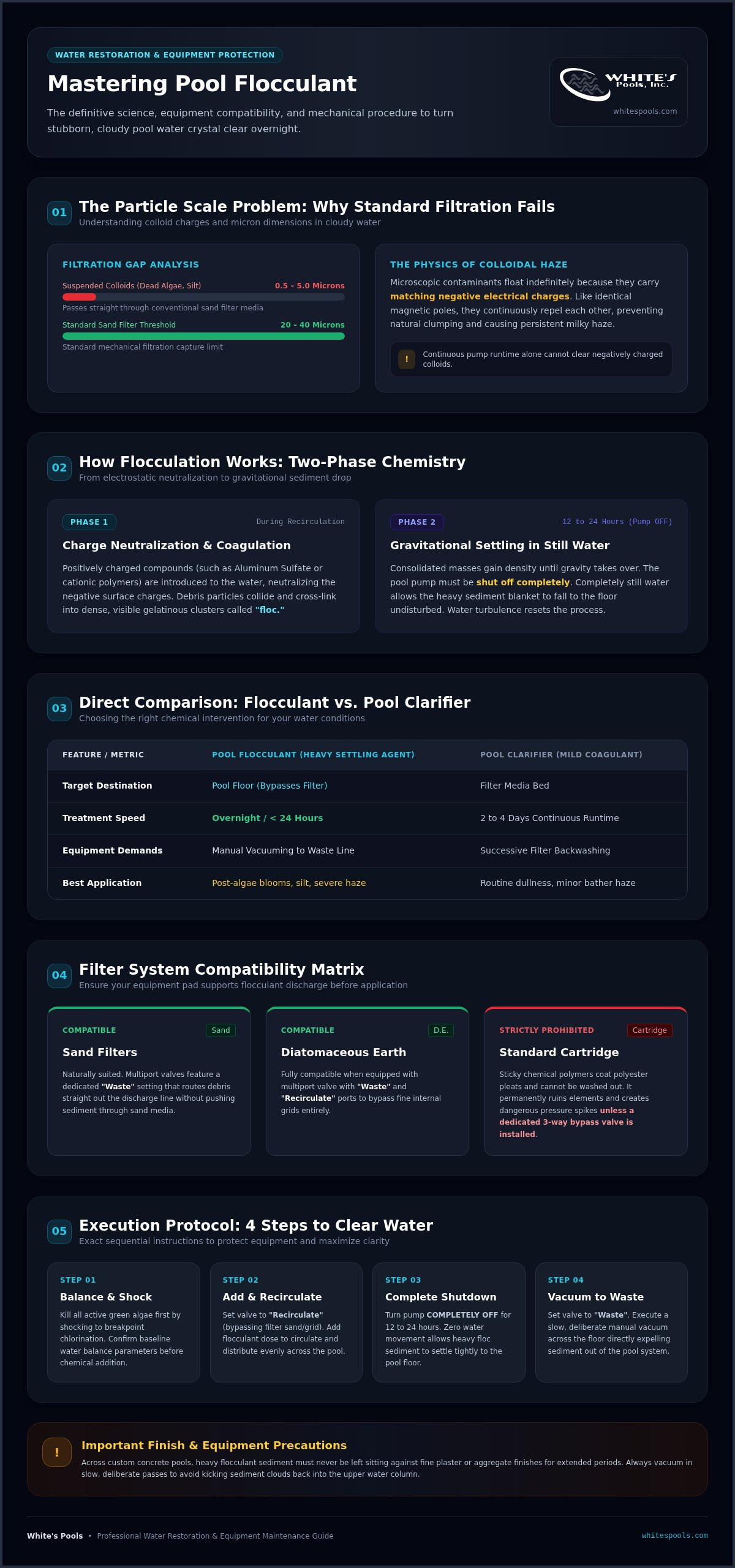
Pool flocculant is a specialized, fast-acting chemical compound designed to clear severe water cloudiness when standard filtration stalls. Under normal circumstances, microscopic contaminants like dead algae, airborne silt, and organic matter float indefinitely. These suspended colloids typically measure between 0.5 and 5.0 microns, allowing them to pass straight through standard sand filter beds, which capture particles down to roughly 20 to 40 microns. Because these colloids carry matching negative electrical charges, they repel one another constantly, creating an enduring milky haze across your pool finish. Flocculant interrupts this cycle by forcing those particles together into heavy clumps that sink directly to the floor.
The Chemistry of Coagulation and Flocculation
The clearing process operates in two distinct phases: chemical neutralization and gravitational settling. Typical flocculants utilize aluminum sulfate (alum) or high-charge cationic polymers. When introduced to circulating water, these positively charged compounds attract and neutralize the negative surface charges of suspended debris. Once destabilized, the particles collide and cross-link into visible, dense gelatinous aggregates known as “floc.”
Physics dictates the next phase. Unlike light debris that remains buoyant, these consolidated masses gain sufficient density for gravity to take over. Still water is essential here. The circulation pump must be shut down entirely, allowing the heavy sediment to drop undisturbed through the water column over 12 to 24 hours. Any water movement shatters these fragile structures and resets the settling timeline.
Pool Flocculant vs. Pool Clarifier: Key Differences
Homeowners often confuse clarifiers with flocculants, yet their mechanical functions and equipment demands differ substantially:
- Target Destination: Clarifiers are mild coagulants that build medium clumps designed for your filter to capture over several days. In contrast, pool flocculant drops heavy debris straight to the pool floor, bypassing filter media entirely.
- Treatment Speed: Clarifiers operate gradually, requiring continuous pump runtime across two to four days. Flocculants settle particulate overnight, clearing the upper water column within 24 hours.
- Equipment Impact: Clarifiers place all the burden on your filter media, demanding successive backwashing cycles. Flocculant requires manual vacuuming directly to the waste line, protecting your filter sand or DE from severe particulate loading while expelling contaminated water entirely from the system.
When to Use Flocculant (and When to Avoid It)
Flocculation serves as an emergency intervention rather than a routine shortcut. Deploying pool flocculant makes sense after treating severe algae blooms, clearing dense construction dust, or resolving persistent particulate haze that days of filtering fail to lift. However, if your water displays only mild dullness or standard bather haze, a gentle clarifier remains the wiser, less labor-intensive choice. Settling agents require deliberate handling, especially across custom concrete pools where heavy sediment must never be left sitting against fine plaster or aggregate finishes for extended periods.
Filter System Compatibility: Sand, D.E., and Cartridge
Your equipment pad dictates whether you can safely attempt this treatment. Sand and diatomaceous earth (D.E.) filters are naturally suited because their multi-port valves include a dedicated “Waste” port. This setting directs heavy suction straight out the backwash line without pushing sediment through the filter bed.
Cartridge filters present an entirely different scenario. Flocculant is strictly prohibited on standard cartridge setups unless your plumbing features a dedicated three-way bypass valve installed before the filter tank. When drawn into a cartridge chamber, sticky chemical polymers coat the polyester fabric pleats. This gummy barrier cannot be washed out with a garden hose; it permanently ruins the elements and drives tank pressure to dangerous operating thresholds, requiring an expensive set of replacement cartridges. If you manage complex equipment or custom water features, partnering with experienced specialists for your pool cleaning and maintenance ensures challenging water issues are resolved without putting your mechanical investments at risk.
Evaluating Your Pool Water Conditions
Before introducing settling chemicals, confirm that your baseline water parameters support successful coagulation:
- Kill Live Algae First: Never apply flocculant to active, green algae blooms. Flocculants consolidate particles, but they do not sanitize. Shock your pool to reach breakpoint chlorination first, confirming that all biological growth is dead and the pool has turned a cloudy, chalky gray before proceeding.
- Stabilize Target Chemistry: Check that your pH measures between 7.4 and 7.6 (or up to 7.8 if dosing aluminum sulfate, which depresses pH upon contact) and maintain total alkalinity between 80 and 120 ppm. Out-of-balance water prevents coagulants from cross-linking effectively.
- Ensure Adequate Water Depth: Vacuuming settled debris to waste discharges significant water volume out of the pool. Always top off the pool line prior to chemical application so the skimmers do not run dry during evacuation.
How to Use Pool Flocculant: Step-by-Step Instructions
Executing a flocculation treatment demands methodical preparation and steady hands. Because this process relies on delicate gravity separation rather than mechanical filtration, each phase must occur in precise order. Rushing any step compromises particle consolidation and risks redistributing settled sediment across your pool floor.
Pre-Treatment Water Balancing and Pool Preparation
Successful clearing starts with baseline water chemistry. Verify your pH sits precisely between 7.4 and 7.6. This target window provides the exact ionic environment polymers require to bond tightly with organic debris. Total alkalinity must read between 80 and 120 ppm to prevent sudden pH drift during chemical addition.
Next, grab your garden hose and raise your pool water level approximately two to three inches above the midway point on your skimmer throat. Discharging directly to waste will purge between 1,000 and 3,500 gallons during manual extraction. Pre-filling prevents water levels from dropping below the skimmer mouth, protecting your pump from pulling air and losing prime mid-cleanup.
Circulation, Dispersion, and Settling Protocols
Distribute the chemistry correctly to initiate the binding process:
- Set Valve to Recirculate: Rotate your multi-port valve handle to “Recirculate.” This setting circulates water through the plumbing lines while bypassing sand or D.E. filter beds entirely.
- Disperse the Chemistry: Dilute the recommended dose of pool flocculant in a large bucket of pool water, then pour it evenly around the deep-end edges and surface perimeter.
- Circulate Briefly: Run the pump on recirculate for exactly two hours to distribute the coagulant throughout the entire water volume.
- Enforce Complete Stillness: Shut off the pump entirely. Disable automated timer trippers, deactivate solar heaters, turn off aeration features, and pull robotic cleaners out of the basin. Let the water sit undisturbed for 12 to 24 hours.
Vacuuming to Waste: The Critical Removal Process
Once particles form a thick blanket across the floor, manual extraction begins. Set your multi-port valve directly to “Waste.” Submerge your manual vacuum head and prime the hose carefully to purge trapped air before securing the adapter plate into the skimmer.
Glide the vacuum head at a deliberate crawl, advancing no faster than one foot every three to five seconds. Quick movements generate underwater turbulence that sweeps delicate floc clouds back into suspension. In architectural designs such as custom concrete pools, specialized floor slope profiles and dual main drains naturally gather debris into central floor channels. Direct your vacuum passes toward these low drainage zones first. If the water column clouds up from minor floor disturbance, stop immediately, let the remaining particles settle for two hours, and complete the final pass.
Common Pool Flocculant Mistakes and How to Fix Them
Even with careful planning, applying pool flocculant can present unexpected hurdles. The most frequent errors involve misaligned valve positions, rushed vacuuming passes, and dosage miscalculations. Overdosing or stirring up settled waste creates a sticky, milky suspension that leaves owners wondering why their pool looks cloudier than before. Knowing how to troubleshoot these mechanical and chemical snags will help you salvage your water clarity without causing permanent damage to your equipment pad.
What to Do If Floc Enters Your Filter System
Accidentally running floc through your filter media quickly leads to sharp pressure spikes. If you sent floc into a sand filter, shut the pump off immediately. Initiate an extended, three-to-five-minute backwash, followed by a two-minute rinse cycle to purge the coagulated bed before sand channels fuse together. For D.E. filters, a simple backwash rarely suffices. You must open the tank, hose down the internal fabric grids individually, inspect the manifold for tears, and recharge the system with fresh diatomaceous earth powder.
When floc contaminates a cartridge filter, act immediately. Remove the filter elements and submerge them in a heavy-duty degreasing and cartridge-cleaning solution for 24 hours. If the gummy residue has dried or hardened between the pleats, the fabric pores remain sealed, leaving full element replacement as the only safe remedy. To protect your investment and avoid equipment breakdowns, explore professional pool cleaning and maintenance from seasoned specialists who handle complex chemical restorations with precision.
Handling Floating Floc and Persistent Haze
Occasionally, consolidated particles form an unsightly layer across the water surface instead of sinking to the plaster floor. Several conditions trigger this buoyancy problem:
- Trapped Micro-Bubbles: Air leaks on the suction side of the pump or running water features during chemical dispersion introduce micro-bubbles into the water column. These microscopic air pockets cling to the forming polymer flakes, lifting them toward the surface.
- Severe pH Imbalance: Water with a pH below 7.2 or above 7.8 destabilizes the binding reaction, yielding light, wispy clusters that lack the mass needed for gravitational settling.
If you face floating debris, start by skimming the surface using an ultra-fine mesh net. For lingering surface rafts, set your garden hose nozzle to a fine mist and spray the clusters directly; this knocks out trapped air bubbles and forces the sediment downward. Never add a second dose of settling agent to clear lingering haze. If a faint turbidity remains after vacuuming the floor, balance your water chemistry and dose with a mild polymer clarifier, letting your regular filtration system polish the water over the following 48 hours.
Preventing Chronic Water Cloudiness for Long-Term Clarity
Reaching for pool flocculant delivers rapid relief during a water clarity emergency, but frequent chemical rescues should never replace sound mechanical habits. Treating persistent haze reactively exhausts sanitizers, wastes thousands of gallons through repeated waste cycles, and places avoidable strain on pump seals. Achieving consistent, diamond-bright water requires shifting focus toward proper hydraulic turnover, balanced water parameters, and proactive surface care. Compact architectural installations like luxury plunge pools demonstrate this dynamic clearly. Because these bodies hold lower total water volumes, swimmer waste and thermal shifts spike biological demand quickly, demanding strict chemical ratios and continuous circulation to prevent sudden cloudiness.
Filtration, Turnover, and Routine Sanitizer Discipline
Water clarity relies on disciplined physical filtration as much as sanitizer chemistry. Keep your pool operating smoothly with these core maintenance standards:
- Calculate Complete Turnover: Size your pump runtime to filter your entire pool volume at least once per day during cooler months, expanding to twice daily during peak summer heat or heavy swimmer loads. Most residential setups require 8 to 12 hours of active circulation daily to pull suspended particles through the filter bed before they accumulate.
- Track Operational Pressure: Note your clean filter baseline pressure on the tank gauge. Initiate a backwash cycle or element cleaning as soon as pressure climbs 8 to 10 PSI above baseline, preventing deep dirt compaction and internal channeling.
- Manage Cyanuric Acid (CYA): Maintain CYA strictly between 30 and 50 ppm. When stabilizer levels climb beyond recommended boundaries, chlorine becomes over-stabilized, creating “chlorine lock” where free chlorine readings appear adequate but the sanitizer lacks the oxidation strength to kill bacteria and burn off organic haze.
When to Rely on Professional Pool Care Services
Recurring cloudiness often points to mechanical issues hidden deep within your plumbing pad rather than simple chemical imbalance. Suction-side air leaks, compromised multiport spider gaskets, worn impellers, or calcified sand beds all degrade circulation while masquerading as routine filtration failure. Diagnosing these subtle mechanical bottlenecks requires technical precision. If you are also planning a new pool installation or upgrade, reviewing a detailed custom pool budget guide before committing to structural changes can help you avoid unexpected costs and protect your long-term investment. Homeowners weighing major renovations may also want to understand whether pools add value to a house before committing to upgrades, since verified resale data can meaningfully shape your decision on materials, finishes, and scope.
Enlisting expert maintenance safeguards both your equipment and your structural surfaces over decades of ownership. Our team at White’s Pools brings over 75 years of multi-generational pool expertise to luxury backyard investments, providing meticulous chemical balancing, equipment servicing, and comprehensive pool cleaning and maintenance. Entrusting your aquatic retreat to experienced craftspeople ensures your water remains inviting, safe, and crystal clear all season long.
Restore Your Swimming Sanctuary with Lasting Clarity
Mastering pool flocculant gives you the power to rescue your pool from severe cloudiness overnight, turning stubborn suspended silt into crystal-clear water. Success comes down to mechanical precision: verifying your baseline water balance, respecting filter compatibility rules, and maintaining a slow, steady vacuum-to-waste pace. While this settling technique offers an effective reset for severe water challenges, maintaining an effortless, pristine swim environment throughout the season begins with consistent care.
Protecting your backyard investment shouldn’t feel like a constant chemistry experiment. As trusted builders of luxury residential concrete pools with over 75 years of dedicated pool craftsmanship and care, White’s Pools provides expert full-service maintenance and equipment optimization tailored to your lifestyle. When you are ready to enjoy sparkling water without the guesswork, schedule professional pool care with White’s Pools. Step outside, unwind, and let our seasoned team keep your pool impeccably clear year-round.
Frequently Asked Questions
Can I use pool flocculant if I have a cartridge filter system?
No, you cannot use pool flocculant in a standard cartridge setup unless your plumbing includes a dedicated three-way bypass valve that dumps directly to waste. Flocculants create a sticky, gelatinous mass that coats polyester filter pleats. This gummy residue cannot be washed clean with a hose; it permanently chokes the filter media, creating severe pressure spikes and forcing you to buy replacement cartridges.
How long do I need to wait after using pool flocculant before swimming?
Wait at least 24 to 48 hours before entering the water. Swimmers must stay out of the pool throughout the entire treatment cycle. You can safely reopen the pool once the settled residue has been fully vacuumed to waste, fresh water has replenished the basin, and your chemical testing confirms that pH, total alkalinity, and free chlorine sit within standard recreational ranges.
Why did the pool flocculant make my water cloudier than before?
Water turns cloudier when the settling agent is overdosed or added to water with an improper chemical balance. Adding too much coagulant causes excess polymer strands to float freely without binding to debris. Similarly, if your pH is outside the 7.4 to 7.6 window, the chemical reaction stalls. The unsettled product remains suspended in the water column as a stubborn, milky fog.
Is pool flocculant the same thing as a pool clarifier?
No, they operate through completely different mechanical processes. A clarifier binds fine micro-debris into medium-sized clumps so your everyday filter can capture them gradually over several days. Flocculant acts as a rapid, heavy-duty settling agent that binds particles into dense clumps that drop to the pool floor overnight, requiring manual vacuuming straight to the waste line.
Can I leave my automatic pool cleaner running while using flocculant?
No, automatic sweepers and robotic cleaners must remain powered off and removed from the pool. Robotic units move too quickly, and their pressurized return thrusters kick up delicate floor sediment instantly. Their onboard filter bags or mesh baskets are also far too coarse to hold flocculated matter, which simply blows back through the exhaust and fogs the water column again.
What should I do if the settled floc stirs back up while vacuuming?
Stop vacuuming immediately and turn off your pump. Moving the vacuum head too quickly creates underwater currents that easily break apart fragile sediment beds. Let the pool sit completely still for two to three hours so the disturbed debris can drop back to the floor. Resume vacuuming at a deliberate crawl, moving no faster than one foot every few seconds.
Does pool flocculant lower chlorine levels or affect water balance?
Flocculant does not directly consume free available chlorine, but aluminum sulfate formulas release acidic compounds during hydrolysis that depress your pH and total alkalinity. Vacuuming the settled waste also expels hundreds of gallons of treated water. Refilling the pool with raw tap water dilutes your sanitizer and stabilizer levels, making comprehensive water testing and rebalancing essential once cleanup finishes.

