
The lowest pool bid can create the biggest project uncertainty. The risks of hiring the cheapest pool contractor often begin with gaps that aren’t obvious in the price: general liability insurance alone may not be enough. Workers’ compensation coverage and a valid state-specific contractor license also matter, and requirements vary by location.
It’s sensible to compare bids closely on a major home project. But a lower price doesn’t show whether the work is properly insured, permitted, or clearly defined in writing. When a bid leaves out important responsibilities, the result can be delays, disputes, or unexpected costs.
This guide explains what to review in a contractor’s insurance, permits, and contract, and how to compare a low bid with the project scope. Use these practical checks to weigh the risks before choosing a pool builder.
Key Takeaways
- Look beyond the lowest bid: compare what each proposal includes, from materials and timelines to workmanship coverage.
- Understand how permits and local requirements affect who is responsible for approvals and compliant construction.
- Review the contractor’s license and insurance coverage, since gaps can expose you to project delays or financial risk.
- Use clear contract terms and progress-based payments to make costs, milestones, and responsibilities easier to track.
1. Confirming permits and regulatory compliance
Before excavation, find out which local office handles pool-construction permits for the property. Requirements vary by location, and the process may involve local building officials and inspections at different construction stages. Ask for the permit plan and clarify who will submit applications, arrange inspections, and address corrections. A low bid that leaves these responsibilities vague can lead to delays or unplanned changes.
Confirm who will apply for the pool permit and whose name will appear on it. Be cautious if a contractor asks you to apply as the owner-builder: that can shift permit-related responsibilities to you, even though the contractor is doing the construction. Before signing, make sure the contract states who obtains permits and who responds to building officials if plans need revision.
Permits connect the proposed pool to applicable building codes and inspection requirements. If construction doesn’t comply, homeowners may face fines, delays, or required modifications. For example, an inspector may require corrections before work can continue. Make sure the project schedule accounts for permit approvals and inspections instead of treating them as paperwork to handle after construction begins.
Compliance also affects how clearly the finished project is documented. During a future sale, buyers may ask whether the pool was permitted and inspected. A permit doesn’t guarantee a higher property value, but missing records can raise questions about the work and its compliance. Keep permit documents, inspection records, and approved plan changes with the property paperwork.
One of the risks of hiring the cheapest pool contractor is finding that essential compliance steps were left out. Before work starts, review the scope for permit responsibility, inspection coordination, and code-related corrections. Confirm whose name will appear on the permit and keep copies of approvals as construction progresses. If the contractor proposes owner-builder filing, clarify the reason and responsibilities in writing before proceeding. Clear answers help establish who is accountable for approvals and compliant construction.
2. Does a pool builder need specific insurance beyond general liability?
Yes. General liability coverage alone may leave important gaps. Ask for evidence of active general liability and workers’ compensation coverage, then confirm that the contractor’s license is valid for pool construction. These protections address different risks: liability coverage relates to property damage or claims, while workers’ compensation concerns employees injured on the job.
To verify a pool contractor’s license, insurance, and bonding, request the license number and Certificate of Insurance, then check the license with the relevant state or local licensing authority. Ask for proof of workers’ compensation and bond coverage, and compare the names and effective dates on the documents with the contract.
California has a specific licensing threshold: according to the California Contractors State License Board, a contractor must hold a valid contractor’s license for covered work costing more than $500 in labor and materials. The license classification must cover the work being performed. A license for unrelated construction does not establish authorization for pool construction.
Workers’ compensation deserves separate attention. According to the California Contractors State License Board, a licensed contractor must carry workers’ compensation insurance for employees or show the Board that the contractor has no employees. This distinction matters when a crew works on your property. Ask for current documentation rather than relying on a verbal assurance.
A bond can offer another form of protection, but it is not a substitute for insurance. Request the bond details and check that the contractor’s name matches the license and agreement. Also review relevant certifications and experience. Certification can indicate industry training, while recent local references can show how the contractor handled completed projects. Request 3-5 recent local contacts and ask about communication, schedule changes, and workmanship.
These checks help separate a low bid from a complete proposal. For a project where construction scope and documentation need to align, explore pool construction planning as you consider the next steps.
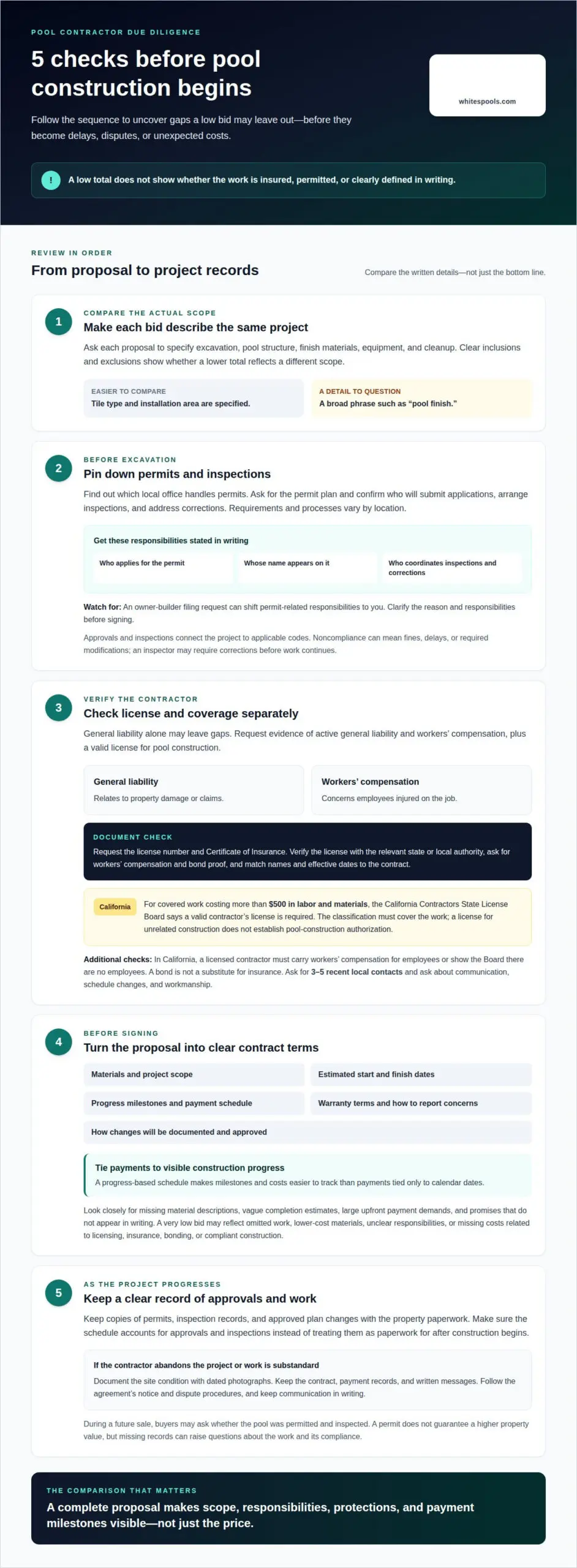
3. What Must Be Included in a Pool Construction Contract to Protect You?
Compare bids by scope, not just by the bottom line. Ask each proposal to describe excavation, pool structure, finish materials, equipment, and cleanup. For example, a bid that specifies tile type and installation area is easier to compare with another than one that simply says “pool finish.” Clear inclusions and exclusions help you see whether a lower total reflects a different project.
The written contract should identify materials, estimated start and finish dates, progress milestones, and the payment schedule. Tie payments to visible construction progress rather than calendar dates. Set out how changes will be documented and approved so a verbal adjustment doesn’t turn into an unexpected dispute. Specify the warranty terms for structural components, equipment, and workmanship, and explain how to report warranty concerns.
A very low bid may reflect omitted work, lower-cost materials, or unclear responsibilities. An unlicensed contractor may also submit a lower proposal if costs associated with licensing, insurance, bonding, or compliant construction are missing. That doesn’t prove the work will be poor, but it makes careful comparison essential. Look for missing material descriptions, vague completion estimates, large upfront payment demands, and promises that don’t appear in writing.
If a contractor abandons the project or performs substandard work, document the site’s condition with dated photographs and keep the contract, payment records, and written messages. Follow the agreement’s notice and dispute procedures, and keep communication in writing. A clear record can show what work was promised, completed, or left unfinished.
For a fair comparison, assess the same design, materials, project scope, schedule, and warranty terms across proposals. The project price depends on those choices and site conditions; the exact figure is provided in a quote for your case. A contract that spells out these details helps you understand what you’re paying for and who may be liable for each responsibility.
4. Risks of choosing the lowest pool-contractor bid
A low bid isn’t automatically a bad choice, but the price alone can conceal important differences. One proposal may omit excavation details, equipment, finishing work, or cleanup included in another. Compare every line item against the same pool design. If the scope is unclear, you can’t tell whether the contractor has priced the same finished project or left work to be added later.
Upfront payment demands deserve particular attention. A risky contractor may request 30-50% before any work begins. Paying a large share before excavation or material delivery can leave homeowners with limited leverage if progress stalls. Compare the proposed payment schedule with visible milestones, such as excavation, structural work, and finishing. Record each payment and the completed work it covers.
Poor construction or unsuitable materials can lead to cracks, leaks, uneven surfaces, or finishes that deteriorate sooner than expected. The specific problem depends on the material, installation, and site conditions. If a low bid substitutes materials without identifying them, it’s harder to compare durability and understand who is responsible for repairs.
Unclear responsibilities can also turn a defect into a liability dispute. For example, a contractor might attribute a leak to equipment while the homeowner suspects an installation problem. The contract should identify materials, workmanship responsibilities, warranty coverage, and how concerns will be documented. Keep dated photographs, written change approvals, and payment records together in case a disagreement arises.
Use the lowest proposal as a prompt for closer comparison, not as the deciding factor. Match scope, materials, schedule, payment milestones, and written protections across bids. If essential work is missing, or a large advance is required before visible progress, pause before committing. A clear project plan can help you make an informed choice for a custom concrete pool.
White’s Pools
White’s Pools helps homeowners plan custom pool projects, including custom concrete and indoor pools, and provides pool cleaning and maintenance. These services are relevant when you’re comparing construction scope and considering the ongoing care a pool will need after installation.
If bids leave you unsure about the design, materials, or maintenance a pool will need, use those questions to guide your planning conversation. Clarifying your goals helps you discuss the project and the options that suit it. Contact White’s Pools to talk about your pool plans.
Choose a pool plan with confidence
The risks of hiring the cheapest pool contractor are easier to manage when you assess the whole project, not just the starting bid. Consider how you want the space to work, what construction it involves, and how it will be cared for over time. A well-defined vision gives you a stronger basis for discussing priorities and choosing what suits your home.
White’s Pools offers custom concrete pools, pool cleaning and maintenance, and outdoor fireplaces. Whether you’re planning a new pool or considering how to bring the wider outdoor space together, keep your goals and practical needs at the center of the conversation.
Take the next step when you’re ready to talk through your plans. Contact White’s Pools today to discuss your pool project and explore a direction that feels right for your home.
Frequently Asked Questions
Does a pool builder need specific insurance beyond general liability?
Yes. General liability and workers’ compensation cover different exposures, so one doesn’t replace the other. For example, damage to a neighboring structure during equipment delivery differs from an employee injury during excavation. Ask for current documents showing the contractor’s name and active coverage. Before work begins, clarify whether the crew includes employees and how their coverage applies.
What Must Be Included in a Pool Construction Contract to Protect You?
A protective contract defines the finished scope, not just the pool in general terms. It should identify materials and equipment, estimated start and finish dates, approval responsibilities, milestone payments, and warranty coverage. For example, if a specified tile becomes unavailable, require a written change that describes the replacement and any schedule adjustment before approving it. This gives both parties a shared record of the agreed project.
Why is the Lowest Bid Often a Major Red Flag for Your Budget?
One of the risks of hiring the cheapest pool contractor is that the bid may exclude work needed to deliver the agreed design. Excavation, finishes, equipment, or cleanup omitted from the proposal may later be added as changes, while code-related corrections can mean more work and delays. Assess affordability against the complete written scope and payment schedule, not the opening total. A low quote is useful only if it covers the same finished project.
What are the risks of hiring an unlicensed pool contractor in the United States?
An unlicensed contractor can leave you with work that may not meet local requirements; exact consequences depend on state law. In California, according to the California Contractors State License Board, covered work costing more than $500 in labor and materials requires a valid contractor’s license. California contracts with unlicensed contractors may also be legally unenforceable, making written protections less useful if a dispute arises.
What are common warning signs of a low-ball pool construction quote?
Warning signs include a quote that bundles major tasks into vague labels, leaves materials unidentified, or relies on verbal promises for later additions. Another concern is a demand for 30-50% upfront before any work begins. Ask for a revised written scope and milestone-based payment terms before deciding. If the contractor won’t clarify what the bid includes, you can’t compare it reliably with other proposals.
What hidden costs can arise when building a pool with a low-cost contractor?
Extra expenses can stem from exclusions rather than a surprise line item. A quote may omit site work, specified finishes, equipment, cleanup, or corrections for noncompliant construction. Permit-related delays or required modifications can also affect the project. Before signing, compare the proposal with the intended finished pool and make sure every included and excluded task, along with the change-approval process, is clearly stated in writing.

