
A saltwater pool still uses chlorine. A salt chlorine generator makes chlorine from dissolved salt, so saltwater vs chlorine for concrete pools is really a choice between how sanitizer is supplied and how you’ll manage water, materials, and equipment. The key questions are whether the pool’s finishes and components suit a salt system, how much equipment care you’re comfortable with, and which routine fits your preferences.
Neither system is maintenance-free. Salt systems can reduce how often you add sanitizer, but still require regular water testing, pH attention, and salt-cell care. Traditional chlorine systems require routine sanitizer dosing and testing. This guide compares how the two approaches work, what to consider for concrete pool materials and equipment, and how to choose a routine you can maintain.
Key Takeaways
- Saltwater and traditional systems both sanitize pool water with chlorine. The difference is how the sanitizer is supplied.
- For saltwater vs chlorine for concrete pools, consider the whole pool assembly, including finishes, sealants, and metal equipment, not just the concrete shell.
- Compare the routines you prefer: salt systems need salt-cell care and pH attention, while traditional chlorine systems require regular sanitizer dosing.
- Use your comfort preferences, equipment considerations, and willingness to maintain water balance to guide your choice.
- Include consistent cleaning, water-quality checks, and equipment maintenance in your pool-care plan.
Saltwater vs. Chlorine for Concrete Pools: What Is the Real Difference?
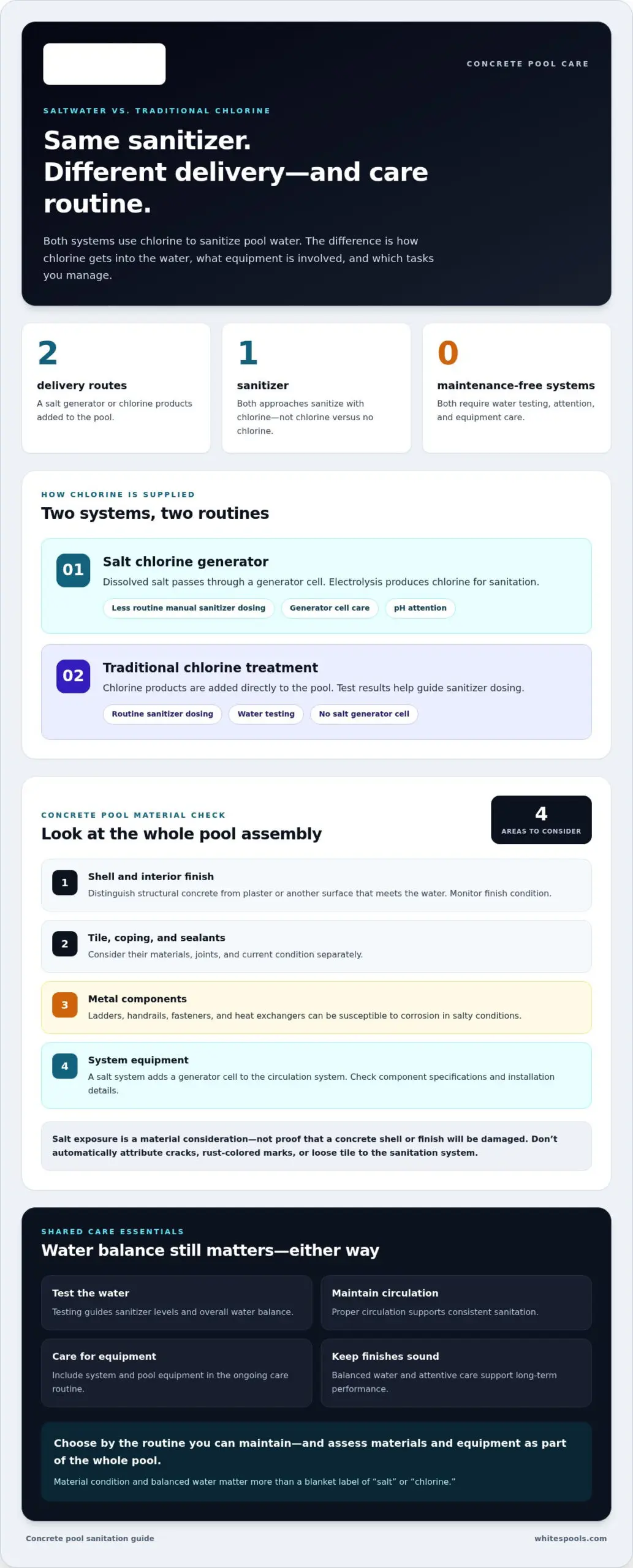
Both systems use chlorine to sanitize pool water. In a saltwater pool, a salt chlorine generator produces chlorine from dissolved salt as water passes through its cell. With traditional chlorine treatment, the owner adds a chlorine product to the water. So the difference in saltwater vs chlorine for concrete pools is the delivery method, the equipment involved, and the routine each system requires, not chlorine versus no chlorine.
Neither approach removes the need to test the water. A generator doesn’t guarantee balanced water, and manual dosing still requires checking how the pool responds. Regular testing helps guide sanitizer levels and overall water balance. Proper circulation and equipment care also support consistent sanitation.
How does a salt chlorine generator sanitize pool water?
Pool salt is dissolved sodium chloride. As water passes through the generator cell, electrolysis acts on the dissolved salt and produces chlorine for sanitation. The process is explained in Salt water chlorination. This doesn’t make the pool chlorine-free. It changes how chlorine is supplied. Testing and water-balance management remain necessary even when the system is producing sanitizer.
What does “traditional chlorine pool” mean?
A traditional chlorine pool receives sanitizer through chlorine products added to the water rather than through a salt cell. The product and dosing routine can vary with the pool and its care plan, so there isn’t one schedule for every pool. Test results help guide sanitizer dosing and show whether other aspects of water balance need attention.
A salt system generates chlorine from dissolved salt; a traditional system relies on adding chlorine products directly to the pool. The distinction is the source of the sanitizer and the equipment or tasks involved. Both systems require attention to water conditions.
For a concrete pool, that distinction is only the starting point. Sanitation describes how the water is treated, but it doesn’t determine how the shell, finish, or equipment will perform. Those considerations depend on the pool’s components and how consistently water quality is maintained. Understanding the delivery method makes it easier to compare material compatibility and upkeep without assuming one system is right for every concrete pool.
How Salt and Chlorine Systems Interact With Concrete Pool Materials
A concrete pool is an assembly of materials, not one surface exposed uniformly to the water. The structural shell, interior finish, tile, coping, sealants, and metal fittings each have different roles. When comparing saltwater vs chlorine for concrete pools, consider those components alongside the sanitation system and ongoing water care.
Salt in the water doesn’t mean concrete will inevitably deteriorate. The practical questions are whether the finishes and equipment are compatible with the chosen system and whether the water is kept balanced. Worn finishes, damaged sealants, or neglected water chemistry need attention with either system. Salt can also raise corrosion concerns for susceptible metal components, particularly when water and equipment care are inconsistent.
Can saltwater damage concrete, plaster, or pool tile?
Saltwater exposure is a material consideration, not proof that a concrete shell or finish will be damaged. The shell provides structure, while plaster or another interior finish directly meets the pool water. Tile, grout, coping, and sealants also have their own materials and condition to consider. Balanced water and sound finishes support long-term performance. Visible deterioration should be assessed on its own merits rather than attributed to the sanitation system alone.
Concrete, finishes, and embedded reinforcement are not interchangeable. A crack, rust-colored mark, or loose tile can have more than one possible cause, so don’t automatically blame salt. Structural concerns call for a qualified assessment of the pool. For routine planning, focus on the materials, their condition, and consistent water-balance monitoring.
Which pool components need material-aware consideration?
Look beyond the shell. Metal ladders, handrails, fasteners, and heat exchangers can be susceptible to corrosion in salty conditions. A salt generator also adds a cell to the circulation system, which becomes part of the equipment-care routine. Compatibility depends on component specifications and installation details, so don’t assume every metal part or piece of equipment responds the same way.
- Shell and finish: Distinguish structural concrete from the interior surface, and monitor the finish condition.
- Tile, coping, and sealants: Consider their materials, joints, and current condition separately.
- Metal components: Include ladders, fasteners, and heat exchangers in material-aware planning, especially with saltwater.
- System equipment: Account for the generator cell and equipment specifications in the overall care routine.
Material condition and balanced water matter more than a blanket label of “salt” or “chlorine.” Every pool needs attentive care, whatever sanitation approach it uses. When planning a new build, consider the sanitation system alongside finishes and equipment. Custom concrete pool design brings those choices into the broader planning conversation.
Saltwater vs. Chlorine for Concrete Pools: Compare the Everyday Trade-Offs
The everyday difference is less about whether a pool needs care and more about which tasks you’d rather manage. A salt system can reduce routine manual chlorine dosing, but it adds generator equipment and salt-cell upkeep. Traditional chlorine avoids a generator cell but requires regular attention to sanitizer dosing. Both approaches depend on testing, balanced water, and consistent pool and equipment care.
| Consideration | Saltwater system | Traditional chlorine |
|---|---|---|
| Equipment | Uses a salt chlorine generator and cell in the circulation system. | Doesn’t rely on a salt generator; chlorine products are added to the water. |
| Routine tasks | Monitor salt and water balance, and inspect and clean the cell as needed. | Test the water and add chlorine products as indicated by results and pool conditions. |
| Water feel | Some swimmers describe the water as softer. | Feel varies with water conditions and individual perception. |
| Material considerations | Include salt exposure and equipment compatibility in pool-care planning. | Maintain balanced water and care for finishes and equipment. |
Which system involves less hands-on maintenance?
Saltwater can mean less frequent manual sanitizer dosing, not less responsibility overall. You still need to monitor salt levels, test the water, and check the generator cell, cleaning it when needed. Traditional chlorine calls for testing and adding sanitizer based on pool conditions. Neither system has one universal maintenance schedule. Use test results and equipment guidance to shape the routine.
Automation can simplify one part of sanitation, but it doesn’t replace cleaning, water checks, or equipment care. Consider which tasks fit your habits. If you prefer handling chlorine products directly, traditional dosing may feel straightforward. If reducing manual dosing appeals to you, a generator may suit your routine, provided you’re comfortable maintaining the added equipment.
Does saltwater feel different from traditionally chlorinated water?
Some swimmers perceive saltwater as softer, but the experience isn’t guaranteed or the same for everyone. A salt system still sanitizes with chlorine, and water feel depends on more than the sanitation method. Balanced water matters with either system. Don’t choose based on an assumption that saltwater will prevent irritation or suit every swimmer. Weigh comfort preferences alongside the practical care involved.
There isn’t a universal winner in saltwater vs chlorine for concrete pools. A fair comparison also considers expenses over time, not just the equipment installed at the start. Lifecycle costs vary with pool design, use, equipment needs, and upkeep. Since there is no single cost that applies to every pool, focus on the system components, regular tasks, and care routine you’re prepared to maintain.
How to Choose a Sanitation System for Your Concrete Pool
Start with the routine you’re most likely to maintain consistently. The better fit isn’t simply the system with fewer visible tasks. It’s the one whose equipment and care requirements make sense for your pool and habits. Use these steps to weigh comfort preferences, existing equipment, and concrete-pool components.
- Decide which routine suits you. Consider whether you prefer adding chlorine products as needed or managing a salt generator, salt levels, and cell care.
- Weigh swimmer comfort. If softer-feeling water appeals to you, treat it as a preference, not a guaranteed experience or health benefit.
- Review the pool’s materials and equipment. Account for finishes, metal components, and the compatibility of the equipment you plan to use.
- Consider the pool’s stage. A new build allows sanitation equipment to be considered during design. An established pool may need a closer review of its current setup and condition.
No sanitation system removes the need for balanced water and regular care. That applies whether you’re comparing saltwater vs chlorine for concrete pools during a new project or considering a change to an existing system. Choose based on the complete pool, not just one feature of its upkeep.
What should new concrete-pool owners decide during design?
Include sanitation preferences in early planning, alongside circulation equipment and access for inspection and servicing. Consider how the selected system fits the layout and the materials planned for the interior finish, tile, coping, and metal components. If the design includes water features, account for them in the overall equipment and maintenance plan. Addressing sanitation early helps keep it from becoming an afterthought.
What should owners of existing concrete pools weigh?
Start with what’s already in place: circulation and sanitation equipment, the condition of finishes and components, and the care routine that has worked so far. A system change involves more than choosing a new sanitizer method. Consider equipment fit and how you’ll manage water quality during the transition. For broader planning context, White’s Pools’ guide to custom concrete pools can help connect design choices with how you want to use and care for the space.
For a new build, sanitation can be part of the wider design plan. For an established pool, base the decision on its current equipment and condition, as well as the care routine you’re willing to follow. White’s Pools brings custom concrete pool design and ongoing maintenance together to help owners plan for their pools. Plan your concrete pool with White’s Pools.
Plan Concrete Pool Care With White’s Pools’ Construction and Maintenance Experience
Choosing between saltwater and traditional chlorine is one part of a concrete-pool plan. The sanitation system needs to work alongside the pool’s design, finishes, equipment, and preferred care routine. Considering these elements together connects the experience you want at the water’s edge with the work needed to keep the pool in good condition.
White’s Pools is a family-owned, third-generation pool construction company with over 75 years in business. The company designs and builds custom concrete pools and provides ongoing pool cleaning and maintenance. Whether you’re planning a new pool or caring for an established one, design choices and regular care belong in the same conversation.
Connect sanitation choices to the pool design
During planning, consider sanitation preferences alongside the pool’s finish, equipment layout, and access for routine inspection and servicing. A system that suits your preferred care routine should also make sense within the complete design. Tile, coping, metal components, and planned water features all belong in that discussion, so the pool is considered as a whole.
For a new project, this integrated view gives you a clearer framework for weighing saltwater vs chlorine for concrete pools. White’s Pools designs custom concrete pools around each project, bringing practical considerations into the wider vision for the space. Plan for how the pool will look and be used, as well as the equipment and maintenance that support it over time.
Build a dependable routine after construction
After construction, consistent cleaning, water-quality checks, and equipment maintenance support care with either sanitation system. Regular testing helps guide adjustments, while equipment checks can show when a component needs cleaning or inspection. Shape the routine around the pool’s setup and condition rather than assuming one system can run without ongoing attention.
White’s Pools provides professional pool cleaning and maintenance, supporting owners beyond the design and construction stage. Ongoing care brings regular attention to the pool and its equipment. If you’re planning a project, consider how sanitation fits the broader design of a custom concrete pool, from finishes to equipment access and future care.
White’s Pools brings construction and maintenance experience to concrete-pool ownership. If you’re planning a new pool or looking for support with ongoing care, explore White’s Pools’ custom concrete pool construction and pool cleaning and maintenance options.
Shape a Pool Plan That Fits Your Life
Turn your preferences into a practical plan. Consider how you want to care for the pool, how the equipment will fit the design, and what kind of space you want to enjoy. For a new build, bringing these priorities together early can help guide choices about layout and features. For an existing pool, use the current equipment and care routine as a starting point for future decisions.
A good plan should remain manageable after construction, not just look appealing on paper. A clear approach to cleaning and maintenance helps you care for the pool as it becomes part of everyday life. White’s Pools combines custom concrete pool design and construction with professional pool cleaning and maintenance, supporting the process from planning through ongoing care.
Ready to plan a pool that fits your home and the way you want to use it? Explore White’s Pools’ custom pool construction and maintenance services.
Frequently Asked Questions
Is a saltwater pool chlorine-free?
No. A saltwater pool contains chlorine because its generator produces sanitizer from dissolved salt. The difference is that chlorine is generated in the circulation system instead of being added as a chlorine product. When comparing saltwater vs chlorine for concrete pools, think of it as two ways to supply the same type of sanitizer, not a choice between chlorine and no chlorine. Water testing still helps you monitor sanitation.
Can a saltwater system be used with a concrete pool?
Yes, a salt chlorine generator can be used with a concrete pool. The design should account for the complete pool assembly, not just the concrete shell. Interior finishes, tile, sealants, metal fittings, and connected equipment each have material considerations. For example, include ladder and heat-exchanger compatibility in planning, then maintain balanced water and inspect components as part of routine care.
Does saltwater damage concrete pool surfaces?
Saltwater doesn’t automatically damage a concrete pool surface. The shell and interior finish are different parts of the pool, and surface condition and water balance matter when assessing long-term performance. If you notice a stain, crack, or loose tile, don’t assume salt is the cause. Assess the location and condition of the affected area in context, particularly before changing the sanitation system.
Does a saltwater pool still need regular testing?
Yes. A generator doesn’t measure every aspect of water quality or correct an imbalance on its own. Test the water and use the results to guide adjustments, including sanitizer and pH management. Salt levels also matter to generator operation, so include them in the care routine. After heavy pool use or unusual weather, testing can help you identify changes and respond to the water’s actual condition.
Is saltwater pool water gentler on skin and eyes?
Some swimmers say saltwater feels softer, but comfort is personal and isn’t guaranteed by the sanitation system. Water balance also affects the swimming experience, so saltwater can still feel uncomfortable if its chemistry needs attention. If skin or eye discomfort occurs, check the water rather than assuming the system is responsible or protective. Individual sensitivities vary, and no sanitation method suits every swimmer.
What maintenance does a salt chlorine generator require?
A salt chlorine generator needs attention as part of regular pool care. Monitor salt and water conditions, and inspect the cell for mineral buildup. Clean it when needed, following the equipment’s instructions. Keep an eye on pH as well, since saltwater pools can tend toward higher pH. Don’t treat the generator as a set-and-forget device. Testing, cleaning, and equipment checks help keep it working as intended.
Can you change a concrete pool from chlorine to saltwater?
Yes, an established concrete pool can be converted to a saltwater system, but the change involves more than adding salt. The pool needs compatible generator equipment, and its circulation setup, connected components, and current condition should be considered during planning. The care routine also needs to include salt-level and cell attention. Before converting, understand how the equipment will fit the pool and how you’ll manage water quality afterward.

