
The pool method with the more familiar name isn’t automatically the stronger choice. In the shotcrete vs gunite discussion, the main distinction is usually when water is added: shotcrete is mixed with water before spraying, while gunite is mixed with water at the nozzle. Builders and online sources sometimes use the terms inconsistently, which can make proposals harder to compare.
If you’re unsure whether one method creates a more durable pool shell, that’s a reasonable question. The application processes differ, but lasting quality depends more on the crew’s skill and how the work follows the project specifications than on the label alone. A method name by itself doesn’t tell you how carefully your pool will be built.
This guide explains wet-mix shotcrete and dry-mix gunite in plain language, then looks at the construction and workmanship factors that matter when assessing a pool shell. You’ll also find practical questions to ask a prospective builder about the process, quality checks, and project scope, so you can compare proposals with greater confidence and choose an approach that suits your custom pool plans.
Key Takeaways
- Terminology can vary, so ask your builder to explain exactly what “shotcrete” or “gunite” means in the proposal.
- Wet-mix and dry-mix application differ in when water is added.
- Neither label proves that a pool shell will be stronger or last longer. Review the full construction process.
- Compare proposals by checking the engineering, application details, project scope, and documented quality controls.
- Ask how the proposed process fits your design and site, and how the work will be supervised.
Shotcrete vs. Gunite: What Do These Pool-Building Terms Mean?
In common pool-building usage, gunite usually means dry-mix shotcrete, while shotcrete is the broader term for concrete applied by spraying. The distinction can be confusing because builders and other industry sources don’t always use the words consistently. In a proposal, the label alone may not tell you how the concrete is prepared or delivered.
Both methods apply concrete pneumatically, meaning it’s propelled through a hose and sprayed onto a prepared pool shell. Unlike concrete poured into a mold, the material is directed onto the surface and built up to form the shell. When comparing proposals, first ask each builder what the terminology means for the specific project.
Is gunite a type of shotcrete?
In technical usage, shotcrete is an umbrella term for pneumatically applied concrete. Gunite commonly refers to the dry-mix process, where dry ingredients travel through a hose and water is introduced at the nozzle. Some contractors use “shotcrete” and “gunite” interchangeably, so this distinction isn’t universal in everyday pool construction. The Shotcrete overview provides useful context on the broader process and its terminology.
Ask the builder to describe the preparation and delivery method: Is the concrete mixed with water before it enters the hose, or is water added at the nozzle? A clear answer gives you a more useful basis for comparing proposals than a familiar label.
What does each term mean for a custom pool?
These terms describe how concrete is applied to the pool shell, not a guaranteed level of strength or service life. The method is one part of the construction plan, not a shortcut for judging quality. Neither word on its own proves that a finished shell will perform better.
Ask how the project’s engineering informs the shell design, which materials are specified, how the crew will apply the concrete, and how curing will be handled. These details help you understand how the work is planned and controlled. A builder should be able to explain the choices in plain language and relate them to your pool’s design and site.
There’s no single label that suits every pool shape, site, or construction team. Instead of asking only, “Which method is best?” ask, “What method is proposed, why does it fit this project, and how will the work be carried out?”
How Wet-Mix Shotcrete and Dry-Mix Gunite Are Applied
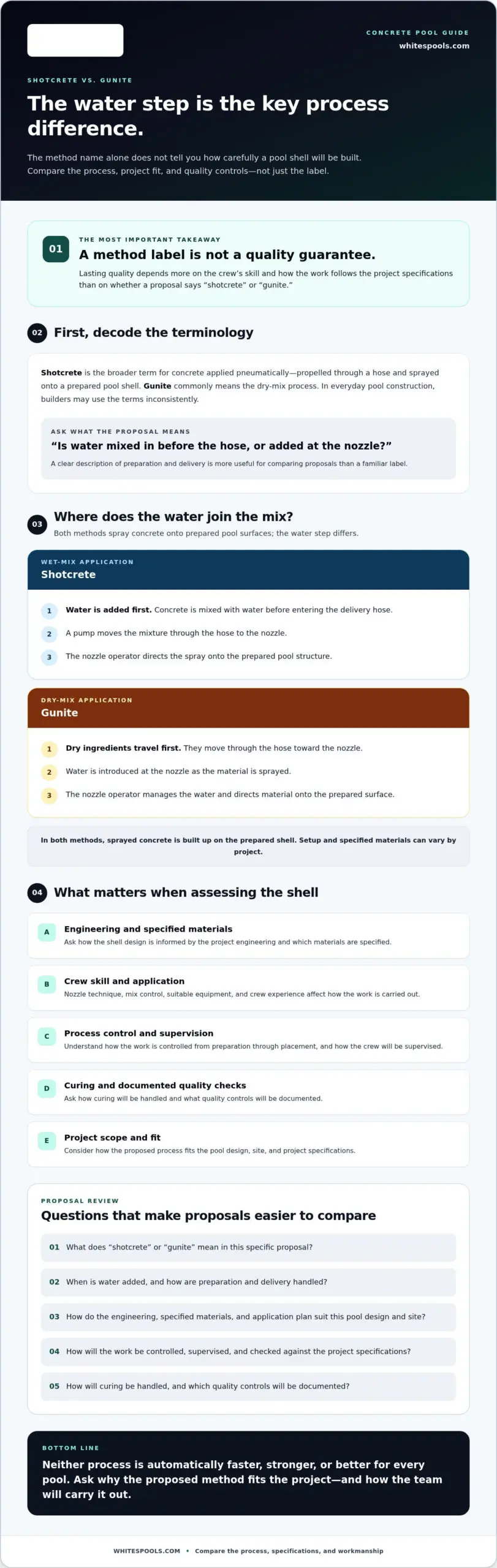
The clearest process difference is where water joins the mix. Wet-mix shotcrete is mixed with water before it enters the delivery hose, while dry-mix gunite receives water at the nozzle. In both methods, equipment conveys material to the pool shell, and a nozzle operator directs the spray onto prepared surfaces and reinforcement. Project setup and specified materials can vary.
How wet-mix shotcrete reaches the pool shell
For wet-mix application, concrete is prepared with water before it enters the pump. The pump moves the mixture through a delivery hose to the nozzle, where the operator directs it onto the prepared pool structure. The equipment setup, specified mix, and crew’s placement technique all affect how the work is carried out. Shotcrete technology offers additional construction context on pneumatically applied concrete.
How dry-mix gunite reaches the pool shell
With dry-mix gunite, dry ingredients travel through the hose, and water is introduced at the nozzle as the material is sprayed. The nozzle operator manages the water and directs the material onto the prepared surface. The process name alone, however, doesn’t establish the finished shell’s quality or durability.
For homeowners comparing shotcrete vs gunite, the practical distinction isn’t simply “wet” versus “dry.” Ask how the builder controls the process from preparation through placement. Nozzle technique, mix control, suitable equipment, and crew experience all affect execution. Request a plain-language explanation of the proposed setup and how it aligns with the project specifications.
Neither process is automatically faster, stronger, or better suited to every pool. The right approach depends on project-specific planning and the team’s ability to carry out the work. As you develop a custom pool plan, discuss your design goals and construction questions with White’s Pools.
Shotcrete vs. Gunite: Comparing Quality, Control, and Project Fit
A useful shotcrete vs gunite comparison looks beyond the name on the proposal. The preparation and water-introduction steps differ, but neither label alone proves a pool shell will be stronger or last longer. What matters is how the method is planned and carried out for the specific project.
| Consideration | Wet-mix shotcrete | Dry-mix gunite |
|---|---|---|
| Preparation | Concrete is mixed with water before pumping. | Dry ingredients travel through the hose. |
| Water introduction | Water is part of the mix before it reaches the hose. | Water is added at the nozzle. |
| Process consideration | Mix preparation, pumping, and placement need to align with project specifications. | Nozzle technique includes managing water introduction and material placement. |
Which method is stronger or more durable?
Neither method is automatically superior. A well-built shell depends on the complete construction process: sound engineering, appropriate specified materials, careful application, proper curing, and skilled workmanship. A method name can’t stand in for those details.
Ask the builder to explain how the proposed method meets the project specifications. Request relevant plans or written details that clarify the design, materials, application approach, and quality checks. If the answer is only that one label is “stronger,” ask what project-specific reasoning supports that claim. Clear explanations help you assess the work rather than rely on jargon.
Does pool shape or site determine the better method?
Pool design and site conditions can influence a builder’s recommendation, but they don’t establish a universal rule for choosing wet-mix or dry-mix. Equipment access, the proposed design, project specifications, and the crew’s experience with its chosen process may all be relevant. For example, a constrained work area could make equipment setup an important discussion, but it doesn’t by itself identify the right method.
A sound recommendation connects the application approach to your plans and site, then explains how the crew will execute it. Ask the builder to walk through that connection and identify any project conditions that shaped the decision. The goal isn’t to choose a label in isolation. It’s to understand why the proposed process fits the work and how its quality will be managed.
How to Evaluate a Shotcrete or Gunite Pool Proposal
A proposal should make clear what will be built, how the work will be carried out, and who is responsible for each stage. Since builders may use “shotcrete” and “gunite” differently, compare the scope and specifications rather than treating either word as a quality rating. Site-specific engineering and construction requirements should be confirmed by qualified professionals.
Use this sequence to review the proposal:
- Clarify the terminology. Ask whether the proposed process is wet-mix or dry-mix, and how the builder is using the terms.
- Review the engineering. Confirm which plans and project-specific engineering are included, and which requirements need review by qualified professionals.
- Understand the application. Ask how the specified mix and reinforcement relate to the planned work, and who oversees material placement and nozzle application.
- Confirm quality controls. Find out how application and curing will be supervised, inspected, and documented, and who is responsible for each step.
Questions to ask your pool builder
Keep the conversation practical. Ask, “Does this proposal specify wet-mix shotcrete or dry-mix gunite, and what do those terms mean in your scope?” Then ask how the project addresses the specified mix, reinforcement, application, and curing. These questions help reveal whether the proposal describes a defined construction approach or relies on a general label.
Also ask who supervises the application, who performs inspections, and what records you’ll receive. The aim isn’t to direct technical decisions yourself. It’s to understand who is accountable and how the work will be checked.
What to compare beyond the method name
Compare like with like: the pool design, engineering scope, listed inclusions, and each party’s construction responsibilities. Look for relevant experience with projects that share important features of your design or site conditions. If two proposals use different terminology, ask each builder to explain the actual process in writing so you can assess the scope side by side.
For a clearer shotcrete vs gunite comparison, focus on project-specific reasoning and documented execution rather than broad claims that one method is always better. A capable builder should be able to connect the proposed approach to your plans, site, and construction requirements in language you can understand.
Planning a custom concrete pool? Discuss your pool design and construction questions with White’s Pools as you assess your options.
Choosing a Concrete Pool Builder for Shotcrete or Gunite Construction
A good decision starts with understanding the application process, then asking why a particular approach is proposed for your pool. In the shotcrete vs gunite comparison, the label matters less than the builder’s project-specific reasoning and how the work will be planned, supervised, and documented. A clear proposal should explain the intended result and who is responsible for each stage.
Ask how the builder’s experience relates to your design, site conditions, and planned features. White’s Pools is family-owned and operated by three generations, with more than 75 years in business. This background offers a starting point for discussing custom pool planning, but it doesn’t confirm which application methods the company currently uses. Ask directly about the approach proposed for your project.
Match the builder’s experience to your project
Discuss the design and site conditions that matter for your pool, then listen for clear explanations of how the proposed construction approach addresses them. Ask who coordinates engineering, supervises application, and handles quality-control responsibilities. The most useful answers connect those roles to your project rather than relying on a general claim that one method is always best.
For more background as you shape your plans, explore this guide to custom concrete pool design and construction.
Plan the next conversation with White’s Pools
Bring your design ideas, site questions, and proposals that use different method terminology. Ask the team to explain the construction approach proposed for your pool and which project details inform that recommendation. You don’t need to arrive with every technical term mastered. Focus on getting clear answers you can compare.
Discuss your custom pool project with White’s Pools and take a thoughtful next step toward a pool shaped around your vision.
Make Your Pool Decision With Confidence
The best choice isn’t made by picking the more familiar term. In the shotcrete vs gunite comparison, focus on what the builder means by each label, why the proposed process fits your project, and how the work will be overseen and documented. A clear explanation is a stronger basis for comparing proposals than a method name alone.
Bring your design priorities and construction questions to a builder who can discuss the project in practical terms. White’s Pools is family-owned and operated by three generations, with more than 75 years in business, and designs and builds custom concrete pools. The company’s specific application method isn’t confirmed here, so ask directly which approach it proposes for your plans.
Discuss your custom pool project with White’s Pools and take the next step toward a pool thoughtfully planned around your vision.
Frequently Asked Questions
Is shotcrete the same as gunite?
Not exactly, though the terms are often used interchangeably in pool construction. Shotcrete is the broader term for concrete applied pneumatically, while gunite commonly refers to the dry-mix process. Some builders use “shotcrete” to mean wet-mix specifically, so terminology can vary. Ask the builder to explain the preparation and delivery method in the proposal rather than relying on the label alone.
Which is stronger, shotcrete or gunite?
Neither process is automatically stronger based on its name. Pool-shell performance depends on factors such as engineering, specified materials, application, curing, and workmanship. A builder’s explanation should connect the proposed process to your pool’s plans and construction requirements. Ask what specifications and quality checks apply to your project, and request supporting details rather than relying on a general claim that one method is always stronger.
Can you build a swimming pool with shotcrete?
Yes. Shotcrete is used to form concrete swimming pool shells by spraying concrete onto a prepared structure rather than pouring it into a mold. The term may refer broadly to both wet-mix and dry-mix application, depending on how the builder uses it. To understand what a proposal includes, ask how the material is prepared, delivered, and placed for your pool.
What is the difference between wet-mix shotcrete and gunite?
The main difference is when water is added. For wet-mix shotcrete, concrete is mixed with water before it’s pumped through the hose. For dry-mix gunite, dry ingredients travel through the hose and water is introduced at the nozzle. Both methods spray concrete onto a prepared surface. Contractors may use the terms differently, so confirm which process the proposal describes.
Does gunite last longer than shotcrete in a pool?
There’s no automatic lifespan advantage from choosing gunite over shotcrete. How well a pool shell performs depends on the project’s engineering, materials, application quality, curing, and ongoing care, not simply the method label. Ask your builder how the planned work addresses these factors and what documentation is available. Avoid treating a broad promise about longevity as a substitute for project-specific details.
How do I know whether a pool builder means shotcrete or gunite?
Ask directly whether the proposal describes wet-mix or dry-mix application. You can clarify by asking when water enters the mix: before it’s pumped into the hose, or at the nozzle? Request that the builder define its terminology in writing and explain the material preparation and delivery process. This makes proposals easier to compare, especially if different builders use the same terms differently.
Should I choose a pool builder based on shotcrete or gunite?
No. Consider whether the builder can explain why its proposed process fits your design and site, and how engineering, material placement, supervision, and quality checks are handled. Review the project scope and responsibilities, not just the application-method label. A builder experienced with custom concrete pools should be able to discuss your plans clearly and identify which project details need confirmation by qualified professionals.

