
What if the right pool shape could make a challenging backyard feel thoughtfully designed rather than compromised? Swimming pool shapes do more than set the look of the water. They influence how your family swims and gathers, how the pool relates to your home’s architecture, and how the rest of your outdoor space flows.
It’s easy to feel overwhelmed by the choices, especially when you’re weighing crisp geometry against a relaxed freeform outline or wondering whether a style will still suit your home over time. Start with your lot, your priorities, and the kind of outdoor space you want to create.
In this guide, you’ll learn how geometric and freeform designs differ, what to consider in an irregular yard, and how custom concrete construction allows flexibility in shape, size, and depth. You’ll also see how a pool can anchor a broader outdoor living plan alongside features such as fireplaces and sports courts. White’s Pools designs and builds custom concrete pools, bringing more than 75 years of family experience to projects shaped around each homeowner’s vision.
Key Takeaways
- Think of your pool’s shape as the footprint of your outdoor lifestyle, influencing how the space looks and works.
- Compare geometric, freeform, and transitional designs to find a style that complements your home and how you use your yard.
- Consider specialty designs, including infinity edges and plunge pools, for a distinctive focal point.
- Assess your lot’s slope, existing features, and planned activities before narrowing down swimming pool shapes.
- Custom concrete construction can bring complex shapes to life as part of a cohesive backyard design.
The Architecture of Water: Why Your Swimming Pool Shape Matters
A pool is more than a place to swim. Its footprint organizes the backyard, influencing where people gather, how they move between the house and outdoor areas, and how the landscape feels as a whole. Choosing among swimming pool shapes is an architectural decision as much as a personal one. Straight edges can echo a home’s clean lines, while curves can soften a formal setting or create a more natural transition into planting and stonework.
Defining the Visual Anchor of Your Backyard
Pool shape is a key geometric element connecting your home’s architecture with the surrounding landscape. A considered design can make the pool feel integrated with the property rather than like an object placed in the yard. It can also help define outdoor zones: a broad edge may frame a lounge area, while a long, open stretch can keep swimming space clear for exercise or play.
Lines influence the way a space feels. Rectangular forms often look orderly and composed, complementing structured patios and contemporary architecture. Curves tend to feel softer and more relaxed, especially when they follow garden beds or existing landscape features. These are design impressions, not strict rules. Materials, planting, lighting, and the home itself all affect the result. For a broader overview of the types of swimming pools and their construction, consider how design and materials work together.
Functionality Meets Aesthetics
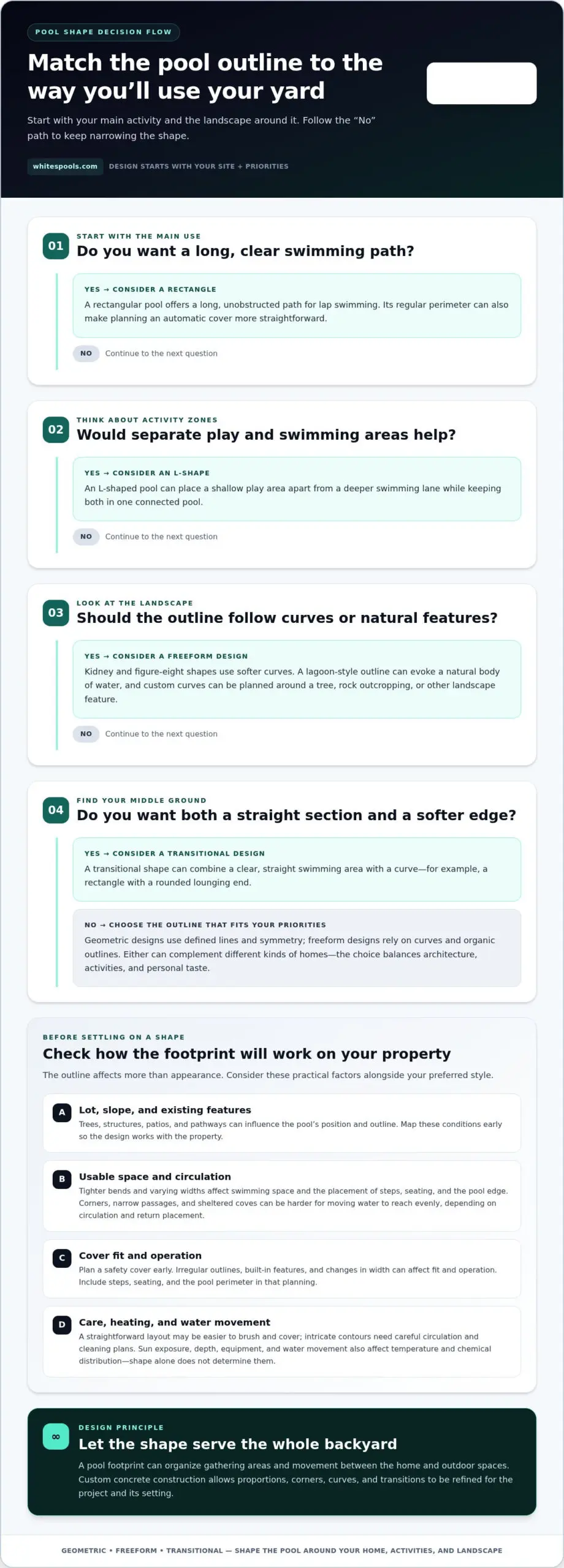
Begin with how you expect to use the water. A long, unobstructed lane supports lap swimming; an open central area gives family play more room; and a compact, sculptural footprint can prioritize visual impact over swimming distance. These activities can coexist, but the shape should make your main use feel natural rather than squeezed into leftover space.
Shape also affects circulation, heating, and routine care, although it is only one factor. Corners, narrow passages, and sheltered coves can be harder for moving water to reach evenly, depending on the circulation system and return placement. A straightforward layout may be easier to brush and cover, while intricate contours need careful planning for circulation and cleaning. Sun exposure, depth, equipment, and water movement also affect temperature and chemical distribution, so shape alone cannot ensure uniform heating or determine maintenance needs.
Plan for a safety cover early. Covers can be made for different pool configurations, but irregular outlines, built-in features, and changes in width can affect fit and operation. Considering the cover alongside steps, seating, and the pool perimeter helps keep practical requirements aligned with the design.
Let the site guide the footprint. A slope, mature trees, existing structures, and the space needed for patios or pathways can all influence the pool’s position and outline. Mapping these conditions early helps the design work with the property instead of forcing a standard shape into a difficult space. Custom concrete construction gives the design flexibility to respond to the site and connect the pool with the wider outdoor setting.
Geometric vs. Freeform: Navigating the Two Primary Design Philosophies
Most swimming pool shapes fall into two broad families: geometric designs, which use defined lines and symmetry, and freeform designs, which rely on curves and organic outlines. Neither belongs exclusively to a particular kind of home. A rectangular pool can feel welcoming beside a traditional house, while a curved design can bring softness to a modern landscape. The right choice balances architecture, activities, and personal taste.
Geometric Shapes: Symmetry and Modern Elegance
Geometric forms define the pool’s boundaries and can support purposeful layouts. A rectangle offers a long, unobstructed path for lap swimming, and its regular perimeter can make planning an automatic cover more straightforward. Grecian and Roman designs add architectural character through rounded ends or clipped, notched corners. An L-shape can separate a shallow play area from a deeper swimming lane while keeping both within one connected pool.
These familiar outlines are starting points, not fixed templates. Custom concrete construction gives the design flexibility to refine proportions, corners, and transitions for the project. That might mean crisp right angles for a disciplined architectural look or a precise circular form as a focal point. Edge details and surrounding finishes help determine whether the result feels formal, contemporary, or somewhere between.
Freeform Shapes: Natural Curves and Organic Flow
Freeform designs trade strict symmetry for a softer outline. Kidney and figure-eight shapes are enduring options, with curves that can create a relaxed atmosphere and suggest separate areas for conversation or play. A lagoon-style pool takes the idea further, using irregular contours to evoke a natural body of water. Custom curves can also be planned around a tree, rock outcropping, or other landscape feature to help the pool feel connected to its setting.
Curves need careful planning. Tighter bends and varying widths affect usable swimming space and the placement of steps, seating, and the pool edge. With concrete construction, those elements can be considered together rather than selected from a fixed outline. This reference on swimming pool design standards covers design and structural considerations.
Transitional Designs: A Considered Blend
There’s room between the two families, too. Transitional designs pair the clarity of straight sections with a softer curve, such as a rectangular swimming area with a rounded lounging end. This blend can echo both a home’s architecture and the shapes in its landscape without making the pool feel undecided. Discussing proportions, materials, and intended use together helps turn a broad style preference into a coherent plan.
Concrete can accommodate both clean geometry and intricate contours. Durability depends on sound design and skilled construction, not on choosing one shape family over another. White’s Pools designs and builds custom concrete pools, helping homeowners develop a plan around their priorities. For inspiration, explore custom concrete pool design.
Luxury Specialized Shapes: Infinity Edges, Plunge Pools, and Natural Lagoons
Some swimming pool shapes are defined by more than their outline. An infinity edge changes how the pool meets the view, a plunge pool makes a compact footprint feel intentional, and a natural lagoon uses flowing contours to create a landscape-inspired retreat. Each design needs to work as a complete structure, not just look striking in a sketch. Custom concrete gives the design room to account for the pool’s edges, interior features, and relationship to its surroundings.
The Vanishing Edge: Shaping the Horizon
An infinity edge, also called a vanishing or negative edge, makes water appear to continue toward the horizon. The effect depends on a carefully planned edge and a view that draws the eye outward. It isn’t limited to a hillside: the setting and sightline determine where the visual effect works, while the site’s elevation informs the structural design.
Beyond the visible pool, water typically spills over the edge into a catch basin, creating a second, lower layer. Water collected there returns to the main pool through the circulation system. The basin, overflow edge, and surrounding structure need to be coordinated so water flows as intended and the finished edge reads as a clean line. This is precision work that must suit the property, not a detail to add at the end. For a closer look at the design considerations, explore infinity edge pool design.
Plunge and Cocktail Pools: Luxury in Small Footprints
A plunge pool can create a focused water retreat in a compact yard where a full-length swimming area isn’t the priority. Square and circular outlines each have a distinct character: a square shape feels composed and efficient, while a circle can soften a small patio setting. Either can be planned for cooling off, relaxing, or gathering near the water.
In a limited footprint, every design decision matters. A wider shape may allow more room to sit together, while additional depth changes the pool’s feel and use. Built-in seating ledges can make the interior more social, but they also take up water space, so place them to support movement without crowding the usable area. The right balance depends on how you intend to enjoy the pool and how much room the site allows. Find more ideas in this plunge pool guide for small spaces.
Natural lagoons take a different approach, using irregular curves and transitions to evoke a sheltered swimming hole. They can be shaped around the landscape for an organic impression, while custom concrete gives the form a durable structure. White’s Pools builds custom concrete pools, including infinity edge and plunge pool designs, with the form and features planned around the property.
Design Factors: Matching Your Pool Shape to Your Lifestyle and Landscape
A strong design begins with the property, not a shape picked from a catalog. The lot’s slope, soil conditions, access, and existing structures all affect where a pool can sit and how its outline can work. A sloped yard, for example, may call for a different layout than a broad, level lawn. Mapping these conditions early helps position the pool in relation to the home and leaves room for the outdoor spaces you want around it.
Think about daily use, too. A swimmer may prioritize a clear lane, while a family may want easy entry and space for play. If entertaining is central, consider how guests will move between the pool, seating, and the house. There’s no fixed “golden ratio” for the right pool-to-home proportions; the goal is visual balance. The pool should feel intentional from inside the home and from the main outdoor gathering areas, without overwhelming either.
Integrating Sports and Recreation
Plan courts alongside the pool, not as an afterthought. A rectangular pool can echo the strong lines of a pickleball or tennis court, while a more organic pool may soften the recreation area’s geometry. Preserve comfortable buffer space between the water’s edge and active play areas so movement, seating, and circulation don’t compete. White’s Pools builds pools and sports courts as parts of coordinated outdoor spaces, helping each feature feel purposeful.
Sketch the main routes between the house, pool, court, and outdoor fireplace. Consider where players enter and exit the court, where people will sit, and which views matter from the water. This simple exercise can reveal whether the pool should shift, rotate, or change shape before the surrounding layout is set.
The Social Flow: Steps, Benches, and Sun Shelves
Interior details affect usable space and the pool’s outer footprint. A tanning ledge or sun shelf needs enough room for its intended use while leaving space for the pool’s primary activities. Entry steps can follow a straight wall or turn with a curved edge, creating a more natural approach. Built-in benches can face an outdoor fireplace or a favorite view, making the pool a place for conversation as well as swimming.
For a practical design review, list the features you want and mark which are essential and which are optional. Place them on a simple site sketch showing the house, property boundaries, trees, and planned outdoor amenities. This gives the design conversation a clear starting point and helps reveal trade-offs before construction details are finalized. Custom concrete construction allows the pool shape and built-in elements to be tailored to the site.
Ready to translate your priorities into a cohesive backyard plan? Start planning your custom pool design with White’s Pools.
Bringing Your Vision to Life with Custom Concrete Pool Construction
A distinctive pool shape needs a construction method that can follow the design rather than forcing the design to fit a preset mold. Pre-manufactured shells come in fixed forms, which can limit options for unusual outlines, tailored dimensions, or features integrated into the pool structure. For complex, highly customized designs, concrete construction offers flexibility to shape the pool around the home, landscape, and intended use.
That flexibility is useful whether your vision includes an angular layout, a freeform lagoon, a vanishing edge, or a combination of forms. “No limits” is best understood as creative freedom guided by practical design: the site, structure, circulation, and intended features all need to work together. Custom concrete gives the design room to resolve those considerations as part of one cohesive plan.
The Gunite and Shotcrete Advantage
Gunite and shotcrete are methods used to apply concrete in pool construction. In a custom pool, concrete is applied around a planned framework and reinforcement, forming a structure that can follow tailored contours rather than the fixed outline of a factory-made shell. This flexibility supports curves, corners, varying dimensions, and transitions that can be difficult to achieve with a pre-shaped form.
The same design flexibility can accommodate features such as built-in waterfalls or rock grottos, with their placement considered in relation to the pool’s overall shape. Each element still needs careful design and construction so the structure, finishes, and water movement work together. The construction method alone doesn’t determine longevity; thoughtful planning, sound workmanship, and ongoing care all matter.
A concrete pool can be shaped around the way you want to live and designed as part of your property for years to come. White’s Pools brings more than 75 years of experience and three generations of family craftsmanship to custom concrete pool design.
Your Partner in Custom Design
A successful design conversation begins with your priorities: how you’ll use the pool, what you want it to look like, and how it should relate to the rest of the backyard. From there, the shape and its practical details can be developed together. Share inspiration, describe the features that matter most, and consider how the finished pool should connect with areas for relaxing, entertaining, or recreation.
Every property is different, so the design needs to respond to its conditions rather than rely on a standard template. That’s the value of custom work: swimming pool shapes can be tailored to your home and vision, with experienced craftsmanship guiding the process from concept toward construction.
Ready to explore a design that feels distinctly yours? Contact White’s Pools for a custom consultation.
Shape a Backyard That Feels Like Yours
Your next step doesn’t need to be a finished blueprint. Start with a few clear priorities: how you want to spend time outdoors, what you want the pool to feel like, and which parts of the yard should remain open. A simple sketch or a collection of inspiration images can help turn an early idea into a useful design conversation. The right swimming pool shapes will grow from the way you live, not from a passing trend.
White’s Pools is a family-owned business with three generations of experience in custom pool design and construction. The team brings creative thinking and a commitment to craftsmanship to projects shaped around each home and the moments homeowners want to share outdoors.
Ready to take the first step? Start your custom pool design journey with White’s Pools.
Frequently Asked Questions
What is the most popular swimming pool shape for modern homes?
Rectangular pools are a popular choice for modern homes because their clean lines pair naturally with contemporary architecture. They can also create a clear visual axis from the house to the far end of the yard. Popularity alone shouldn’t decide your design, though. Consider the home’s proportions, patio layout, and how you want people to move around the pool before settling on a shape.
Are rectangular pools cheaper to build than freeform pools?
Not necessarily. A simple rectangle may be more straightforward to lay out, but the final cost depends on the whole project, including site conditions, dimensions, depth, materials, and added features. A freeform outline can involve more detailed shaping, but that doesn’t automatically make it more expensive than every rectangular design. Compare complete plans with similar dimensions and features rather than judging cost by the outline alone.
Which pool shape is best for a small backyard?
A compact plunge pool can be a strong fit when you want a place to cool off or relax without dedicating the yard to a long swimming lane. Square and rectangular layouts can use a narrow space efficiently, while a circular design may suit a tucked-away patio. Before choosing, map the room needed for access, seating, and other backyard uses, not just the water’s footprint.
Can I design a custom pool shape to fit around my trees or deck?
Yes. Custom concrete construction allows a pool’s outline to be tailored to features such as an existing deck or selected landscape elements. The design should account for access, clearances, and the relationship between the pool and the feature you want to preserve. For example, a curved perimeter might follow a garden edge while leaving a practical path between the water and the house.
How do I choose between a geometric and a freeform pool?
Start by deciding what you want the pool to do and how you want it to feel beside your home. If you value a crisp, ordered look or a defined swimming path, geometric forms may suit you. If you prefer a softer outline that relates to a relaxed garden setting, consider freeform. Use a simple yard sketch to compare how each option affects patio space and movement.
Do certain pool shapes require more maintenance than others?
Shape can affect how easily you can reach every part of the pool during routine cleaning. Tight curves, narrow coves, or complex contours may require extra attention with a brush or cleaning equipment, while a straightforward outline can be simpler to access. Maintenance also depends on circulation, equipment, landscaping, and pool use. A thoughtfully planned design can make cleaning easier regardless of style.
What is the best pool shape for swimming laps?
A long rectangle is usually the most practical shape for lap swimming because it provides a clear path with fewer turns and interruptions. Before finalizing the design, consider how much uninterrupted length your routine needs and whether steps, benches, or shelves will intrude into that path. If the pool must also serve family or social activities, the layout can balance a dedicated swimming lane with other uses.
Can any shape be built using custom concrete or Gunite?
Custom concrete construction can accommodate a broad range of shapes, from precise geometric forms to flowing, irregular designs. It offers more freedom than a pre-manufactured shell, whose dimensions and outline are set by its mold. Still, a design must work with the site and structural requirements. White’s Pools designs and builds custom concrete pools shaped around the property and the features you want to include.

