
A pool’s construction estimate is only one part of the financial picture. To understand the total cost of pool ownership 2026, account for the decisions and responsibilities that continue after construction: equipment, energy, cleaning, chemicals, repairs, and future upgrades.
It’s reasonable to want a clear number before committing to a major home project. But a generic average can hide the factors that matter most, including the pool’s design, features, and maintenance plan. A more useful approach is to compare complete ownership scenarios, not just initial estimates.
This guide outlines the one-time and recurring costs to consider, then offers a practical framework for comparing pool types and features. You’ll also learn how to plan for routine care, equipment choices, and future repairs so your budget reflects the pool you want and how you intend to use it. With thoughtful planning, you can make informed decisions about both the design and the care it will need over time.
Key Takeaways
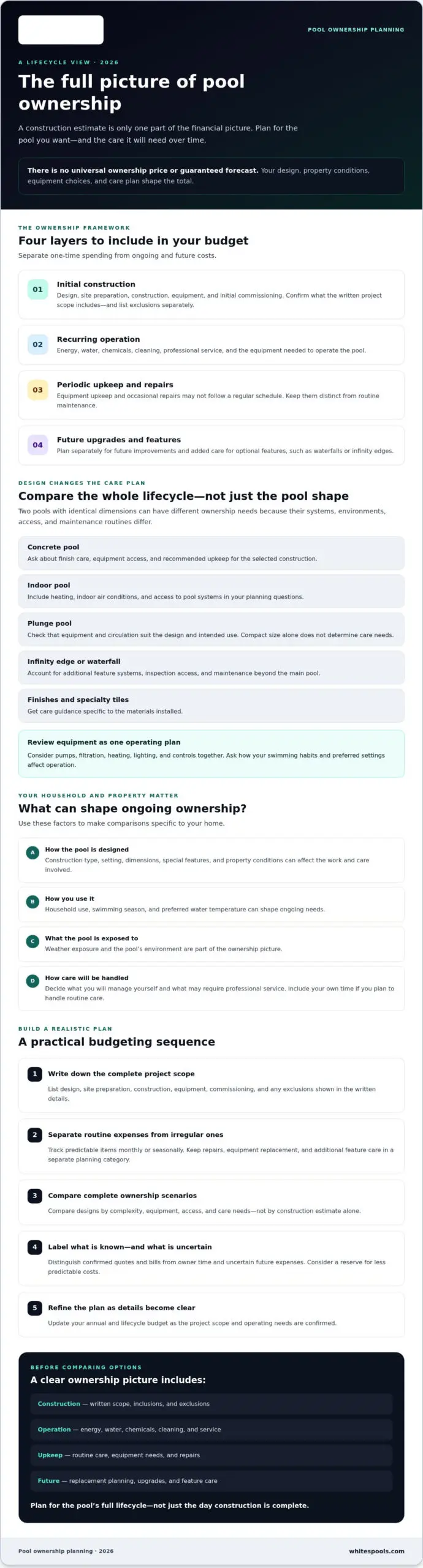
- Build a full ownership picture by separating construction, recurring operation, periodic upkeep, and future upgrades.
- Use the total cost of pool ownership 2026 as a property-specific planning exercise, not a one-size-fits-all estimate.
- Compare pool designs by practical factors such as complexity, equipment, access, and care needs, not price alone.
- Account for how household use, swimming season, weather exposure, and preferred water temperature can shape ongoing costs.
- Create a realistic annual and lifecycle budget by distinguishing confirmed quotes and bills from owner time and uncertain future expenses.
2026 Pool Ownership Costs: What to Budget For?
A complete pool budget has four layers: initial construction, recurring operation, periodic upkeep, and eventual upgrades. The total cost of pool ownership is a planning framework that accounts for construction, operation, maintenance, repairs, and future improvements, not a universal price or guaranteed forecast. Your pool design, property conditions, equipment choices, and care plan all affect the total.
Start by listing expenses in these categories:
- Design, site preparation, construction, and initial commissioning
- Pool equipment and the energy needed to operate it
- Water, chemicals, cleaning, and routine service
- Equipment upkeep, periodic repairs, and replacement planning
- Care or upgrades for optional features
Upfront pool investment versus recurring ownership expenses
Separate the construction estimate from the costs of owning the pool after completion. The initial project scope may include design, site preparation, construction, equipment, and commissioning. Property conditions and the selected design affect what work is required. A custom concrete pool, indoor pool, or infinity-edge design may involve different planning and equipment considerations. For background on pool types, materials, and sanitation, see this overview of Swimming pool fundamentals. Ask for written details of what the construction scope includes, and list exclusions separately so they don’t get mistaken for included items.
Installation expenses are not the same as annual operating and maintenance costs. Once the pool is in use, budget for regular bills and care separately from the original project. This makes it easier to compare proposals and see the ongoing commitments associated with each design.
The recurring and occasional expenses owners can overlook
Routine ownership may include energy, water, chemicals, cleaning, professional service, and equipment upkeep. Some expenses follow a regular schedule and are easier to track in an annual budget. Others are irregular, such as repairs, equipment replacement, or additional care for features like waterfalls and infinity edges. Keep these in separate planning categories rather than assuming routine maintenance covers them.
For a practical starting point, make two lists: predictable expenses to review monthly or seasonally, and less predictable expenses that may call for a reserve. Include your own time if you plan to handle cleaning and routine care. This gives you a more useful basis for estimating the total cost of pool ownership 2026 than relying on a broad average. Refine the plan as you confirm the project scope and learn more about operating needs.
How pool type, equipment, and features shape long-term ownership
Pool dimensions alone won’t tell you what a pool will require over time. Construction type, setting, equipment, and special features all affect how you operate and care for it. Two pools with identical dimensions can have different ownership budgets because their systems, environments, access needs, and maintenance routines aren’t the same.
Compare designs through a lifecycle lens
A concrete pool’s finish and construction details influence its care requirements, so ask which maintenance practices are recommended for the specific design. For a deeper look at design choices, see this custom concrete pool design and longevity guide.
Indoor pools have a different operating environment from outdoor pools. Include heating and the systems that manage indoor air conditions in your planning questions. A plunge pool may have a compact footprint, but its equipment and care needs still depend on its design and how you use it. Infinity edges and waterfalls can add systems and surfaces to inspect and maintain. Specialty pool tiles and other finishes also require care guidance specific to the materials installed.
| Pool type or feature | Relative planning factors |
|---|---|
| Concrete | Confirm finish care, equipment access, and recommended upkeep for the chosen construction. |
| Indoor | Plan around indoor air conditions, heating preferences, and access to pool systems. |
| Plunge | Check that equipment and circulation suit the design and intended use. A compact size alone doesn’t determine care needs. |
| Infinity edge or waterfall | Account for additional feature systems, inspection access, and maintenance beyond the main pool. |
Evaluate equipment and future upgrades
Review pumps, filtration, heating, lighting, and controls as parts of one operating plan. How often you swim, the settings you choose, and the condition of each system affect the energy and care it requires. Ask the builder to document equipment specifications, access points, routine service recommendations, and any feature-specific care instructions. This information helps you compare proposals and prepare for future equipment decisions without assuming a replacement schedule or cost.
For a more useful estimate of the total cost of pool ownership 2026, compare designs by the systems and responsibilities they include, not just their dimensions. If you’re weighing options, discuss your pool vision and maintenance needs with an experienced pool professional.
Which pool ownership costs vary most from one household to another?
A pool’s operating pattern depends on how your household uses it, not just what was included in the original design. Swim frequency, the length of your swimming season, desired water temperature, and equipment schedules all affect how much energy and attention the pool may need. A pool used often and kept warm year-round can have different operating demands from one used occasionally in warmer months.
How use, weather, and design affect routine care
Consider who will use the pool and how often. More frequent use can mean closer attention to water condition and cleaning. Outdoor exposure matters, too: falling leaves, dust, wind, and rain can change how much debris reaches the water and how often it needs care. Heating preferences and operating schedules also affect equipment use. Build your plan around conditions and habits at your property rather than assuming a broad average will apply.
Pool size and design are part of the picture, but neither tells the whole story. A compact design still needs appropriate equipment and consistent care. For ideas about how scale and design influence planning, explore this luxury plunge pool guide.
DIY care or professional pool maintenance?
Hands-on care gives you direct oversight, but it also takes time, consistency, and a willingness to learn routine tasks and keep useful records. Professional cleaning and maintenance can shift some of that responsibility to a service provider. This may be helpful if your schedule is tight or you prefer experienced support with ongoing care. Either way, confirm which tasks are included and which remain your responsibility.
| Approach | Potential advantages | Trade-offs to consider |
|---|---|---|
| Owner-managed care | Greater oversight of routine tasks and water condition, with flexible timing. | Requires regular time, record keeping, and knowledge of the pool’s equipment and care needs. |
| Professional service | Less hands-on routine work and access to experienced care. | Requires coordination and a clear agreement about the service scope, schedule, and owner responsibilities. |
No single online average can predict every household’s total cost of pool ownership 2026. Compare scenarios using your expected use, heating preferences, exposure to debris, and chosen care arrangement. If you’re weighing ongoing care options, learn more about pool cleaning and maintenance and clarify which responsibilities you want handled by a professional.
How to calculate a realistic pool ownership budget for your home
A useful budget starts with your property, pool design, and expected use. To estimate the total cost of pool ownership 2026, keep confirmed amounts separate from estimates and unknowns. This makes the plan easier to update as you gather quotes and learn more about ongoing care.
Build a monthly and annual pool expense worksheet
Use actual utility bills, product records, and written service estimates where available. Record seasonal bills in the months they occur, then add them to find an annual total. Don’t fill gaps with a generic average. Mark unknowns for verification and follow up with the relevant provider or pool professional.
- Record confirmed upfront expenses. Enter the written construction quote and list any project items it excludes separately.
- Log recurring expenses. Track pool-related energy, water, chemicals, cleaning, routine service, and equipment upkeep as separate lines.
- Account for your time. If you’ll handle care yourself, note the hours and tasks so you can weigh the commitment alongside paid service options.
- Identify irregular costs. List potential repairs, replacements, and optional feature care separately. Verify expected needs rather than treating them as predictable bills.
- Compare scenarios. Add the upfront project scope to the annual operating plan for the period you want to evaluate. Keep assumptions visible so you can revise them.
Fill-in worksheet
- Energy: monthly bills or estimates ______ × months used ______ = annual total ______
- Water: bills or estimates ______; annual total ______
- Chemicals and cleaning supplies: product records ______; annual total ______
- Cleaning or professional service: written estimate ______; annual total ______
- Equipment upkeep: records or estimate ______; annual total ______
- Owner time: hours ______; tasks ______
- Repairs and replacements: verified needs ______; reserve based on professional assessment ______
- Optional features: care requirements and verified expenses ______
Plan for repairs, replacements, and optional features
Keep equipment age, service history, manufacturer guidance, and warranty documentation together. Ask a qualified pool professional to assess likely repair or replacement needs, then use that assessment to set a clearly labelled reserve. Treat the reserve as a planning tool, not a guaranteed forecast. List optional features separately so you can compare a simpler design with an enhanced one and see how each affects care responsibilities.
Revisit your budget whenever your usage, equipment, or maintenance plan changes. For help aligning design choices with ongoing care, discuss your pool vision and maintenance needs with an experienced pool professional.
Choose a pool and maintenance plan you can own with confidence
A sound pool plan brings together the design, equipment, expected household use, and maintenance commitments. A feature that enhances the experience can also bring additional care considerations. Equipment access and routine service needs can affect how practical the finished design is to own. Review these details before settling on the project scope, not after construction is underway.
Questions to ask before committing to a pool project
Clear answers help you compare proposals and understand what you’ll be responsible for once the pool is in use. Ask your builder:
- Which design choices or features affect routine cleaning and equipment servicing?
- What work is included in the project scope, and what assumptions or exclusions should I understand?
- Which equipment is specified, and can I review its documentation and recommended care?
- What maintenance tasks will I need to manage, and which pool cleaning and maintenance services are available?
- What does each service include, and how will service recommendations or completed work be documented?
Request written details rather than relying on verbal assumptions. Keep the project scope, equipment information, care instructions, and maintenance records together. They’ll help you make informed decisions as your use changes or equipment needs attention.
Make long-term care part of the design conversation
Discuss equipment access, cleaning needs, expected use, and your preferred level of hands-on care while plans are still being developed. If you’re considering waterfalls, specialty finishes, or other optional features, ask how they may affect routine maintenance and which tasks remain yours. A clear picture of those responsibilities helps you choose a design that fits your vision and day-to-day expectations.
White’s Pools brings custom pool construction and pool cleaning and maintenance together, giving homeowners the opportunity to discuss planned design and ongoing care with an experienced pool professional. The family-owned, third-generation business has been established for over 75 years. Its construction and maintenance services can support a practical conversation about project scope, equipment decisions, and care needs, while recognizing that the right ownership plan depends on each household.
Understanding the total cost of pool ownership 2026 means looking beyond the initial project and considering how the pool will fit your life over time. For a thoughtful discussion about a custom pool and ongoing maintenance, talk with White’s Pools about your vision and care priorities.
Plan for a Pool You’ll Enjoy for Years to Come
A confident pool decision starts with the full picture. Separate construction from recurring care, then account for the design, equipment, household use, and maintenance approach that shape your own total cost of pool ownership 2026. Use confirmed quotes and bills where possible, and keep uncertain repairs or future upgrades visible in your plan rather than treating a broad average as a promise.
Thoughtful planning connects the pool you want with the care it will need. White’s Pools is a family-owned, third-generation pool company established over 75 years ago, offering custom pool construction alongside professional cleaning and maintenance. You can discuss design choices and long-term care together as you evaluate what suits your plans.
Ready to plan a pool that fits your vision and care priorities? Discuss your pool project and ongoing maintenance needs with White’s Pools.
Frequently Asked Questions
How much does it cost to own a pool in 2026?
There isn’t one reliable cost that applies to every pool owner. The total cost of pool ownership 2026 depends on the construction scope, property conditions, pool design, equipment, energy and water use, maintenance choices, and future repairs. Build an estimate from written project quotes and household-specific operating information. Treat broad averages as rough context, not a forecast of what your own pool will cost.
What expenses should I include in a pool ownership budget?
Include both the initial project and the costs that continue after construction. Track design, site preparation, construction, equipment, and commissioning separately from energy, water, chemicals, cleaning, and routine service. Add equipment upkeep, potential repairs or replacements, and care for optional features such as waterfalls. If you’ll handle maintenance yourself, account for the time involved. Mark unknown expenses for verification instead of guessing.
Is a concrete pool more expensive to maintain than other pool types?
Not necessarily in every case. Maintenance depends on the pool’s finish, equipment, design details, accessibility, use, and recommended care, so material alone can’t determine the full comparison. Ask what upkeep the specific finish requires, how equipment can be accessed for service, and whether features add maintenance tasks. Compare written care recommendations for the designs you’re considering rather than assuming all concrete pools have identical needs.
How much does it cost to maintain a pool each year?
Annual maintenance expenses vary with the pool’s design, how often it’s used, conditions at the property, and whether you manage care yourself or hire a professional. Rather than relying on one national figure, total your expected costs for cleaning, chemicals, routine service, and equipment upkeep using bills, product records, and written estimates. Keep irregular repairs separate from predictable annual expenses.
Can a pool increase monthly energy and water bills?
Yes. Pool equipment uses electricity, and topping off water can add to household use. Heating preferences, operating schedules, equipment condition, weather exposure, and how often the pool is used all affect the pattern. To estimate the impact, track pool-related utility use where possible and ask which equipment will be installed and how it is intended to operate. One household’s bills won’t necessarily predict another’s.
Is professional pool maintenance worth including in the ownership budget?
It can be, especially if you want to reduce the time spent on routine care or prefer experienced help with cleaning and equipment upkeep. Compare the written service scope with the tasks you’re prepared to handle, and confirm the schedule, owner responsibilities, and how completed work is documented. Professional service doesn’t remove every ownership task, so clarify what is and isn’t included before adding it to your plan.
What pool equipment may need repair or replacement over time?
Equipment to track can include pumps, filtration systems, heaters, lighting, and controls. Service needs depend on the installation, usage, operating settings, and equipment condition. Keep model and installation details, service history, manufacturer guidance, and warranty documents together. Ask a pool professional to review the system and identify maintenance recommendations or concerns. Use that information to plan a reserve rather than assuming a fixed replacement timeline.
How can I estimate the lifetime cost of owning a pool?
Start with the confirmed construction scope, then add the annual operating and maintenance expenses you can document. Keep owner time, optional features, and uncertain repairs or replacements visible as separate planning items. Choose a time period for your comparison and make assumptions clear, including expected use and maintenance arrangements. Revisit the estimate when equipment, household habits, or care needs change, and verify unknowns with written quotes or professional guidance.

