
What determines whether a pool pump upgrade is right for your pool? Upgrading to a variable speed pool pump can seem like an easy choice, especially when energy savings are part of the pitch. But results depend on circulation needs, run times, and the equipment connected to the pump.
It’s reasonable to wonder whether your current pump can be adapted or whether a full replacement makes more sense, and whether a new model will work with your filter, heater, or water features. Start with your existing setup rather than a broad promise about lower energy use.
This guide explains the practical differences between single-speed and variable speed pumps, the pool and equipment details that affect compatibility, and how to weigh an upgrade against your household’s routine. You’ll have a clearer framework for comparing options and deciding what fits your pool. White’s Pools provides pool cleaning and routine equipment maintenance to help keep pool systems in view as part of ongoing care.
Key Takeaways
- A variable speed pump adjusts its operating speed, while a single-speed pump runs at one set speed. The best fit depends on your pool’s circulation needs.
- Before upgrading to a variable speed pool pump, record your current pump details and connected equipment to guide a practical compatibility assessment.
- Compare pumps by operating flexibility and fit with your pool system, not by efficiency claims alone. Potential energy savings depend on usage, settings, system design, and electricity rates.
- Use your pool’s dimensions, equipment connections, and typical schedule to clarify the circulation your routine requires.
- After a change, monitor circulation and equipment operation as part of ongoing pool care.
Should You Upgrade to a Variable Speed Pool Pump?
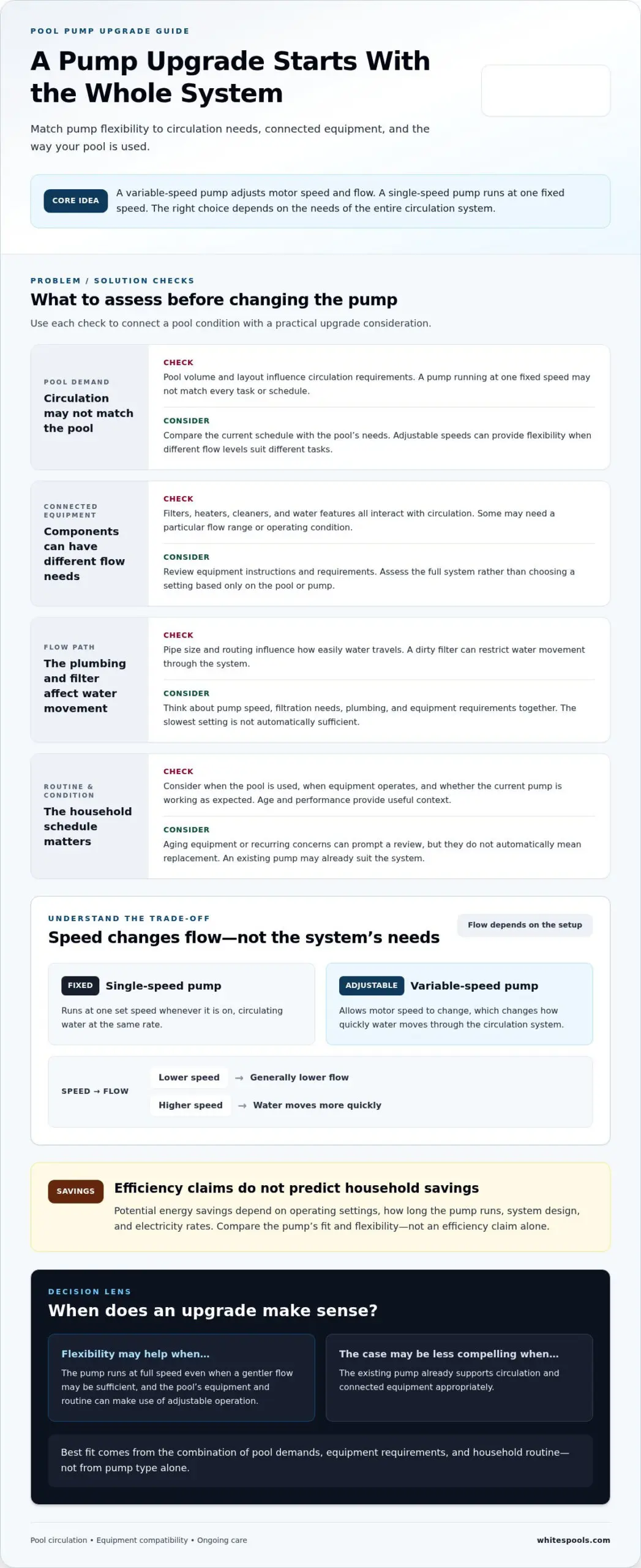
A variable speed pool pump lets you adjust its motor speed to change how quickly water moves through the circulation system. Deciding whether to replace a conventional pump means weighing that flexibility against your pool’s circulation needs, connected equipment, and daily use. A newer pump isn’t automatically the right choice for every setup.
What changes when a pool pump runs at variable speeds?
A variable speed pump operates at adjustable motor speeds, while a single-speed pump runs at one fixed speed whenever it’s on. Adjustable operation lets you match flow more closely to the task and schedule. A fixed-speed pump circulates water at the same rate each time it runs, whether the pool needs routine filtration or a different flow level for connected equipment.
Flow is the amount of water moving through the system over time. Changing motor speed changes that flow and affects how water passes through components such as the filter, heater, or water features. The right setting depends on the needs of the whole system, not simply on choosing the lowest speed. A swimming pool is a connected system of water and equipment, so consider pump performance in that wider context.
When is an upgrade worth considering?
An aging pump, recurring equipment concerns, or a pump that seems poorly matched to the pool’s circulation needs can all be reasons to review the setup. That review doesn’t automatically mean replacement. First, consider whether the current pump is operating as expected and whether its fixed speed suits the way the pool is used.
Potential efficiency benefits are one reason homeowners explore a variable speed model, but savings aren’t guaranteed. The outcome depends on operating settings, how long the pump runs, the pool system’s design, and electricity rates. An efficiency claim alone can’t predict what a household will save.
- Pool size and layout: Water volume and the way water moves through the pool influence circulation requirements.
- Connected equipment: Filters, heaters, cleaners, and water features may have different flow needs that affect pump selection and operation.
- Use patterns: The pool’s typical schedule, including when it’s used and when equipment operates, helps show whether adjustable speeds could suit the routine.
- Current pump condition: Age and performance provide useful context for deciding whether to maintain the existing setup or consider a change.
Compare the pump’s current schedule with the pool’s needs. If it runs at full speed even when a gentler flow may be sufficient, variable speed control could offer useful flexibility. If the existing pump already supports circulation and connected equipment appropriately, the case for upgrading may be less compelling. Upgrading to a variable speed pool pump makes most sense when the equipment, pool demands, and household routine point in the same direction.
How Variable Speed Pumps Affect Pool Circulation and Equipment
A pump moves water through the pool’s circulation loop, sending it through plumbing and connected equipment before it returns to the pool. Changing motor speed changes how much water moves through that loop. Lower speed generally means lower flow, while higher speed moves water more quickly. The useful setting depends on the system’s requirements, not on choosing the slowest setting by default.
How pump speed relates to flow and filtration
Filtration is a scheduled task: water needs to circulate through the filter as part of ongoing pool care. A variable speed pump lets you adjust operation over time and consider the filtration plan alongside other circulation demands. The schedule still needs to provide appropriate circulation for the pool. A quieter or slower setting isn’t automatically sufficient just because the pump is running.
The amount of water reaching the filter can also be affected by the condition of the circulation system. A dirty filter, for example, can restrict water movement, while pipe size and routing influence how easily water travels through the system. Consider pump speed, filtration needs, plumbing, and equipment requirements together rather than treating them as separate decisions.
What connected equipment means for pump choice
Filters, heaters, cleaners, and water features all interact with circulation. Some equipment may need a particular flow range or operating condition to work as intended. A feature that sends water through a raised spillway, for instance, may call for a different setting than routine filtration. The right choice depends on the specific equipment and how it’s used.
Required flow depends on the pool’s volume and layout, plumbing design, filter condition, connected equipment, and the schedule needed to circulate water appropriately. That’s why the same pump setting won’t suit every pool. A larger pool may have different circulation demands than a smaller one, but size alone doesn’t determine the answer. Equipment, plumbing, and use patterns matter too.
- Check equipment instructions: Use the pump and connected-equipment manuals to understand operating requirements and limits.
- Consider the full circulation path: Account for plumbing, filter, heater, cleaner, and water features, not just the pool’s dimensions.
- Assess settings for the system: Avoid copying another pool’s speed schedule. A qualified, system-specific assessment can help determine appropriate operation.
After upgrading to a variable speed pool pump, observe whether circulation and connected equipment operate as expected under the selected schedule. If a feature isn’t working as intended, revisit the equipment instructions and system settings rather than assuming that more speed is always the solution. Routine pool equipment maintenance can help keep the circulation system’s condition in view as part of ongoing pool care.
Variable Speed vs. Single-Speed Pumps: Compare Benefits and Trade-Offs
A useful comparison looks beyond the motor type. Consider how each option fits your pool’s operating routine, connected equipment, and existing setup. A variable speed pump offers adjustable operation; a single-speed pump runs at one fixed speed. Neither design guarantees a particular energy bill or payback. The practical question is whether the flexibility and system fit justify a change for your pool.
What are the practical trade-offs between pump types?
Use this table to frame the decision. Compatibility and setup depend on the pump, motor, plumbing, and equipment already in place, so treat the comparison as a starting point rather than a universal verdict.
| Consideration | Variable speed pump | Single-speed pump |
|---|---|---|
| Speed control | Speed can be adjusted to suit different operating needs. | Runs at one fixed speed when switched on. |
| Operating flexibility | Offers more ways to match pump operation to the pool’s schedule and connected equipment. | Uses the same operating speed for routine circulation and other tasks. |
| Compatibility checks | Requires consideration of existing plumbing, electrical setup, and connected equipment. | The current setup may already be arranged around its operation, but condition and fit still matter. |
| Decision trade-off | Adjustability may be useful, but settings and system fit influence the outcome. | Keeping it avoids a change, provided its condition and performance continue to suit the pool. |
There are also different paths to consider. A pump-only replacement changes the pump assembly. A motor conversion focuses on changing the motor while retaining some existing pump components, if compatible. Keeping the current setup remains an option when it operates appropriately and meets the pool’s needs. These choices have different compatibility and setup considerations, so they aren’t interchangeable.
How to think about efficiency and payback
Before estimating whether upgrading to a variable speed pool pump could make financial sense, gather the details that shape your current operation:
- How many hours the pump runs and how its schedule changes through the season
- The settings used for routine circulation and connected equipment
- Your electricity rate and available information about the current pump
- The existing equipment and any changes needed to make a different pump fit the system
Manufacturer examples can illustrate possible results, but they may use different schedules, equipment, and electricity rates than your household. A payback estimate based on those examples may not reflect your pool, and an upgrade doesn’t guarantee a specific return period.
Actual savings vary with system design, operating settings, usage patterns, and electricity rates. Compare realistic operating information rather than relying on a broad savings promise. Routine pool equipment maintenance can help you keep your current system’s condition and performance in view as you weigh the options.
How to Assess Your Pool Before Upgrading the Pump
A sound comparison begins with a clear record of what’s installed and how your pool is used. That information helps frame compatibility and circulation needs before you consider a replacement or motor conversion. Work through this checklist in order and keep the details together for a system-specific review.
Build a clear picture of your current setup
- Record the pump details. Note the make, model, nameplate information, approximate age, and current operating schedule. A photo of the nameplate can preserve details that are hard to read later.
- Document the pool’s dimensions and shape. Write down the length, width, depth changes, and any unusual sections, attached basins, or built-in water features. If reliable records show the pool volume, use them. Otherwise, use measured dimensions to develop an estimate rather than guessing. Design details affect water movement and circulation needs. For context on how pool design influences equipment planning, explore the custom concrete pool design options.
- List connected equipment. Include the filter, heater, cleaner, and water features, noting identifying information where available. Their operating requirements can affect suitable flow and pump settings. A smaller pool, such as a plunge pool, has a different volume to consider, but its connected equipment still matters.
- Map the circulation setup. Note visible plumbing connections and how water travels between the pool, pump, filter, and other equipment. Don’t assume a new pump or motor will match existing connections simply because the current unit works.
- Describe the pool’s routine. Record when the pool is typically used, how long the pump runs, and when cleaners or water features operate. Weekday, weekend, and seasonal routines may differ, so capture how the pool is actually maintained.
- Plan a qualified compatibility review. Have the electrical supply and installation requirements assessed by a qualified professional. Use the pump and connected-equipment manuals to understand operating requirements, and consider whether the current setup is functioning as intended.
- Choose a considered next step. With the information gathered, compare keeping the current setup, replacing the pump, or exploring a motor conversion. The right path depends on equipment condition, system fit, pool dimensions, and routine, not a single specification in isolation.
This preparation makes upgrading to a variable speed pool pump a more informed decision. It also gives an equipment-maintenance review a practical starting point: the pump, connected components, and schedule can be considered as one system. White’s Pools provides routine pool equipment maintenance to support attentive care of pool equipment.
Plan Your Pump Upgrade Around Long-Term Pool Care
A pump change is one part of maintaining dependable pool performance, not a stand-alone fix for every circulation concern. After upgrading to a variable speed pool pump, let the system run through its normal routine and observe how the pump, filtration, and connected equipment work together. Those observations can help you spot when the schedule or settings may need attention.
What should you monitor after an equipment change?
Watch the pool during ordinary operation, including when a cleaner, heater, or water feature is in use. Look for changes in circulation and note whether connected equipment operates as expected. Keep a simple record of pump schedules, settings, and any changes you make. This creates a useful reference for reviewing performance later.
- Water movement: Notice whether circulation appears consistent across the pool and whether the usual return flow is present.
- Filtration routine: Track the schedule and observe whether the pool remains manageable under its normal use pattern.
- Connected equipment: Note how heaters, cleaners, and water features operate at the settings used for them.
- Changes or concerns: Record unusual sounds, interruptions, or other changes in operation, then refer to the equipment instructions and qualified guidance.
A log doesn’t need to be complicated. A dated note with the schedule, selected settings, equipment in use, and anything that seemed different can make later adjustments more considered. Avoid making several changes at once, since it can be harder to tell which adjustment affected the system.
How ongoing pool care supports equipment performance
Circulation equipment operates within a pool that also needs regular cleaning and attention. Debris and changing pool conditions can influence how the system runs, so caring for the water and equipment together supports a more complete maintenance routine. If circulation seems different after a change, a record of the pump schedule and equipment behavior can help clarify what’s happening.
White’s Pools provides pool cleaning and routine pool equipment maintenance, bringing ongoing attention to the broader system around the pump. This care helps homeowners keep equipment condition and pool performance on the same maintenance plan, without treating an upgrade as a substitute for routine upkeep.
Explore White’s Pools cleaning and maintenance services for ongoing pool care.
Make Your Next Pool Care Decision with Confidence
The best upgrade choice is one that supports your pool’s performance over time, not just a change made for the promise of lower bills. As you consider upgrading to a variable speed pool pump, keep your system’s needs and maintenance routine in view. A considered plan can help you move forward with confidence and continue caring for the equipment that keeps your pool ready to enjoy.
White’s Pools is a third-generation, family-owned business with more than 75 years in business. Its pool cleaning and routine equipment maintenance services keep ongoing care part of the picture alongside equipment decisions.
Explore White’s Pools’ pool care and maintenance services to make equipment care part of your pool’s regular routine.
Frequently Asked Questions
Is upgrading to a variable speed pool pump worth it?
It can be worthwhile if adjustable operation fits your pool’s circulation needs and schedule, but the decision depends on your existing setup and operating costs. A pump that runs for long periods at one fixed speed may present a different opportunity than a system already operating efficiently for its intended use. Compare the pump’s condition, routine, and compatibility before deciding. Don’t assume the upgrade will pay for itself within a particular timeframe.
Can I replace only the motor instead of the whole pool pump?
Possibly, but a motor-only change depends on whether the replacement motor is compatible with the existing pump assembly and electrical setup. The pump housing and other components also need to be in suitable condition. A conversion may be less straightforward if parts are worn, connections differ, or the assembly isn’t designed for the proposed motor. Have the full setup assessed before treating a motor change as a simple swap.
How much can a variable speed pool pump save on electricity?
There isn’t one dependable savings figure for every pool. To form a personal estimate, compare current electricity use with a realistic proposed schedule and settings, then apply your electricity rate. If you have the pump’s power-use information, a basic estimate uses kilowatts multiplied by operating hours and the rate per kilowatt-hour. Actual use can differ from estimates, so treat projected savings as an informed comparison, not a promise.
What size variable speed pool pump do I need?
The appropriate size depends on more than pool volume. Plumbing layout, filter and heater requirements, water features, and the circulation needed for your routine all affect the assessment. Gather the pool’s dimensions or reliable volume records, plus the existing pump and equipment information. A qualified system assessment can help match pump capacity to the pool without relying on a rule of thumb based on dimensions alone.
Will a variable speed pump work with my existing pool equipment?
It may, but compatibility depends on the complete setup, including plumbing connections, electrical supply, and the operating requirements of equipment such as a heater, cleaner, or filter. For instance, a water feature may need a different operating condition than routine filtration. Review your equipment manuals and have compatibility assessed before selecting a replacement. A pump that fits physically may still need to meet the system’s operating requirements.
How long should I run a variable speed pool pump?
There’s no single runtime that suits every pool. The schedule should support your pool’s circulation and filtration needs, account for connected equipment, and follow the pump and equipment instructions. Keep a log of run times and settings, then note changes in water condition or equipment operation as you adjust the plan. If you’re unsure whether the schedule is adequate, get qualified guidance rather than copying another pool’s routine.
Is a variable speed pump quieter than a single-speed pump?
It can be quieter during lower-speed operation, but the sound you notice depends on the pump, its setting, installation, and surrounding conditions. A pump running faster may sound different from the same pump at a reduced speed. Pay attention to changes in sound after installation or adjustment. If the pump develops an unusual noise, consult its operating instructions and arrange a qualified assessment instead of assuming it’s normal.

